
You're scrolling through handmade jewelry online, trying to find a necklace that feels personal rather than pulled from the same factory catalog as everything else. The photos look beautiful, the description says “handcrafted,” and yet you're left wondering what that means, whether the materials are accurately described, and what happens if the ring doesn't fit.
That uncertainty is the hidden challenge of buying handmade jewelry online. Style gets plenty of attention, but proof of workmanship, realistic production details, and clear policies matter just as much. With a few practical checks, you can find independent US makers whose pieces offer a genuine quality upgrade over mass-produced jewelry.
Table of Contents
What Actually Makes Jewelry Handmade
A listing can use the word “handmade” even when the seller's role is limited to selecting a component, attaching a clasp, or adding a small finishing detail to a factory-made piece. That doesn't automatically make the item poor quality, but it does change what you're buying. The useful question is not whether a person touched the product. It's how much of the design and production that person controls.
Consider two listings for similar silver rings. One maker explains how they select the metal, shape the band, set the stone, texture the surface, and polish the finished piece. Slight differences appear from one ring to another because the work is performed individually. The other listing uses identical studio images, offers a broad catalog with vague descriptions, and says little about how the item is produced. The second piece may be assembled or factory-made, even if its page calls it handmade.
Look for the maker's fingerprints
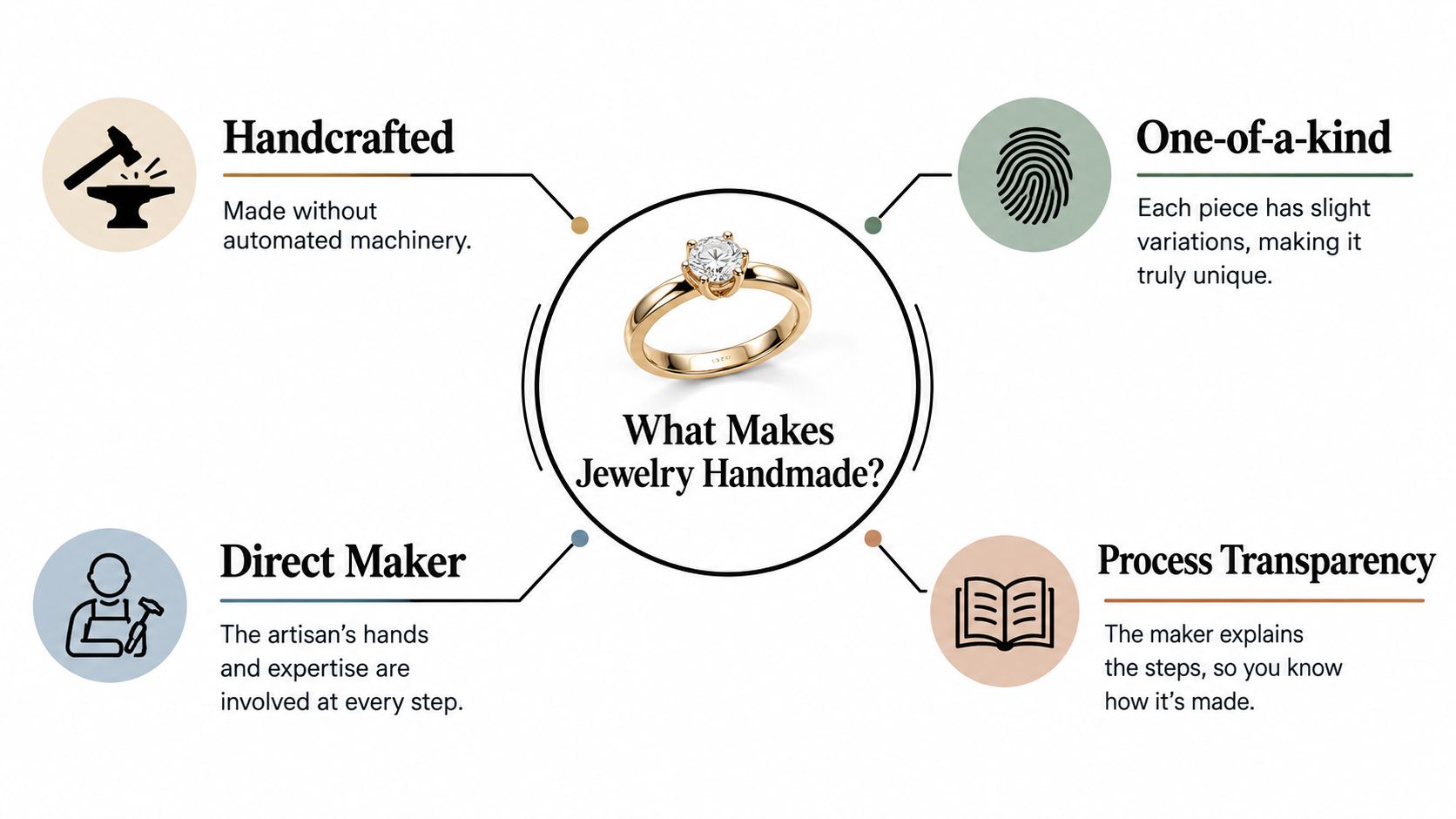
Genuine handmade work often leaves evidence across several stages:
- Design ownership: The maker can explain why the shape, setting, proportions, or combination of materials exists.
- Hands-on construction: The listing describes forming, soldering, carving, weaving, casting, setting, or finishing rather than only “made with love.”
- Natural variation: Small differences in texture, stone placement, or surface character may appear, especially in one-of-a-kind work.
- Process visibility: The seller can show work-in-progress photos, tools, sketches, studio scenes, or a clear production sequence.
Handmade also exists on a spectrum. A maker may hand-fabricate a pendant but use a commercially produced chain. Another may design a piece, purchase a ready-made setting, and hand-set the stone. Transparency is more valuable than an inflated label. You should be able to tell which parts are made by the seller and which are sourced.
Practical rule: If a listing explains the maker's actual role in plain language, you have a much stronger basis for judging it.
That distinction matters because you're paying for more than visual style. You're choosing the level of control, attention, and accountability behind the piece. A clear description lets you decide whether that level matches your expectations.
How to Evaluate Materials and Craftsmanship
Start with the material description, not the mood of the photography. A trustworthy listing names the metal, stones, finish, and major components specifically. “Gold tone,” “silver color,” or “natural-inspired stone” tells you about appearance, not composition.
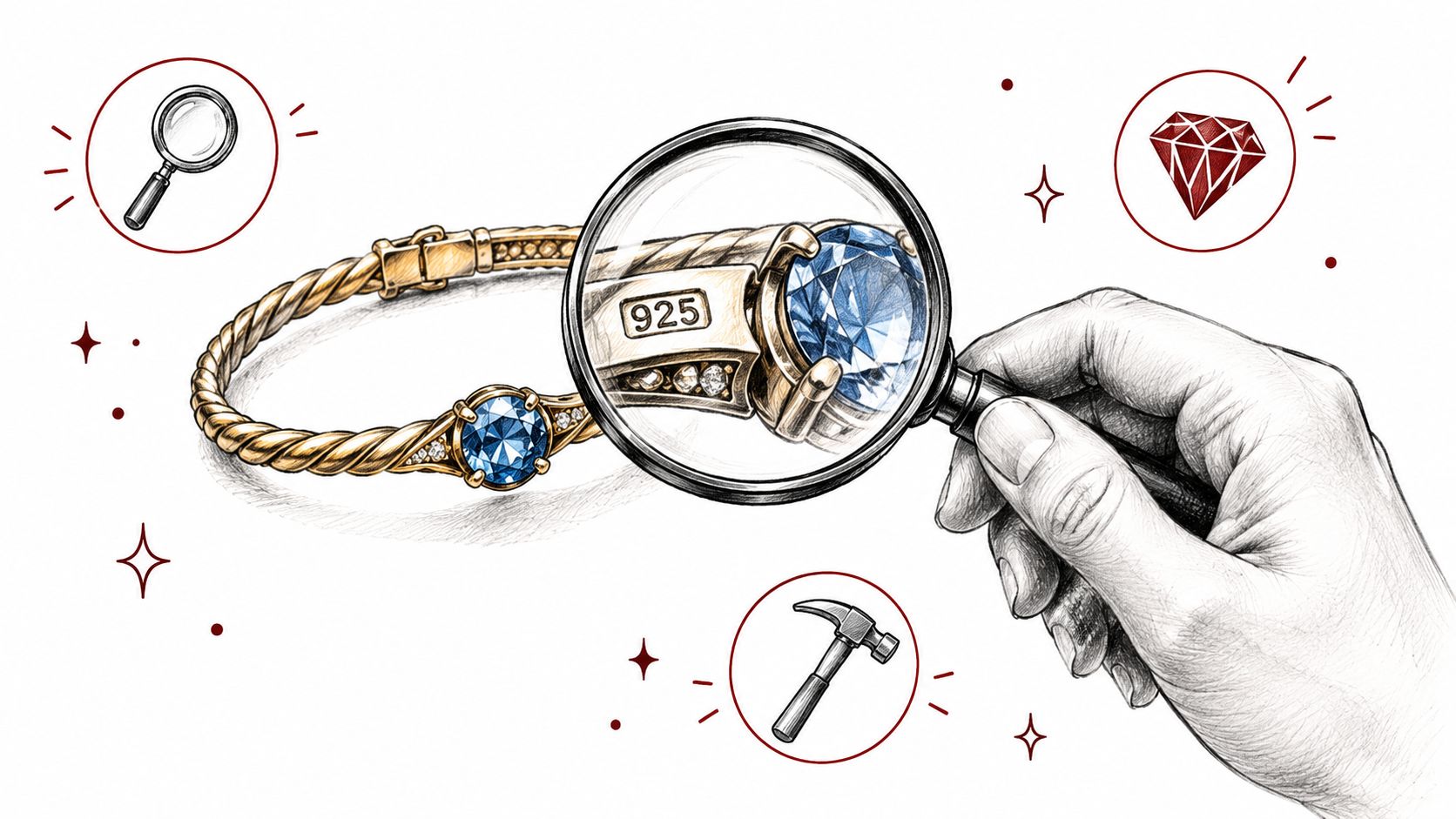
A stamp can help, but it isn't the whole evaluation. A 925 mark commonly indicates sterling silver, while a hallmark or purity stamp can provide useful information about the metal. Still, the listing should explain the material in words, and the seller should answer questions about plating, vermeil, solid metal, alloys, or possible sensitivities.
Inspect construction before decoration
Zoom in on the places where components meet. Look for smooth joins, even prongs, a secure clasp, and a finish that follows the design rather than hiding rough edges. If a stone appears to be held by adhesive, ask whether glue is part of the construction and how the maker expects the piece to handle regular wear.
Stone settings deserve special attention. Prongs should appear evenly placed and should sit securely over the stone. Bezel edges should look continuous rather than jagged. For wire-wrapped pieces, check whether the wire is neatly tensioned and whether exposed ends could catch on clothing.
Photography has a practical job here. A useful listing should include a white-background hero image, macro views of settings and surface finish, an on-model photograph for scale, and a lifestyle image for context, as outlined in this jewelry photography guide. Ask for a close-up if the available images are too distant or heavily filtered.
Look closely at the boring parts. Clasps, backs, edges, solder points, and inner surfaces often reveal more than the front-facing design.
Jewelry pages also have a difficult conversion environment. Benchmarks cited for 2026 place luxury and jewelry conversion around 0.95 percent to 1.46 percent, while professional-quality product photography is associated with a 33 percent higher conversion rate and, in some studies, improvement of up to 94 percent compared with low-quality images, according to jewelry conversion benchmarks. For you as a buyer, that means strong photography isn't just attractive. It helps replace the physical inspection you'd get in a shop.
A product such as the Turquoise Howlite Bracelet should give you enough visual and written information to judge its beads, arrangement, and overall construction before ordering. If it doesn't, send a question rather than guessing.
Authenticity Checklist for Handmade Jewelry Listings
Most shoppers don't need to identify every tool in a jewelry studio. They need evidence that connects the seller to the product. The verification gap is real: buyers often find plenty of style inspiration but little practical help separating handmade work from mass-produced or lightly rebranded pieces. A useful handmade jewelry authenticity checklist should cover the maker's voice, body of work, process, timing, and policies.
Check the listing in this order
Read the maker profile. Look for a real name or clearly identified studio, a coherent story, and specific information about the work. Generic marketing language copied across unrelated products is a warning sign.
Compare the product range. A consistent collection can show that the seller has a recognizable point of view and repeatable skills. A catalog filled with unrelated styles, materials, and photography may indicate resale rather than original production.
Look for process evidence. Work-in-progress images don't need to look polished. A bench photo, partially finished setting, sketch, or material preparation can help connect the finished piece to a real production process.
Read material descriptions carefully. Specific names are useful. “Sterling silver,” “freshwater pearl,” or a named stone gives you something concrete to verify and discuss. “Luxury metal” and “healing crystal” are not material specifications.
Review timing and policies. Handmade production takes planning. The seller should explain whether the piece is ready to ship, made after ordering, or customized. Return, resizing, and damage terms should be easy to find.
The seller's answers matter as much as the page. A maker who can explain why a stone varies, how a finish is applied, or how sizing works gives you useful information. A seller who avoids basic questions or provides contradictory details deserves caution.
The same logic applies when you're assessing independent makers in other categories. For example, Limited Edition Specialty Coffee Blend, Chocolate & Caramel Notes, Smooth Balanced Cup. | Vanta Coffee by Loyaltie is described with concrete flavor notes and a smooth, balanced finish, rather than relying only on broad words such as “amazing” or “exclusive.” Specific information makes an online purchase easier to understand.
Pricing, Customization, and Made-to-Order Realities
A handmade price reflects more than the raw metal or stone. It can include design time, sourcing, forming, soldering, stone setting, finishing, photography, packaging, and the communication needed for a custom order. Two pieces that look similar may require very different amounts of labor, especially if one uses detailed handwork or an unusual construction method.
A low price isn't proof of a bargain, and a high price isn't proof of quality. Compare the material description, construction, level of customization, and the maker's explanation of the work. For a more detailed way to think through costs, this handmade jewelry pricing formula can help you assess whether the listed price accounts for materials and labor rather than treating the finished piece as a simple markup.
Custom work creates trade-offs
Customization can mean a small adjustment, such as a different chain length, or a substantial redesign involving a new stone, setting, or structure. Ask which changes are available, whether the maker will send a sketch or confirmation, and whether the revised item remains returnable.
| Factor | What It Means |
|---|---|
| Materials | Metal type, stone choice, finish, and component quality affect the final result. |
| Labor | Intricate forming, setting, carving, or finishing requires more hands-on work. |
| Personalization | Size, engraving, stone substitutions, and design changes can add time and reduce return flexibility. |
| Production method | Ready-to-ship, assembled, and made-to-order pieces have different timelines and risk points. |
| Communication | Clear answers before purchase reduce mistakes and help you judge the maker's reliability. |
Recent market content points toward demand for personalized, handcrafted, and ethically produced jewelry, while search interest for some handmade jewelry terms remains fluctuating and generally low, according to a 2025 jewelry trend report. That combination suggests an uneven market. Buyers may be interested, but they're more likely to complete a purchase when the maker explains quality, fit, and delivery without ambiguity.
Ask for the total cost before approving custom work. Confirm measurements in writing, especially for rings and bracelets, and don't assume a maker can make every alteration without rebuilding the piece.
Returns, Shipping, and Policy Expectations
A beautiful listing can still produce a frustrating purchase if the logistics are unclear. Before checkout, determine whether the item is ready to ship, made after ordering, or customized specifically for you. Those categories affect production time, dispatch timing, and the options available if you change your mind.
Made-to-order work may require additional time because the maker starts production after receiving your specifications. Shipping time begins after production, not necessarily on the day you place the order. Ask for both parts of the timeline, and request an estimated delivery date if you're buying for a birthday, wedding, or other fixed occasion.
Read the policy before you personalize
Custom pieces often have narrower return options because the maker may not be able to resell an item made to your measurements or instructions. That doesn't mean you should accept vague terms. Look for direct answers to these questions:
- Return eligibility: Can you return ready-to-ship pieces, and are custom pieces excluded?
- Resizing: Does the maker offer resizing, and who pays for the work and shipping?
- Damage on arrival: What should you do if the parcel or jewelry arrives damaged?
- Inspection window: How soon must you report a problem?
- Refund method: Will the seller refund the purchase, offer repair, or provide replacement materials?
- Shipping responsibility: Is tracking provided, and what happens if the parcel is delayed or lost?
Save the listing, measurements, messages, and order confirmation. Those records make it easier to resolve a misunderstanding because you can refer to the exact specifications agreed before production.
For a gift, confirm the date before you confirm the design. A gorgeous custom piece that arrives after the occasion has a practical problem, not a style problem.
You can also review the Loyaltie terms and conditions so you understand the marketplace framework before placing an order. Clear policies protect both sides. They give the maker boundaries and give you a realistic picture of what will happen if sizing, timing, or delivery goes wrong.
Why Buying Directly from Independent Makers Improves Quality
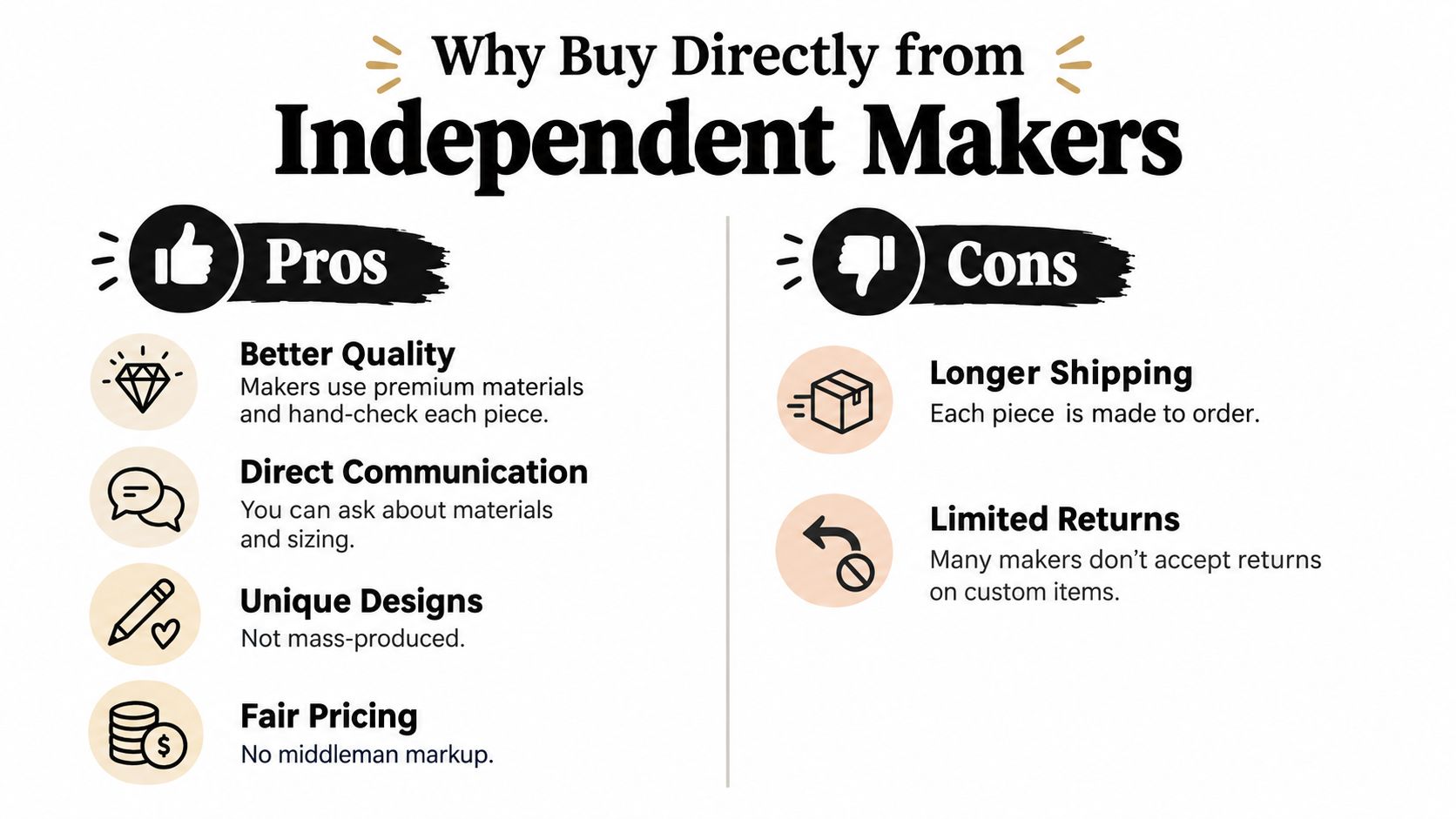
Buying directly from an independent maker isn't a charitable act. You're choosing a closer relationship with the person responsible for the design and construction. That relationship can improve the product because you can ask precise questions, request reasonable changes, and get answers from someone who understands the piece rather than a general retail support team.
A direct maker can often tell you why a stone was selected, how a finish will age, or whether a chain works with the pendant's weight. You may also see designs that don't fit the uniform requirements of mass retail. That doesn't guarantee every independent piece is excellent, but it gives you a clearer path to evaluating quality.
Direct communication creates accountability
Middlemen can make a purchase convenient, but they can also separate you from the person who made the product. Buying directly lets you ask about fit before ordering and report a problem to someone who knows the materials and construction. That exchange can reveal whether the seller takes responsibility for the work.
Direct buying also has a broader e-commerce foundation. A U.S. direct-to-consumer survey found that just over half of Americans had purchased from a DTC brand at least once in the prior year, while 65 percent intended to buy from a DTC brand at least once in 2022, according to Retail Dive's coverage of the survey. Buyers are already open to relationships that bypass mass retail.
Satisfaction data supports a measured view rather than a romantic one. PYMNTS Intelligence and Adobe found that an average of 72 percent of shoppers were very or extremely satisfied when buying directly from a brand's app or website, compared with 76 percent on retailer websites and 80 percent on online marketplaces, as reported by MediaPost. Direct buying can work well, but the seller still needs strong product information and dependable service.
The quality upgrade comes from access. You can reach the person who knows what went into the piece, and that makes better decisions possible.
The trade-off is that an independent maker may have a smaller production capacity and more limited policies than a large retailer. That's acceptable when the listing is honest, the craftsmanship is visible, and the communication is dependable.
Finding Handmade Jewelry on Loyaltie and Similar Marketplaces
You don't need to search every social platform, local directory, and maker website separately. A marketplace can give you one place to compare product pages, read seller information, review policies, and decide whether a piece meets your standards. The important part is to keep using the evidence-based checks above, rather than treating marketplace presence alone as proof of handmade production.
For broader buying context, the Evo Dyne Products jewelry buying guide offers another reference point for comparing places to shop for silver and gold jewelry online. Use any guide as a starting point, then return to the individual listing for material details, scale, construction, and policies.
Turn browsing into a repeatable habit
Start with the kind of piece you want, such as a sterling silver ring, a gemstone bracelet, or a made-to-order pendant. Then narrow the options by asking:
- Does the maker explain what they personally do?
- Are the materials named clearly?
- Can you see close-up and on-model images?
- Is the production timeline realistic?
- Are returns, resizing, and damage procedures visible?
- Does the seller show a consistent body of work?
Loyaltie is a marketplace where people discover and buy directly from independent brands in the US. Its model brings local commerce into an online shopping experience, so you can explore makers and producers without giving up the convenience of digital ordering. You can begin browsing through Loyaltie and apply the checklist to each product page.
The same mindset works beyond jewelry. Whether you're choosing coffee, skincare, wellness products, food, supplements, or pet products, look for specific materials or ingredients, a recognizable maker voice, clear production information, and policies that match the purchase. Better everyday products start with better evidence.
Loyaltie gives you a practical place to discover and buy directly from independent US brands and local makers, including handmade jewelry you can evaluate with confidence. Visit Loyaltie to browse real products, compare maker details, and choose quality without the distance of mass retail.