
What does “glyphosate free” guarantee when it appears beside words like “clean,” “natural,” or “better choice”? You might turn a package around expecting a clear answer, only to find a reassuring phrase with no testing date, production standard, or explanation of which ingredients the claim covers.
That confusion doesn't mean you need a chemistry degree or a fear-based list of foods to avoid. You need a practical way to distinguish how a product was made, what was tested, and what the result really proves. Once you know which questions to ask, buying glyphosate free foods from independent brands and local makers becomes much more straightforward.
Table of Contents
- What standard covers the ingredients?
- Was the product tested, and how?
- Can the maker identify the suppliers?
Why Glyphosate Free Foods Are Confusing to Shop For
Which package gives you enough evidence to trust its glyphosate-free claim? One bag may say “natural,” another “clean,” and a third “glyphosate free.” The third sounds more specific, yet its label may not explain whether the farmer avoided glyphosate, the finished food was tested, or the claim covers every ingredient.
That gap matters because glyphosate free isn't a universal government-defined food category. The phrase can refer to a production practice, a laboratory result, a certification, or a brand's own sourcing policy. These are useful signals, but they answer different questions. A front-label claim is a signpost, not the full map.
Compare the claim with the information behind it. A local maker selling organic freeze-dried strawberry slices may show organic certification and list the ingredients clearly. That gives you specific details to check. A broader statement on another package may leave you guessing about its standard, testing, or coverage.
The label is only the beginning
Use five questions to turn a vague claim into something you can assess:
- What production standard applies? Is the crop certified organic, covered by a documented non-use policy, or sourced through another defined system?
- Which ingredients are covered? The claim may concern oats or wheat without applying to spices, oils, flavorings, or other ingredients.
- Was testing performed? Check whether the sample was a raw ingredient, a finished product, or both.
- What could the laboratory detect? A report should state its detection or quantification limit, so you know what “not detected” means.
- What does the wording mean? “Produced without glyphosate” describes an agricultural practice. “No glyphosate detected above the laboratory's limit” describes a result from a tested sample.
USDA pesticide monitoring can show that residue findings involve many chemicals and commodities. It cannot, by itself, answer whether a particular food is glyphosate free. The EPA's glyphosate overview adds regulatory context, but it does not turn broad pesticide data into a glyphosate-free rate.
Treat the front label as an invitation to verify. Ask for the production standard, ingredient coverage, and relevant testing details before deciding what the claim supports.
What Glyphosate Free Means
Glyphosate has been registered as a pesticide in the United States and is used to control broadleaf weeds and grasses in fruits, vegetables, nuts, corn, soybeans, and other major field crops, as the EPA's glyphosate overview explains. That broad use helps explain why you may look for alternatives. It does not mean every conventional food has the same residue profile, or that every detected residue carries the same significance.
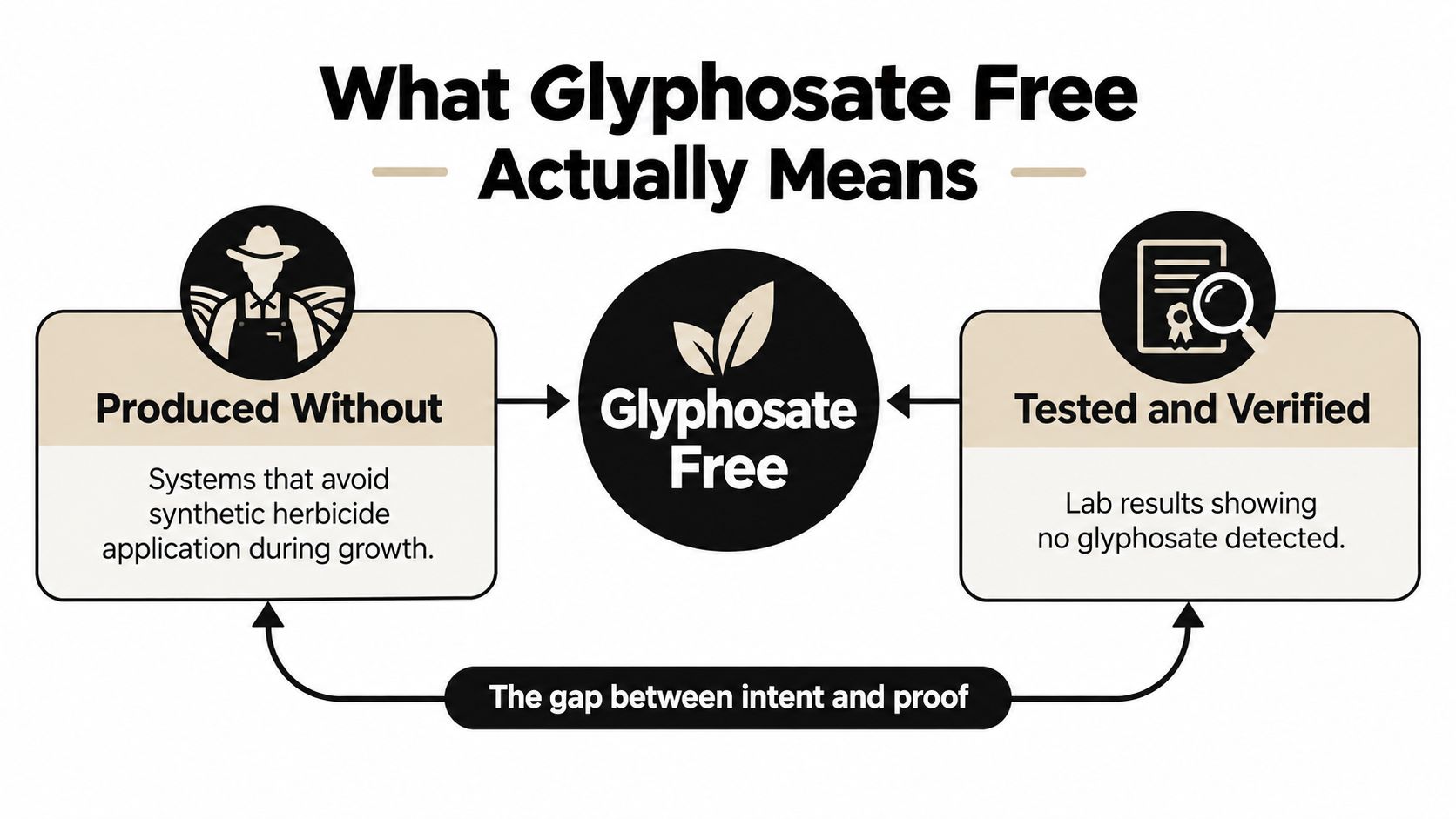
The phrase glyphosate free usually describes one of two claims. A farmer or supplier may say a crop was produced without glyphosate, meaning the production system prohibits or avoids its use. A brand may instead say the food was tested with no glyphosate detected, meaning a laboratory did not find glyphosate above its reporting threshold in the sample it examined.
Those statements answer different questions. The first concerns how the food was grown. The second concerns what a laboratory found in one sample.
The practical distinction: “Produced without glyphosate” describes an agricultural practice. “No glyphosate detected” describes a laboratory result from a particular sample at a particular time.
A laboratory result works like a photograph. It captures one lot under specific testing conditions, rather than promising that every future batch will look identical. The result can provide useful evidence about the tested sample, but it cannot prove that glyphosate was never used anywhere in the supply chain or that later products will produce the same result.
Five details that make a claim useful
A product page or certificate should name the production standard, such as USDA Certified Organic production or a documented non-use policy from the grower. It should also identify the covered ingredients, especially when the product combines grains, soy, corn, herbs, or plant extracts.
Check the testing method and detection limit as well. The word “tested” leaves important questions unanswered. You need to know what the laboratory searched for, how low it could measure, and whether the result applies to a raw ingredient or the finished product.
Then examine the claim's scope. A snack may contain tested oats alongside untested sweeteners, oils, or flavor ingredients. A coffee alternative may include one tested botanical while the complete blend falls outside the report.
The EPA explains that a detected residue does not automatically mean food is unsafe. Legal tolerances address permitted residue levels, while a glyphosate-free claim may use a narrower standard, such as non-use or non-detection. These five details help you judge what the label supports, without treating it as either a guarantee or a reason to panic.
Legal Limits Versus Zero Residues
Could a food meet a legal limit and still contain measurable glyphosate? Yes. “Below the legal tolerance” and “no glyphosate detected” describe different thresholds, much like passing a legal inspection differs from finding absolutely no trace of a substance.
EPA tolerances vary by commodity because residue behavior depends on the crop, application timing, and intended use. The federal entries include 0.1 parts per million for rice, peanuts, strawberries, and sesame, and 0.2 ppm for apples, grapes, berries, stone fruits, and bananas. Other entries are higher, including 3.5 ppm for husk-off sweet corn, 20 ppm for soybean seed, and 30 ppm for corn, barley, oats, sorghum, and wheat, according to the federal glyphosate tolerance table. These differences reflect crop biology and the ways products may be applied.
A commodity comparison
| Food | EPA tolerance (ppm) |
|---|---|
| Rice | 0.1 |
| Strawberries | 0.1 |
| Peanuts | 0.1 |
| Apples | 0.2 |
| Grapes | 0.2 |
| Husk-off sweet corn | 3.5 |
| Soybean seed | 20 |
| Corn | 30 |
| Barley | 30 |
| Oats | 30 |
| Sorghum | 30 |
| Wheat | 30 |
These figures are legal maximum residue levels, not proof that a product contains zero glyphosate. They also cannot be swapped casually between ingredients. A laboratory result for wheat flour should be compared with the entry for the applicable commodity, rather than automatically with a finished cookie. A soybean seed result may not map directly onto a processed soy beverage.
Suppose a report identifies a measurable result in oats. Ask three practical questions: What unit does the report use? What form of the commodity was tested? Which tolerance applies to that specific commodity? A detected amount below the applicable tolerance may be legally compliant. Someone seeking non-detection may still choose a different product, because the two standards answer different buying questions.
Why “free” needs a defined threshold
The FDA's glyphosate questions and answers describe an assignment involving 879 corn, soybean, milk, and egg samples. Glyphosate and/or glufosinate residues appeared in approximately 59% of corn and soybean samples, while measured glyphosate residues remained below EPA tolerances. No residues were detected in the milk or egg samples in that assignment.
The assignment does not establish a glyphosate-free rate for all food. It shows why a “free” claim needs a stated threshold and supporting records. Treat the claim like a photograph of what was tested, not a promise covering every ingredient or every batch. “Compliant with EPA tolerances” means one thing. “Tested with no glyphosate detected above a stated reporting limit” means another.
How Glyphosate Testing Works and How to Read a Report
A laboratory report becomes useful when it tells you what the lab looked for and how clearly it could see it. For glyphosate in food, analytical reviews identify liquid chromatography tandem mass spectrometry, usually written as LC-MS/MS or HPLC-MS/MS, as a highly sensitive and selective approach. The method separates compounds in the sample, then uses mass information to identify and measure the target.
You don't need to understand the entire instrument to read the important lines. Focus on the reporting limits.
LOD and LOQ in plain language
The limit of detection, or LOD, is the lowest level at which the laboratory can distinguish a compound's presence from background noise. The limit of quantification, or LOQ, is the lowest level at which it can measure and report the amount with defined confidence.
Peer-reviewed methods have reported LOQs around 0.001 milligrams per kilogram for solid foods and 0.0005 milligrams per kilogram for liquids, although performance varies with the food matrix and sample preparation. The analytical review of glyphosate testing methods also highlights AMPA, glyphosate's principal degradation product, as an important compound to consider.
A report that says “zero glyphosate” gives you less information than one that says “not detected above 0.001 mg/kg.” The second statement tells you where the laboratory's measurement floor was. Non-detection is meaningful, but it isn't the same as proving absolute absence.
Read the result literally: “Not detected above the stated LOQ” means the lab didn't find glyphosate at or above that limit in the tested sample.
Your report-reading checklist
Look for these details before relying on a certificate:
- Named analytes: Does the report identify glyphosate and, where relevant, AMPA?
- Method: Does it name LC-MS/MS or another matrix-appropriate analytical method?
- LOD and LOQ: Are the detection and quantification limits stated clearly?
- Sample identity: Does the report identify the product, ingredient, lot, or batch?
- Result wording: Does it say “not detected above” a defined limit instead of “zero”?
- Laboratory information: Can the seller identify the laboratory and the scope of its testing?
If you want to understand how food-quality laboratories handle production testing, you can browse this Knouse Foods project for an example of food laboratory casework and quality-control context.
A current certificate, supplier attestation, or batch-specific report doesn't need to be flashy. It needs to connect the result to the product you're holding.
A Practical Shopping Routine for Glyphosate Free Foods
You don't need to ban every grain, soy product, beer, or packaged food from your kitchen. A better routine starts with likely exposure patterns, then applies the right level of verification to the foods you eat most often.
A 2025 review found residues in about 90% of tested wheat samples, 80% of breakfast-cereal samples, and 70% of bread samples, with cereals and derivatives appearing most often among the categories it analyzed. The review's abstract and publication details also emphasize that measured amounts must be interpreted against applicable maximum residue limits and acceptable daily intakes.
That makes frequently eaten grains and grain-based products sensible places to ask better questions. It doesn't turn every loaf of bread or bowl of cereal into a crisis.
Start with the foods you repeat
Begin with the staples your household buys regularly. If you eat oats every morning, investigate the oats first. If your pantry revolves around wheat flour, soy protein, corn products, coffee alternatives, supplements, or pet food, focus your sourcing questions there.
For less frequently eaten foods, ordinary label reading may be enough for your priorities. You can also compare a maker's organic certification, ingredient documentation, and testing policy without trying to create a perfect list of forbidden foods.
When you buy from a local producer or independent brand, you can often ask a direct question instead of searching through generic corporate copy. Ask:
- Ingredient source: Which farms or suppliers provided the grains, beans, coffee, herbs, or extracts?
- Growing practice: Do those suppliers use certified organic production or document non-use?
- Finished-product testing: Was the complete product tested, or only selected ingredients?
- Reporting limit: What were the LOD and LOQ, and how recent is the report?
- Claim scope: Does the statement apply to the whole product or just one crop?
USDA Organic provides a concrete baseline. The program prohibits genetic engineering, ionizing radiation, and sewage sludge, and certified operations must follow regulated production standards, as explained by the USDA Organic standards. Organic and glyphosate free aren't interchangeable labels. Organic describes a regulated production system, while a glyphosate claim may describe testing, non-use, or both.
This approach works across categories. You might compare a maker's sourcing notes for loose tea with the documentation for a packaged grain product, or ask about the ingredient practices behind organic einkorn tea biscuits. The point is not to fear a category. It's to understand the product in front of you.
Advice for Makers Selling Glyphosate Free Products
For an independent food, coffee, supplement, pet-product, or wellness brand, a glyphosate-related claim becomes a useful quality signal when customers can follow the evidence. Buyers do not need dramatic promises. They need a clear path from the ingredient's farm or supplier to the words on the package.
Lead with wording customers can understand:
- “Made with certified organic oats.” This identifies the production standard for a named ingredient.
- “Our growers document non-use of glyphosate.” This describes a supplier practice without claiming a laboratory result.
- “Tested with no glyphosate detected above [defined LOQ].” This states the test result and its measurement threshold.
- “The finished product was tested.” This shows that the evidence covers the complete food, not only one raw ingredient.
These statements work like a photograph rather than a permanent promise. They show what was documented for a named ingredient, product, or lot at a particular point in time. Make the scope visible so a customer does not mistake an ingredient claim for a whole-product result.
Begin with sourcing
Choose certified organic ingredients where they fit your product and budget. If an ingredient is not certified organic, document non-use directly with the grower or supplier, and keep the current attestation with the relevant ingredient record.
Record which supplier provided each lot, which production standard applied, and whether the supplier's statement covers cultivation only or also handling and processing. A farm-practice statement and a finished-food test answer different questions. Keeping them connected helps you describe each one accurately.
Keep evidence connected to the claim
A current organic certificate, supplier attestation, or batch-specific laboratory report gives customers something concrete to review. If you test, ask the laboratory to identify glyphosate and AMPA, state its LOD and LOQ, identify the sampled lot, and report the result as “not detected above” a defined limit.
As the FDA assignment covered earlier showed, residues below tolerances still appeared in most tested corn and soybean samples, which is why threshold wording matters. A broad “glyphosate free” statement without a defined limit can leave customers unsure what was measured.
For makers: Make the narrow claim you can prove, then show the document that supports it.
Avoid implying that one test proves glyphosate was never used in the past or will never appear in every future lot. Update certificates and reports when sourcing changes, and identify the covered ingredients on the product page.
Independent makers can turn this transparency into a quality improvement. A buyer comparing a documented product with an anonymous alternative may value the ability to ask who grew the ingredients, which lot was tested, and what the result means. A maker selling an organic ube powder blend, for example, can provide more useful information through a sourcing page and test summary than through a broad “clean” claim alone.
Your Three Questions Before You Buy
You can carry the whole framework into a farmers market, an online product page, or a conversation with a coffee and supplement maker by asking three questions.
What standard covers the ingredients?
Ask whether the ingredients are certified organic, documented as grown without glyphosate, or sourced under another defined production standard. If the answer is “natural,” ask what that word means in the maker's own process. A broad adjective isn't a substitute for a standard.
Also ask which ingredients the answer covers. A product may contain one certified grain alongside other ingredients with different sourcing histories.
Was the product tested, and how?
Find out whether the maker tested the finished product, the individual ingredients, or both. Request the test date, sampled lot, analytical method, and the laboratory's LOD and LOQ.
“Not detected” is useful only when you know what the lab could detect. A result reported as “not detected above [defined LOQ]” gives you a more honest picture than a statement claiming absolute zero.
Can the maker identify the suppliers?
A maker who can name the farms, growers, or ingredient suppliers gives you a way to understand the product beyond its front label. You don't need every supplier to publish proprietary details, but you should be able to learn whether the claim comes from certification, documented non-use, laboratory testing, or a combination.
Verification beats fear. You can make a thoughtful choice without treating every conventional food as dangerous or every reassuring label as proof.
Independent brands and local makers often make this conversation easier because you can buy directly from the maker and ask a real person how the product was made. That personal access is a quality upgrade over anonymous packaging that offers comforting language but no supporting detail.
Start with the foods you eat most often, ask the three questions, and choose the level of documentation that fits your priorities. You don't need a perfect pantry to shop with confidence.
Loyaltie is a marketplace where you can discover and buy directly from the best independent brands in the US, including makers who share clear sourcing and testing information. Visit Loyaltie to find better everyday food, coffee, wellness, skincare, supplements, and pet products from real makers, with no middleman.