

You want to give something thoughtful. Maybe a child in your family celebrates Kwanzaa. Maybe a friend invited you to a gathering, and you're wondering whether bringing a gift is welcome, awkward, or off-base. That uncertainty is common, especially if most holiday advice you've seen treats every celebration like a shopping event.
Kwanzaa asks for a different mindset. The point isn't to impress someone with cost or quantity. The point is to give with purpose, in a way that supports learning, culture, family, and community. That makes gifts on Kwanzaa feel less like a race through a store and more like an act of care.
Table of Contents
- Beyond the Box The Spirit of Kwanzaa Gifting
- Why people get confused about Kwanzaa gifts
- What a meaningful zawadi usually includes
Beyond the Box The Spirit of Kwanzaa Gifting
A lot of people begin in the same place. They type “gifts on Kwanzaa” into a search bar, hoping for a quick list. But a list alone doesn't answer the core question, which is, “What kind of gift honors this holiday?”
Kwanzaa remains a relatively small but important observance in the United States. A 2009 estimate placed the number of Americans who celebrate Kwanzaa at between 500,000 and 2,000,000, while more recent reporting cited by a marketing analysis says about 4% of Americans, roughly 13.4 million people, now say they celebrate Kwanzaa, up from 1.9% in 2015. That same overview also notes that gift-giving is associated with the seventh and final day, January 1 in mainstream guides about the holiday (Kwanzaa overview).
That timing matters. Gifts on Kwanzaa aren't scattered throughout the week like a retail countdown. They arrive at the end, after days centered on reflection, family, and the Seven Principles.
The heart of Kwanzaa gifting is meaning, not volume.
If you're trying to choose well, it helps to think less like a holiday shopper and more like a careful neighbor, parent, auntie, uncle, teacher, or friend. Many of the same habits that guide mindful gift-giving tips also work here. Ask what will be used, remembered, discussed, or passed on.
Some families lean toward handmade items. Others choose books, symbolic objects, or gifts that connect a child to heritage and identity. If you want a place to browse items with a cultural lens in mind, Ancestral Roots offers one example of the kind of locally rooted shopping approach that fits this spirit better than a generic big-box search.
Understanding Zawadi and the Nguzo Saba
Zawadi means gifts, but in Kwanzaa, the word carries more weight than a holiday exchange. It points to gifts chosen for purpose. That's why people who are used to highly commercial winter holidays sometimes misread what's appropriate.
Why people get confused about Kwanzaa gifts
The confusion usually starts with assumption. People assume every holiday gift should be purchased, wrapped, and presented with the same level of spending pressure. Kwanzaa pushes back on that idea.
UCHealth notes that “gifts are not necessary” for Kwanzaa and says that if parents do give something, they should focus on small educational gifts like books. It also describes Kwanzaa as a time centered on learning and family rather than consumer spending (UCHealth on celebrating Kwanzaa).

That's a big shift. It means a modest gift can fit the holiday better than a flashy one. It also means no gift at all can still be faithful to the spirit of the celebration.
What a meaningful zawadi usually includes
Traditional guidance often says children's gifts should include a book and a heritage symbol. That pairing is powerful because it joins learning with cultural continuity. A book supports growth, imagination, and study. A heritage symbol connects the child to memory, identity, and belonging.
Consider this practical approach:
| Gift element | Why it fits Kwanzaa |
|---|---|
| Book | Encourages learning, reflection, and self-development |
| Heritage symbol | Supports cultural identity and continuity |
| Handmade item | Reflects creativity and care |
| Locally made object | Can align with community-minded buying |
The Nguzo Saba, or Seven Principles, help narrow your choices further. If a gift supports unity, self-determination, creativity, purpose, or community responsibility, it's usually moving in the right direction. That's why handcrafted goods often feel more appropriate than generic novelty items.
A heritage-themed wearable can work when it carries symbolic meaning rather than acting as costume. For example, a simple item such as a stretch beaded bracelet in red, black, and green with a lion charm may make sense when the giver can explain why those colors or symbols matter.
The same principle applies to personal care gifts. A product like Moonlit Radiance – African Black Soap Face Wash | Midnight Oasis Essentials by Loyaltie can fit if it's chosen thoughtfully and given in a values-based way. The available product description says it combines African Black Soap with aloe vera and turmeric to help clear buildup and calm skin without a tight, stripped feeling. That kind of gift works best for an older recipient when paired with context, not as a random add-on.
Practical rule: If you can clearly explain how the gift supports learning, heritage, creativity, or community, you're probably close to the spirit of zawadi.
Thoughtful Kwanzaa Gift Ideas to Inspire
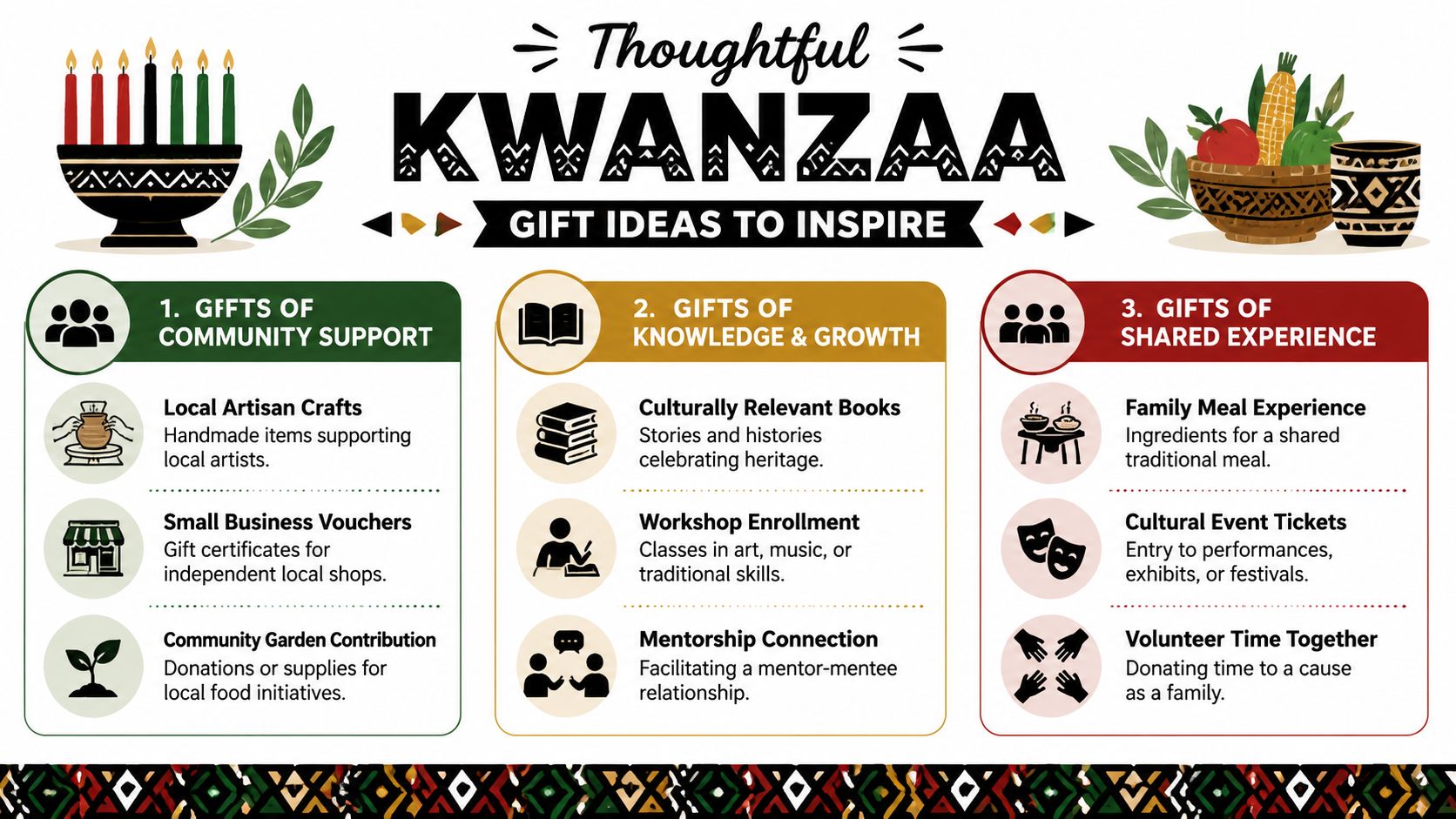
Once you understand the why, the what gets easier. The strongest gifts on Kwanzaa usually do one or more of three things. They teach. They connect. They strengthen community.
Ideas that teach, connect, and last
A useful guideline from one Kwanzaa gift reference is that gifts should ideally include both a book and a heritage symbol, and that gifts tied to principles such as creativity, self-determination, and unity fit better than generic consumer goods. That same guidance favors book-plus-artifact sets and handcrafted goods (Kwanzaa gifts for kids guide).
Here are some examples that follow that logic:
For knowledge and growth
Choose a children's book by a Black author, a family history book, a journal, or art materials that encourage reflection and making. These gifts support curiosity and self-definition.For heritage and continuity
Consider a symbolic object, a handmade textile, a piece of art, or an item in Pan-African colors that can be explained and appreciated over time. The key is meaning, not trendiness.For creativity
Pottery, sewing kits, woodworking kits, sketchbooks, printmaking supplies, or music-related gifts can support Kuumba in a practical way.For shared family life
A recipe journal, ingredients for a family cooking project, a storytelling game, or materials for an intergenerational craft night can center connection instead of stuff.
A home-centered gift can also be appropriate when it supports reflection and ritual. For instance, a scented travel tin candle with frankincense, spiced honey, tonka, and cozy amber incense notes may suit an adult recipient who values calm space and intention.
A short visual roundup may help spark ideas in a more concrete way.
A simple way to build a gift that fits
If you're still unsure, use a bundle approach instead of hunting for one perfect object.
Try one of these combinations:
Book plus symbol
A culturally relevant book and a heritage item.Tool plus practice
Art supplies and an invitation to create together.Object plus story
A handmade item with a note explaining why you chose it and which principle it reflects.
A meaningful Kwanzaa gift should still make sense after the holiday ends. It should be useful, teach something, or carry a story the recipient can keep.
How to Find and Purchase Meaningful Kwanzaa Gifts
You are standing at a holiday market a few days after December 26. One table has mass-produced gift sets with generic winter packaging. Another has handmade journals, carved wooden objects, and printed cards that explain who made them and why. For Kwanzaa, that second table usually gives you a better starting point, because the purchase itself can reflect community ties, cultural care, and intention.
That is the part many gift guides skip. They focus on items, but the method matters too. A Kwanzaa gift carries more meaning when you can trace it back to a maker, a neighborhood, or a shared purpose.
Kwanzaa gift-giving is intentionally non-commercial. The holiday runs from December 26 to January 1, and the final day is traditionally when children receive zawadi. Guidance also emphasizes that gifts should be educational, handmade, or culturally significant, and should include a book and a heritage symbol as a way to resist Christmas-style consumerism (Jackson Advocate on Kwanzaa gift-giving).

Where to look first
Start nearby if you can. Community markets, neighborhood holiday fairs, local bookstores, African or Caribbean cultural shops, museum stores, and small artisan pop-ups often make it easier to find gifts with a clear story behind them.
That story matters. A Kwanzaa-aligned purchase works a bit like buying ingredients from a local farm instead of grabbing a boxed meal. You are not only choosing the final product. You are also choosing the chain of relationships behind it.
Useful places to search include:
- Local maker directories that sort independent sellers by region
- Black-owned business roundups shared by community groups, chambers, or neighborhood organizations
- Social media searches using your city name with tags like handmade, Black-owned, or artisan
- Marketplace platforms that connect shoppers with nearby sellers directly. Loyaltie is one example, a marketplace where people can discover and purchase from local businesses, makers, growers, and producers online
If you are considering a handmade candle, soap, or home item from a small seller, it helps to understand the work involved. A quick read on how to make scented soy candles can give you a better sense of materials, labor, and why handcrafted goods are priced differently from mass retail versions.
How to tell if a gift source fits the holiday
A strong source gives you context, not just inventory. You should be able to learn who made the item, what it is made from, and whether the seller understands the cultural meaning attached to the product.
That is especially helpful with Kwanzaa, because a gift can look appropriate on the surface and still feel disconnected from the holiday's purpose. A wooden bowl from a local ceramicist or woodworker may fit beautifully if it supports family gathering, daily use, or heritage. The same object, stripped of context and sold as generic seasonal decor, may not carry the same weight.
Use this quick filter before buying:
| Ask this question | Why it matters |
|---|---|
| Who made this? | Knowing the maker adds personal and cultural context |
| Is it handmade, educational, or symbolic? | Those qualities align more closely with Kwanzaa traditions |
| Can I explain why this gift belongs in Kwanzaa? | A clear reason usually means the choice is thoughtful |
| Does this purchase support local or community-based commerce? | That reflects the holiday's emphasis on shared responsibility and economic care |
Buy with enough time to ask questions. Read maker bios. Check whether materials, process, and purpose are explained clearly.
When you are unsure, choose fewer gifts and choose with more care. One useful object from a local maker, paired with a clear reason for giving it, often honors Kwanzaa better than a larger pile of unrelated items.
A Maker's Guide to Creating Kwanzaa-Ready Products
For makers, Kwanzaa isn't a label to paste onto existing inventory. Buyers who care about this holiday are usually looking for signs of thoughtfulness, not seasonal repackaging.
What buyers are really looking for
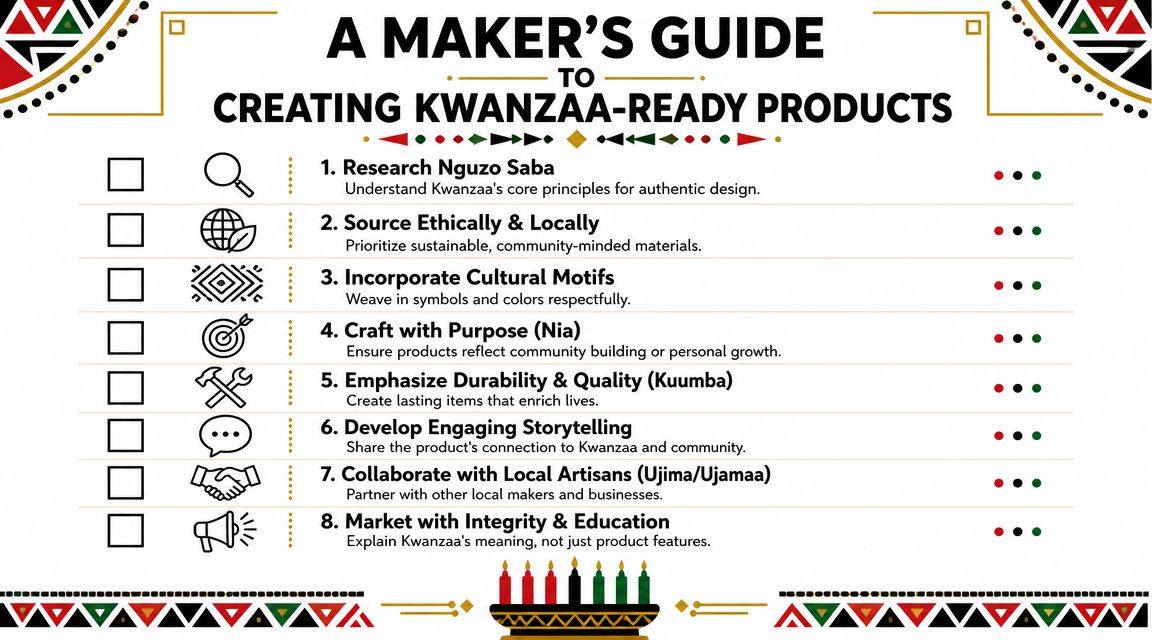
One of the biggest content gaps in Kwanzaa gift coverage is that many guides mention the Seven Principles but don't connect them to practical gift choices. Guides that do make those links, especially around Umoja, Kujichagulia, Ujima, Nia, and Kuumba, create more value for readers. That also opens room for makers to offer journals, family activities, and local heritage goods in a more meaningful way (Imani Oliver Kwanzaa gift guide).
That means your product development can start with a principle, not a trend.
For example:
- Kuumba can guide DIY kits, art tools, handmade ceramics, or sewn goods.
- Kujichagulia can shape journals, affirmation cards, identity-centered art, or customizable items.
- Ujima can inspire family activity bundles or products made in collaboration with another local maker.
- Nia fits reflection tools, planners, keepsake objects, and products tied to study or intention.
How to present Kwanzaa-ready products respectfully
Presentation matters as much as the product itself. A candle isn't automatically a Kwanzaa gift. But a candle offered as part of a reflection set, with thoughtful language about purpose, family gathering, or handmade craft, can make sense.
If you make candles, process content can also help customers value the labor behind the item. A simple educational resource like this guide on how to make scented soy candles can show the kind of craftsmanship buyers often appreciate when they choose handmade gifts.
Use a checklist before listing a product for Kwanzaa shoppers:
Name the principle
State which value the product connects to, if any.Explain the use
Tell buyers how the item supports learning, creativity, reflection, or community.Share origin details
Mention materials, maker collaboration, or local sourcing when relevant.Bundle with care
A journal plus handmade pen, or a book plus symbolic object, often feels more intentional than a single item with seasonal keywords.
Buyers respond to products that help them give with purpose. They hesitate when a listing uses Kwanzaa language but gives no cultural or practical context.
Keep your language steady and respectful. Avoid treating Pan-African colors, heritage references, or symbolism like decorative shorthand. Explain what you made, why you made it, and who it's for.
Give the Gift of Community and Culture
A family stands in a market a few days before Kwanzaa, choosing between a mass-produced item and a hand-bound journal made by a local artist. Both can be wrapped. Only one clearly carries a story, supports a neighbor, and reflects the purpose behind zawadi.
That purpose matters. Kwanzaa gifts are not only about giving someone an object to open. They are a way to pass along memory, encourage learning, support creativity, and keep community relationships active after the celebration ends.
For that reason, a meaningful Kwanzaa gift often comes from where and how you buy as much as from what you buy. A children's book from an independent bookseller, a carved bowl from a nearby craftsperson, or a print from a neighborhood artist does more than fill a gift bag. Each purchase can help local businesses stay visible, keep makers paid for their work, and connect holiday spending to the values Kwanzaa teaches.
This closing idea is simple.
Give in a way that strengthens the circle around you. Shoppers can ask who made the item, where the money goes, and what the gift helps the recipient learn or do. Makers can describe their process clearly, price their work fairly, and present products with enough context for buyers to choose with care. That is how gift-giving becomes cultural practice, not seasonal consumption.
If you want a practical place to start, Loyaltie can help you find local makers, independent businesses, and community-rooted products that fit the spirit of Kwanzaa.
Drafted with Outrank