
Type "ghee vs butter" into a search bar and you get the same sermon back. Ghee is the healthy one: higher smoke point, no lactose, ancient tradition, so swap your butter and never look back.
That advice skips the only part that matters. Ghee is butter cooked until the water and milk solids are gone, which makes it a more concentrated fat, not a better one. Per gram it carries more calories and more saturated fat than the butter it came from. Its heat tolerance is real, and I reach for it constantly when searing, but heat tolerance is a cooking property, not a health credential.
The category keeps growing, which is why the labels get louder. Mordor Intelligence estimated the global ghee market at USD 59.23 billion in 2025 and USD 62.46 billion in 2026, with cow ghee taking a 59.85% share. Judge a jar the way you'd judge anything else you cook with, by how gently it was clarified, how fresh the batch is, how you store it, and what you're cooking tonight.
Table of Contents
- Ghee vs Butter at a Glance
- How Ghee Is Made and Why It Changes the Fat
- Which Fat Fits Which Job and Why
- Calories, Fat and Health Claims Compared
- Storage, Shelf Life and Spotting a Tired Jar
- Choose and Buy Your Ghee or Butter Wisely
Ghee vs Butter at a Glance
The short answer is that butter is a water-in-oil emulsion churned from cream, and ghee is that same butter cooked until the water boils off and the milk solids are skimmed away, leaving almost pure milk fat. Every other difference follows from that one change.
| Feature | Butter | Ghee |
|---|---|---|
| Milk fat | At least 80% | At least 99.6% |
| Water | Up to 16% | 0.2 to 0.5% |
| Milk solids | Up to 2% nonfat solids | Almost none |
| Smoke point | About 175°C (347°F) | About 250°C (482°F) |
| Flavor | Creamy, dairy, lightly sweet | Nutty, toasted, rich |
| Lactose and casein | Present | Trace when fully clarified |
International standards put hard numbers on the split. The Codex Alimentarius text reproduced in the FAO's food standards document sets butter at a minimum of 80% milk fat, a maximum of 16% water and no more than 2% nonfat milk solids, while ghee must reach at least 99.6% milk fat, with moisture down at 0.2 to 0.5%. In plain terms, 100 grams of butter can be 16 grams water. The same weight of ghee is all fat.
Read the table as a cooking guide rather than a scorecard. The water row explains why butter foams, spreads straight from the fridge and browns so eagerly, and the smoke point row explains why none of that hurts you in a hot pan.
Flavor moves from creamy and lightly sweet to nutty and toasted, and that toasted note is the reason some people prefer ghee on rice and others find it too strong for toast. The lactose and casein row is about traceability, not marketing: those compounds are present in butter and only trace in a jar that was properly clarified. If your weeknight cooking runs on garlic and herbs anyway, a garlic butter seasoning blend does flavor work that no plain fat can, and you can build it on either one.
One line to keep: ghee is a cooking fat that started as butter, and butter is a dairy spread that also cooks beautifully.
How Ghee Is Made and Why It Changes the Fat
Ghee is butter with the water and milk solids removed. That extra step concentrates the fat and changes how it behaves in a pan.
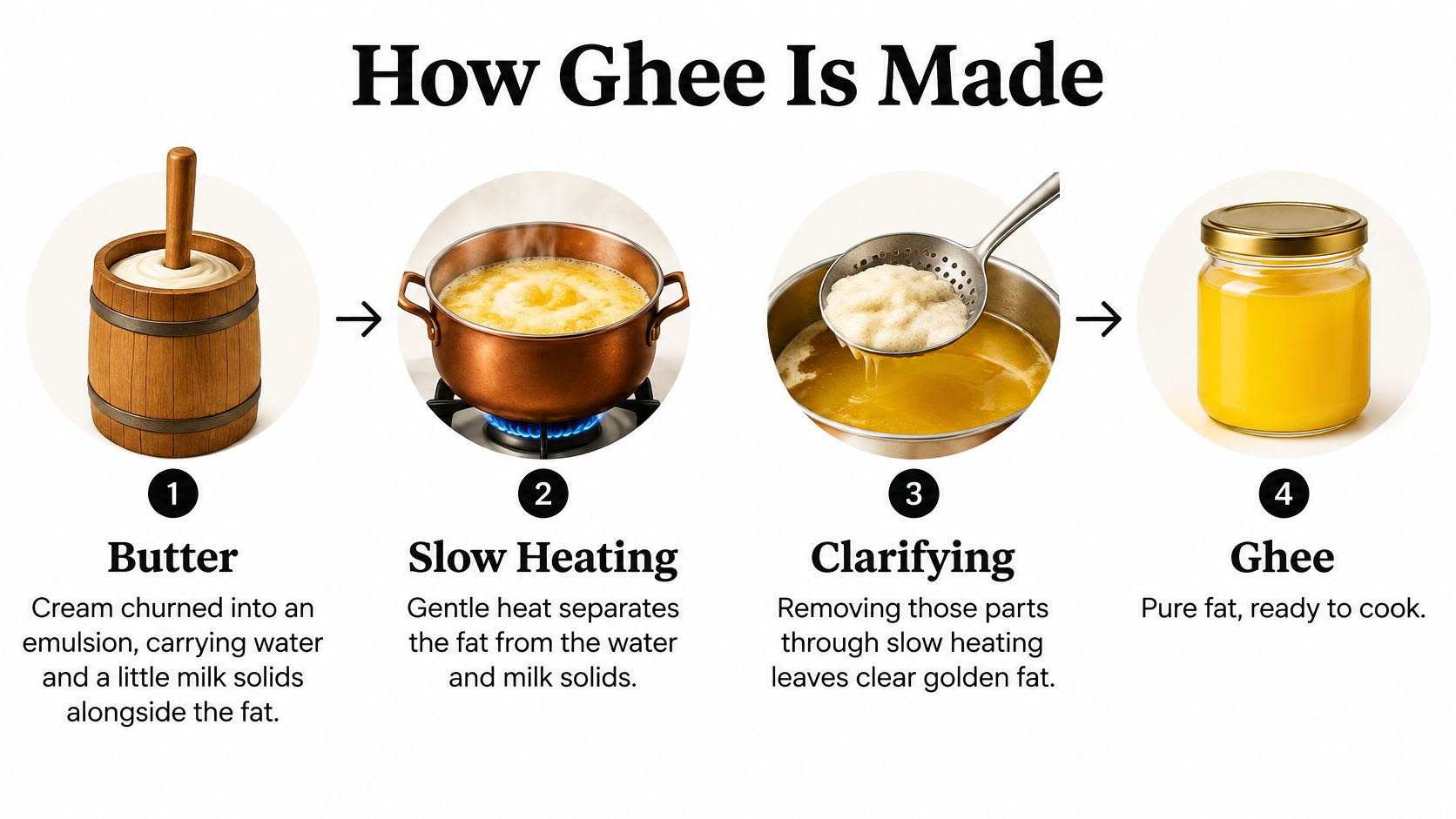
Butter begins as cream churned into an emulsion, so it contains water and milk solids alongside fat. Clarifying separates them with gentle heat. Here's the process, and what to watch at each stage.
- Melt cubed unsalted butter over low heat. Smaller pieces melt evenly. High heat can scorch the butter before the water has boiled off, leaving the finished ghee bitter.
- Let the foam rise as the water simmers off. A soft crackle and milky foam are normal. As the water boils away, the foam gradually fades and the crackling quiets.
- Watch the solids sink and turn golden. The milk proteins and sugars collect at the bottom and brown. Golden solids add a toasted note; dark brown ones can make the ghee taste burnt.
- Skim the foam from the top. Use a shallow spoon or fine skimmer to lift off floating solids before they break apart into the fat.
- Pour the clear fat through cheesecloth. Line a fine sieve with cheesecloth or a paper filter, then pour slowly and leave the solids behind. Pressing them can push grit and burnt flavor into the ghee.
- Cool and store in a clean, dry jar. Dry the jar fully, then let the ghee cool until warm before sealing it. Any water left in the jar works against the care taken during clarification.
Removing water and milk solids leaves a more concentrated fat. Taiwan's food standards for butter and butter oil set butter at a minimum of 80% milk fat, with no more than 16% water and 2% nonfat milk solids. Ghee and butter oil must contain at least 99.6% milk fat.
The butter you start with also shapes the flavor. Cultured butter gives the finished ghee a tangier note; sweet cream butter produces a cleaner, nuttier profile.
Which Fat Fits Which Job and Why
Ghee earns its place when a pan needs sustained heat. Butter is the better choice when its flavor, moisture, or milk solids help make the dish.
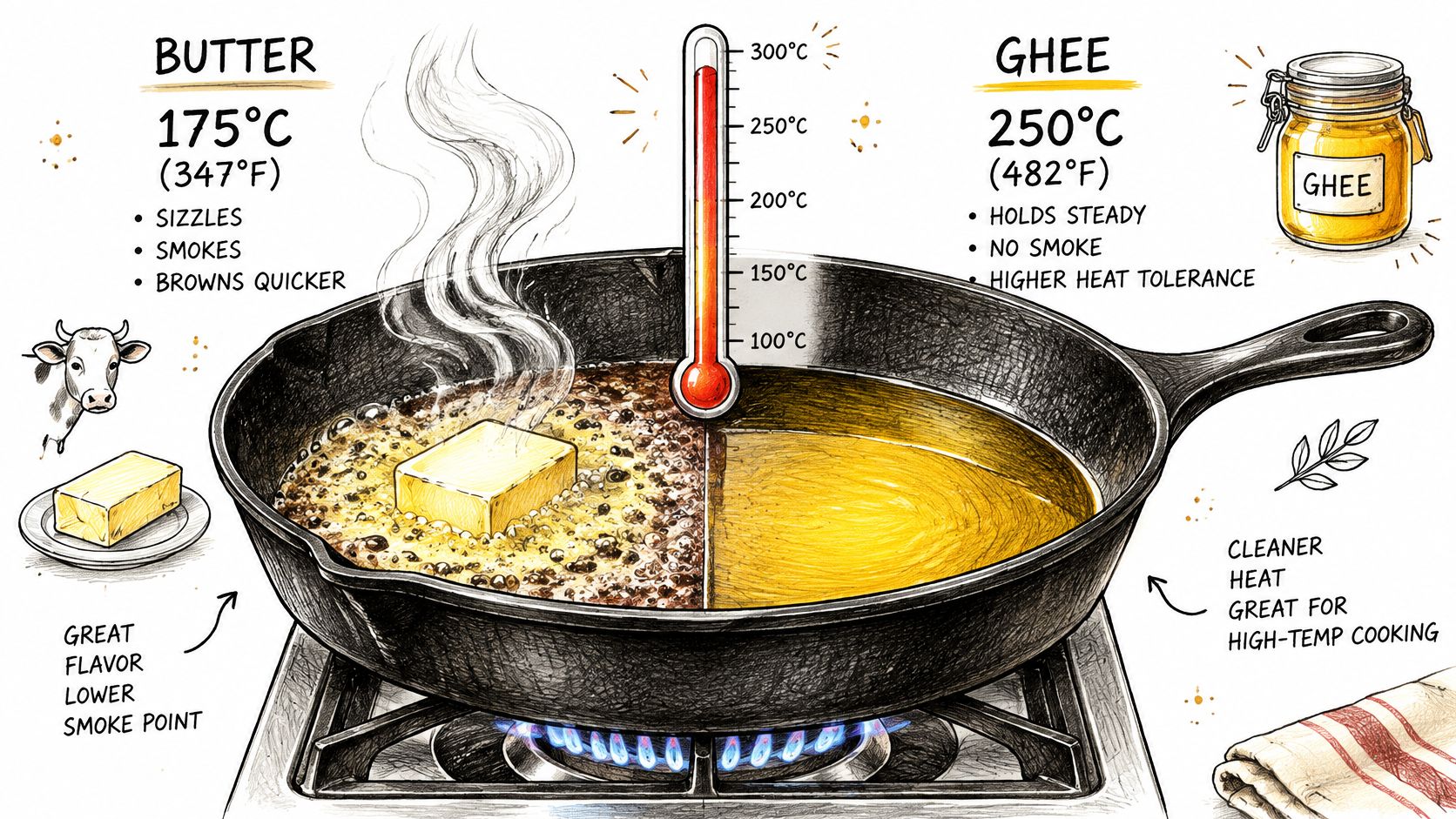
Nutrition Advance's comparison of ghee and butter gives ghee a smoke point of approximately 250°C (482 to 485°F) and butter about 175 to 176°C (347 to 350°F). Ghee tolerates more heat because it has been clarified to remove water and milk solids, which can spit and scorch. That makes it useful for shallow frying or tadka; it does not make ghee the better fat for every job.
| Cooking task | Better pick | Why it wins |
|---|---|---|
| Shallow frying or tadka | Ghee | Handles higher heat and adds a toasted, nutty note |
| Brown butter | Butter | Browning the milk solids creates the flavor |
| Cookies, pie crust, flaky pastry | Butter | Its water contributes steam and flaky layers |
| Pan sauces that need emulsifying | Butter | Its water helps form a smooth emulsion |
| Spreading on toast or bread | Butter | It spreads at room temperature |
| Dairy-light cooking with fully clarified ghee | Ghee | Properly made ghee has only trace lactose and casein |
| Severe milk-protein allergy | Neither without verification | Ghee is not automatically milk-free |
Smoke point varies with refinement, storage, and measurement method. If the fat smokes, lower the heat rather than pushing on.
Where the Swap Goes Wrong
Baking is where treating ghee and butter as interchangeable can change the result. A gluten-free banana cinnamon sugar cookie mix calls for eggs and butter. Butter's water creates steam as the dough bakes; ghee has no water, so the cookies may spread differently and pastry may lose some flakiness.
In a skillet, use slightly less ghee when substituting it for butter. Butter is partly water, while ghee is entirely fat, so the same volume of ghee gives the dish a richer result.
The Move Worth Copying From Restaurant Kitchens
Cook with ghee, then finish with a pat of butter off the heat. Ghee takes the higher-temperature work; butter adds its flavor without leaving its milk solids in the pan to burn.
For a dish where butter melts into a pan sauce, try how to make garlic butter mushrooms. The sauce shows why butter's water and solids can be useful, not just something to remove.
Calories, Fat and Health Claims Compared
Ghee is more calorie-dense than butter by the spoonful because it contains less water. That is a concentration difference, not a nutritional upgrade.
| Per tablespoon (about 14 g) | Butter | Ghee |
|---|---|---|
| Calories | About 102 | About 123 to 130 |
| Total fat | About 11.5 to 12 g | About 13.9 to 14 g |
| Saturated fat | About 7 g | About 8.7 to 9 g |
| Cholesterol | 31 mg | 35 mg |
| Vitamin A | About 97 µg RAE | About 118 µg RAE |
The USDA FoodData Central clarified butter entry lists about 900 calories and 100 g of fat per 100 g, with no protein or carbohydrate. Per tablespoon, the figures vary by product and serving weight, so treat the table as a practical comparison rather than a label-specific guarantee.
The cholesterol difference is small. Evidence on ghee's effects on blood lipids is mixed: a review of research on ghee describes a systematic review that found no significant overall effect on lipid profiles, alongside a marginal association with coronary heart disease and a need for better research. It also discusses a small, short crossover trial in which ghee raised apoB and non-HDL cholesterol more than olive oil. For a flavor comparison, try ghee alongside cold-pressed extra-virgin olive oil made from Palestinian olives.
What the Evidence Supports
A 2024 laboratory study in Food Science & Nutrition analyzed 60 butter, ghee and margarine samples from five food-chain stores in Tehran. Its reported fatty-acid results put saturated fatty acids at 66.69% of butter fat and 64.26% of ghee fat. Those percentages describe the fat itself. Ghee still provides more saturated fat per tablespoon because it contains more fat by weight.
Vitamin A figures also depend on the serving and the product. The USDA FoodData Central ghee entry lists about 840 µg RAE per 100 g. Both butter and ghee contain fat-soluble vitamins; vitamins A, D, E, K explained outlines how these vitamins differ from water-soluble ones.
Choose based on the job and the amount you use. Ghee supplies more concentrated fat per spoonful; butter offers spreadability and a distinct dairy flavor. Neither is a heart-health shortcut, and a “pure” label does not make ghee safe for someone with a severe milk-protein allergy.
Storage, Shelf Life and Spotting a Tired Jar
Storage is where the two fats part ways most sharply. Butter holds water, and water is where spoilage begins, so keep it cold, use it within a few weeks of opening, and freeze what you won't finish. Ghee is almost all lipid, so a sealed jar sits happily in the pantry for months.
That low water content buys stability, not immunity. A characterization cited in a comparative study of ghee composition and quality puts ghee at roughly 98.9% lipids, 0.3% water and under 0.9% nonfat solids, and the same work reports that exposing ghee to high temperatures raised free fatty acids, peroxides and thiobarbituric-acid-reactive substances, all markers of fat oxidation. Indian standards for ghee cap free fatty acids at 3% measured as oleic acid, per the FAO's technical review of traditional ghee, which tells you the industry treats rancidity as a number rather than a smell.
How to Read a Tired Jar
Your nose gets there faster than any lab test. A sharp, paint-like or crayon smell means oxidation has started. A flat or waxy taste confirms it. A jar that has gone noticeably darker than it was on day one, especially near the edges, is telling you it has been through too many heat cycles.
None of that shows up on a label. "Pure" describes what's in the jar, not how long it has been there or how hot it got on the way.
Habits That Keep a Jar Fresh
- Use a dry spoon, every time. A wet spoon introduces water, and water shortens the life of a fat that was made to avoid it.
- Store it away from the stove. The warm shelf above the range is the worst spot in the kitchen for oxidation.
- Write the open date on the lid. You won't remember, and a marker costs nothing.
- Buy small jars if you cook with it slowly. Freshness beats bulk pricing on a fat you use two spoons at a time.
Reading the back label is a start, and how to read nutrition labels makes that quicker, though the batch date tells you more about freshness than the nutrition panel ever will.
Choose and Buy Your Ghee or Butter Wisely
A high smoke point does not make ghee a better choice for every pan. Match the fat to the job: ghee suits searing and roasting, while butter brings its flavor to baking and finished sauces. Your usual recipes matter more than a “pure” or “high smoke point” label.
- Choose for the food you cook most. If you rarely sear or roast, a jar of ghee may sit unused. Butter is often the more practical choice for baking and sauces.
- Check the product name and ingredients. Look for ghee or clarified butter, then read the ingredient list. The USDA entry for anhydrous butter oil lists about 876 calories, 99.5 grams of fat and 61.9 grams of saturated fat per 100 grams. Added salt or oil changes what is in the jar, so check the label rather than assuming every product has the same composition.
- Consider freshness and packaging. A visible batch or production date helps you judge how long the jar may have been sitting. Packaging that limits light exposure can help protect the fat, but storage and handling still matter.
- Ask the maker what you need to know. Ask how the butter is clarified, what milk it comes from, and whether the maker tests for oxidation or adulterants. Answers can help you compare products without relying on broad claims or labels.
- Start with a small amount. If you are unsure, buy a small jar and use it in a familiar recipe. Compare the flavor and how it behaves with the butter you already use.
Loyaltie is a marketplace where shoppers can discover and buy directly from nearby independent makers. Every order is backed by Loyaltie, so you can start with a single jar and compare it with the butter in your fridge. Find products on Loyaltie.