
You're in the bathroom with wet hands, two bars on the sink, and a pink patch that showed up after last night's shower. One wrapper says fragrance free. The other says unscented. From the front they look almost the same, and neither tells you which chemistry will sit on your skin.
That's the gap worth closing. Fragrance free soap is the safer starting label when your skin reacts easily, but treat the front of the wrapper as a claim, not a conclusion. Unscented can hide an ingredient that cancels smell while still touching you, and odor-masking chemistry rarely gets printed in large type.
What separates the two bars is usually who will answer your questions. A maker who sells direct can read you the full formula before you pay, including the parts that never reach the front label. That access matters more than shelf position. I'd ask two plain questions before buying: what makes this bar smell like nothing, and will you send the complete ingredient list. A vague answer to either one is itself information.
Table of Contents
Fragrance Free and Unscented Compared
Two bars sit an inch apart on the shelf. One is labeled fragrance free. One is labeled unscented. You can't tell, from the cardboard, which one is kinder to reactive skin.
Fragrance free means no fragrance and no fragrance-related ingredients were added to change or cover smell. Unscented describes what your nose notices. A maker can hit that second word by adding something that cancels odor, so the bar smells like nothing and still carries chemistry you didn't expect.
Four labels, four shelf questions
| Label | What It Usually Means | What to Check |
|---|---|---|
| Fragrance free | No fragrance or fragrance-related ingredients added | Scan the list for fragrance, parfum and essential oils anyway |
| Unscented | Odor-masking ingredients may be added to cancel smell | Look for masking agents and botanical extracts |
| Scented or perfumed | Fragrance is added on purpose | Skip it if you react to fragrance |
| Essential oil scented | Natural oils provide the smell | Essential oils can still sensitize skin |
Will this bar smell of anything on purpose? A fragrance free bar should not. The fats can still smell faintly like themselves, a little like cocoa butter or olive oil, and that base smell is not a perfume line.
Could the same chemicals still touch my skin? An unscented bar often can. Masking agents exist to cancel the base odor. If the list hides a botanical extract or a quiet odor-neutralizer, your nose is not the test.
Is the smell the point of the formula? Scented or perfumed soap adds fragrance on purpose. If you already react, put it back.
Does "natural" change the risk? Essential oil scented bars use lavender, citrus, or mint for smell. Those oils are plants, and they can still sensitize skin. Treat them as scent, not as a free pass.
The front label is only a starting point in the United States. The FDA's allergen guidance for cosmetics states that "fragrance-free," "hypoallergenic," and "for sensitive skin" have no federal definition, and a complex fragrance mixture may be listed as "fragrance" or "perfume." Those formulas can contain numerous potential sensitizers, and allergic contact dermatitis typically shows up as an itchy, red rash.
Shelf rule: For sensitive skin, pick fragrance free over unscented, then read the full ingredient list before you buy.
If you moisturize after you wash, the same trap shows up in creams. Fresh aloe skincare for sensitive skin walks through a leave-on step you can hold to the same standard as the bar.
Why Sensitive Skin Responds to Fragrance
A bar can smell neutral and still carry a fragrance ingredient. A European Commission assessment of perfume allergies puts fragrance allergy at about 1% to 3% of the general population, based on limited testing of eight common fragrance allergens, and in that assessment about 16% of patients patch tested for suspected allergic contact dermatitis tested positive, fragrance allergy ranked as the second most frequent cause after nickel, and it showed up in roughly one of every ten patients investigated for contact allergy.
The 2021 analysis of 3,119 people patch tested across five European countries is the same dataset behind the two reaction counts, not a second sample, and it found that 224 people, or 7.2%, reacted to at least one of 21 fragrance allergens, that an earlier count in the same dataset found 140 people, or 4.5%, reacted to at least one ingredient in fragrance mixes I or II, that clinically relevant fragrance contact allergy was estimated at 1.9% of the general population with a 95% confidence interval of 1.5% to 2.5%, and that inside the fragrance-allergic group 59.6% reported dry skin, 47.9% reported sensitive skin, and 16.1% had contact dermatitis, versus 52.1%, 41.0%, and 8.1% across the full sample.
Those gaps link fragrance reactions with more dryness, sensitivity, and dermatitis. They do not prove fragrance caused every symptom, and they do not mean you will react to every scented bar on the shelf. A positive patch test tells you that your skin has reacted to a specific allergen under test conditions. It does not measure how much fragrance is in a finished bar or how your skin will handle the next one.
That uncertainty is why a maker's answers matter. Ask what scent ingredients, masking agents, or botanical extracts are in the formula, and whether the full list is available before you buy. A plain answer tells you more than a front-label claim about sensitive skin. It also separates a bar that is truly unscented from one that smells neutral because something else is covering the base odor.
If a scented soap keeps leaving your skin itchy, stop using it and book patch testing with a dermatologist instead of cycling through more bottles.
The same logic reaches the clothes that sit on your skin all day. A plant-based liquid laundry detergent with a fragrance-free or optional essential-oil scent is worth reading the same way you read a soap label, especially if the rinse leaves a scent on fabric.
Ingredients to Look For and Avoid
Scent can hide in three or four spots on a single ingredient list, and only one of them is spelled "fragrance." Read the list by what each ingredient does, and the decision gets simpler.
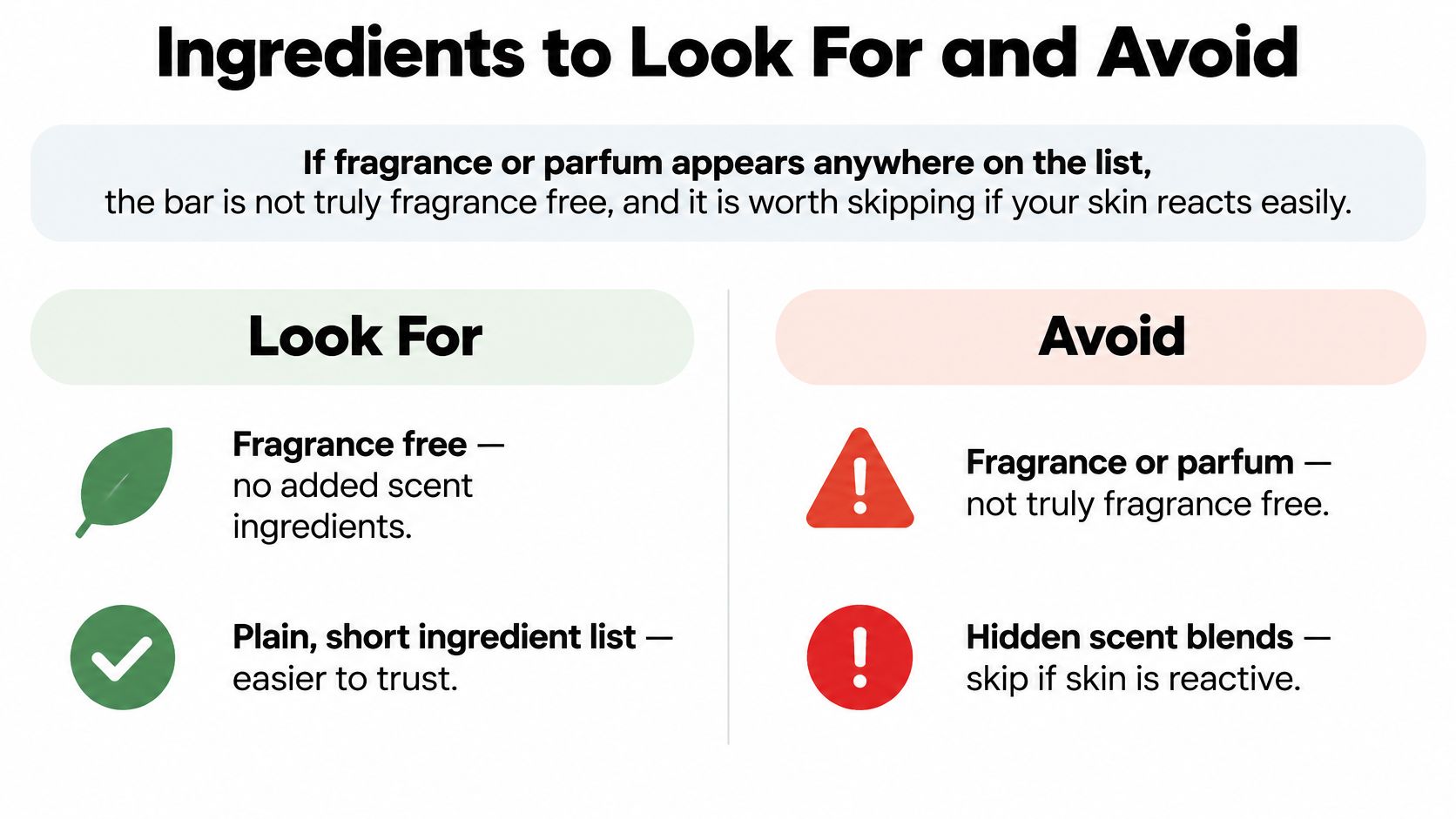
Read the list by job, not by vibe
| Ingredient | Why It Matters | What to Do |
|---|---|---|
| Fragrance or parfum | Blanket term that can hide dozens of aroma chemicals | Avoid if your skin is sensitive or reactive |
| Essential oils such as lavender or citrus | Plant-derived, and still a frequent skin sensitizer | Avoid if you react to botanicals |
| Masking agents and botanical extracts | Can cover odor while adding aromatic material | Ask what the extract is doing in the formula |
| Isothiazolinone preservatives | Known contact allergens | Avoid when they arrive as the new hero ingredient |
| Cocamidopropyl betaine | Mild surfactant that some people still react to | Patch test if you have a history of reactions |
| Glycerin, shea butter, ceramides | Humectants and barrier-supporting lipids | Look for these on the list |
| Traditional soap at high pH | Alkaline enough to disrupt the barrier | Choose a syndet if your skin is reactive |
Start at the bottom of the list, where scent usually hides. Fragrance or parfum can stand in for a whole blend, and nothing forces the maker to itemize it. Essential oils such as lavender or citrus come from plants and still count as scent. Masking agents and botanical extracts can leave a bar smelling of nothing while aromatic material stays in the formula, so ask what job a plant extract is doing before you treat it as a selling point.
One pass through those three categories rules out most of the risk.
A review in Contact Dermatitis treats fragrance and preservative chemicals as recognized causes of allergic contact dermatitis. Swapping a debated preservative for a "clean" stand-in can bring in isothiazolinones, which belong on your avoid list when they show up as the replacement. Cocamidopropyl betaine is a milder surfactant, and some people still react to it, so a history of surfactant reactions means a patch test, not a guess.
Alkaline soap versus a milder syndet
The surfactant and the pH number decide how gentle the wash feels, and fragrance has nothing to do with either. A review of cleansers for sensitive and eczema-prone skin reports that traditional soap commonly sits around pH 10.2, high enough to disrupt the stratum corneum, remove intercellular lipids, and increase barrier impairment, while syndet cleansers built with mild nonionic or amphoteric surfactants, such as alkyl polyglucosides or cocamidopropyl betaine, at about pH 5.0 to 5.5, sit closer to skin's acidity and are tied to less lipid and protein loss.
A fragrance free traditional bar can still leave your skin tight. When a maker shares the specs, look for a soap-free or syndet system, a pH near 5 to 5.5, and humectants or barrier lipids such as glycerin, shea butter, or ceramides.
That pH gap matters more on skin that stays damp and folded. Cleansing with the vulvovaginal microbiome in mind walks through why an alkaline wash and a mildly acidic one are not interchangeable. The same habit carries over to hair. An unscented shampoo for a sensitive scalp still needs a full ingredient read, because "unscented" on a bottle is a claim you have to check against the list.
If you want the leave-on step to match, Finally All Natural's Skincare Starter Kit is worth running through the same list check before you buy.
How to Read Labels and Certifications
A soap wrapper can say "pure" and "gentle" in large type and still list parfum in the small type. The back panel is where the ingredients have to be named, so start there and treat the front as a claim to test. Certifications work the same way: useful when you know their scope, misleading when you treat them as a fragrance-free stamp.
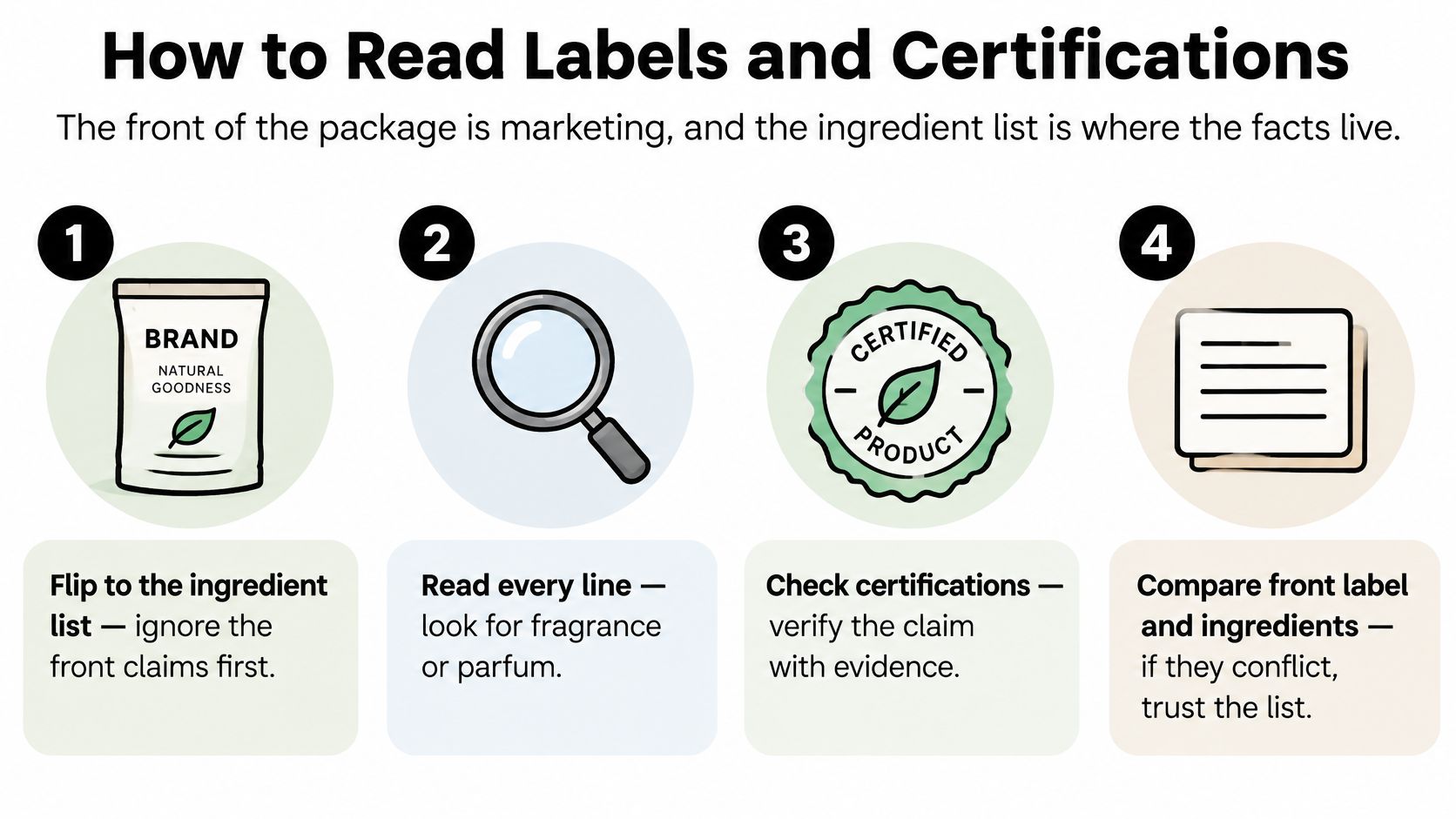
The scent scan gets you to the starting line. These four checks decide whether the label holds up.
- Read the full list for what hides behind "aroma." Masking fragrance, aroma, and botanicals with no clear job can sit in a bar that smells like nothing. If a plant extract appears with no purpose beyond scent, ask the maker what it does.
- Check what a seal covers. Organic, vegan, and third-party marks describe sourcing or a test protocol. They do not certify fragrance free status. Cross-check the mark against the claim on the front; a vegan seal can sit on a bar scented with essential oils. If plant-based sourcing matters to you, how to choose vegan skincare explains what those labels cover, and it still does not replace the ingredient list.
- Put the exclusions in writing. Ask for the full ingredient list and a plain sentence confirming that no fragrance materials, including masking agents, are added. A saved reply from the maker is stronger than a product page that can change after you buy.
- Keep the category claim separate from the scent claim. A bar sold only as soap and a cleanser that promises to treat a skin condition are regulated differently. The scent claim can be true while the category claim is doing something else, so read both.
A market analysis cited in FDA guidance on fragrances in cosmetics found fragrance-related allergens in 45% of products labeled fragrance-free. That result is why a written answer and a full list carry more weight than a short front label. One listed word can cover a blend, and a blend is exactly what a sensitive-skin shopper is trying to catch.
A clean list narrows the field. The formula still has to suit your skin. A listing that already states the absence of masking agents, such as this fragrance free liquid hand soap, is easier to verify than one that only says "gentle."
Finding and Verifying Local Fragrance Free Soap Makers
A local bar gives you something a national bottle cannot: a person who knows the batch. The useful test is not whether the maker says "fragrance free." It is whether their answers match the label when you ask about unscented, ingredients, and shared equipment.

What the seller calls soap is not always the regulatory category. Under the FDA interpretation referenced by the Consumer Product Safety Commission, a true soap is mainly alkali salts of fatty acids: the compounds formed when fats or oils react with an alkali such as lye. Those compounds have to do the cleaning, and the item has to be labeled and marketed only as soap. If synthetic detergents do the cleaning, or the product claims to moisturize, deodorize, treat skin conditions, or kill germs, it may be regulated as a cosmetic or a drug instead.
Questions that beat the wrapper
Ask these four before you trust the front label.
- Is this a true soap or a cosmetic cleanser? Ask it outright, then check that the label and the claims match the answer. A bar that "treats eczema" is making a different claim from one that only says soap.
- Can you share the full ingredient list, with names? A fragrance free claim without names is a slogan. You want every oil, every preservative, and a clear no on fragrance materials. Ask what "unscented" means here: no added scent, or a masking fragrance used to cover the base oils.
- Do you make scented batches in the same space? Cross-contact is a real issue if essential oils are poured nearby. Ask how tools, molds, and curing racks are kept apart, and whether the maker cleans between batches.
- Which preservative do you use, and what is the pH? A liquid needs a preservative answer. A bar needs a pH or a straight "this is alkaline true soap" answer. Vague "all natural" is not either of those.
Buying direct from the maker shortens the chain between the answer and the person who poured the batch. You can ask for the ingredient list, the scent policy, and the cleaning routine for molds in one conversation, then compare those answers with the listing before you buy.
Loyaltie is a marketplace where people buy directly from independent brands in the US. A listing that gives you a start is the Activated Charcoal Soap Bar from Cottonwood Soap Company, a 4.5 oz artisan bar described as an unscented, fragrance free cleanse for oily, acne-prone skin. The listing gives you the product type and size, not the batch details. Use it as a starting point, then put the same four questions to the maker before you order.
Caring for Your Bar Without Irritation
A bar can be perfectly clean on paper and still leave your hands tight and itchy if you treat it like a bottle of body wash. True soap is alkaline by nature, and how you use it decides whether that alkalinity sits on your skin or rinses away.
Patch test on a single site first. Lather a small spot on the inner forearm or behind the ear and keep it as the only test site for two to three days. Calm skin there gives you the go-ahead for the rest of your body. Redness or itch means the bar stays out of rotation.
Let the bar dry, and respect cure time. Handmade bars need air between uses. If the maker names a cure window, wait it out. A soft, waterlogged bar is a different product from the one you bought: it dissolves faster and leaves more residue behind.
Build lather in your hands before it touches your body. Rinse with lukewarm water. Rubbing the bar straight across one spot delivers a heavier dose of cleanser than a worked-up lather does, and hot water strips lipids that the bar never replaced.
Pat dry and moisturize while skin is still damp. You have a couple of minutes before the tight feeling sets in. A plain oil or balm on damp skin holds water in better than a heavy cream on skin that has already dried.
Store it on a draining dish, clear of the spray. A bar sitting in a puddle dissolves early and turns mushy enough to leave a film on your skin.
Use it within the maker's window. Handmade bars soften as they age, and old bars can smell stale even with no fragrance added. If a use-by stretch is printed, follow it instead of fishing a tired bar out of the back of the shower.
The one thing that overrides all of this is a reaction that starts small and spreads. That is your signal to stop and see a dermatologist, and to bring the full ingredient list with you. Skin does not build tolerance to a cleanser it dislikes; a growing patch is information, not something to push through.
Choose Your First Fragrance Free Bar
If your skin is sensitive, choose a fragrance free bar with a short ingredient list, no fragrance or essential oils, and a maker who answers plain questions. A pH or syndet note helps if the maker shares one, but the ingredient list and the maker's written answer carry more weight than a front-label claim.
Ask these before you buy:
- Does the list contain fragrance, parfum, or essential oils? If yes, it's not your bar.
- Has the maker confirmed in writing that no fragrance materials are used? A verbal "it's clean" doesn't count.
- Is it labeled as soap, and do the claims match? Treatment claims change the category.
- Have you patch tested it for several days? New-to-you is still new-to-you.
Unscented can hide more than fragrance free. Some bars use a masking fragrance to cover the base oils, and an essential oil can add scent without the word "fragrance" on the front. Ask the maker to name every fragrance material in the formula, including essential oils. A reply that says "it's natural" is not an answer. A reply that lists the materials, or confirms none are used, is the one you can act on.
What the shelf costs
| Product | Format | Listed price | Year and source |
|---|---|---|---|
| The Unscented Company body soap | 500 ml bottle | $18.57 | 2025, iHerb |
| Everyone Unscented 3-in-1 Soap | 32 fl oz bottle | $14.99 | 2024, Sprouts Farmers Market |
| Kirk's Fragrance Free Castile Bar Soap | Single bar | $2.69 | 2025, Kirk's Soap |
| Dove Beauty Sensitive Skin fragrance-free bar | 8-bar pack | $8.52 | 2025, CamelCamelCamel Amazon price |
Before you compare those stickers, convert each listing to cost per bar or per ounce. The Dove pack's per-bar cost is lower than Kirk's single-bar price, so a bigger pack is not always the bigger spend. Run that math from the table rows, then start with one bar, note how your skin responds over two weeks, and reorder from the maker you trust.
The marketplace at Loyaltie lets shoppers discover and buy directly from nearby independent makers, growers, and producers. You can ask for the ingredient list, get a plain answer about fragrance materials, and reorder the bar once your skin has weighed in. Start with one fragrance free bar you can verify.