
Sustainable agriculture isn't a vague promise printed on a label. It's something you can see in healthier soil, more careful water use, crop diversity, targeted inputs, and the relationship between a producer and the people buying the finished product. The most useful examples of sustainable agriculture connect those visible choices to a farm's ability to stay productive and earn a living.
That matters whether you're growing food or choosing coffee, wellness products, skincare, supplements, pet products, and other everyday goods. Sustainable agriculture now has a measurable place in global food systems. Certified organic farming covered 78 million hectares under certified organic status or in conversion in 2022, according to FAO's global agricultural reporting. The scale doesn't prove that every organic product is automatically better, but it does show that sustainability has moved beyond a niche label.
The eight examples below move from field practices to the direct-sales systems that help independent US producers make those practices viable. For each one, you'll find a practical scenario, implementation ideas, trade-offs, buyer questions, and ways to explain the resulting product without making unsupported claims about taste, nutrition, or price. If you're starting with your own garden, green gardening methods for beginners can help translate the same principles into a smaller space.
Table of Contents
1. Regenerative Agriculture and Soil Health
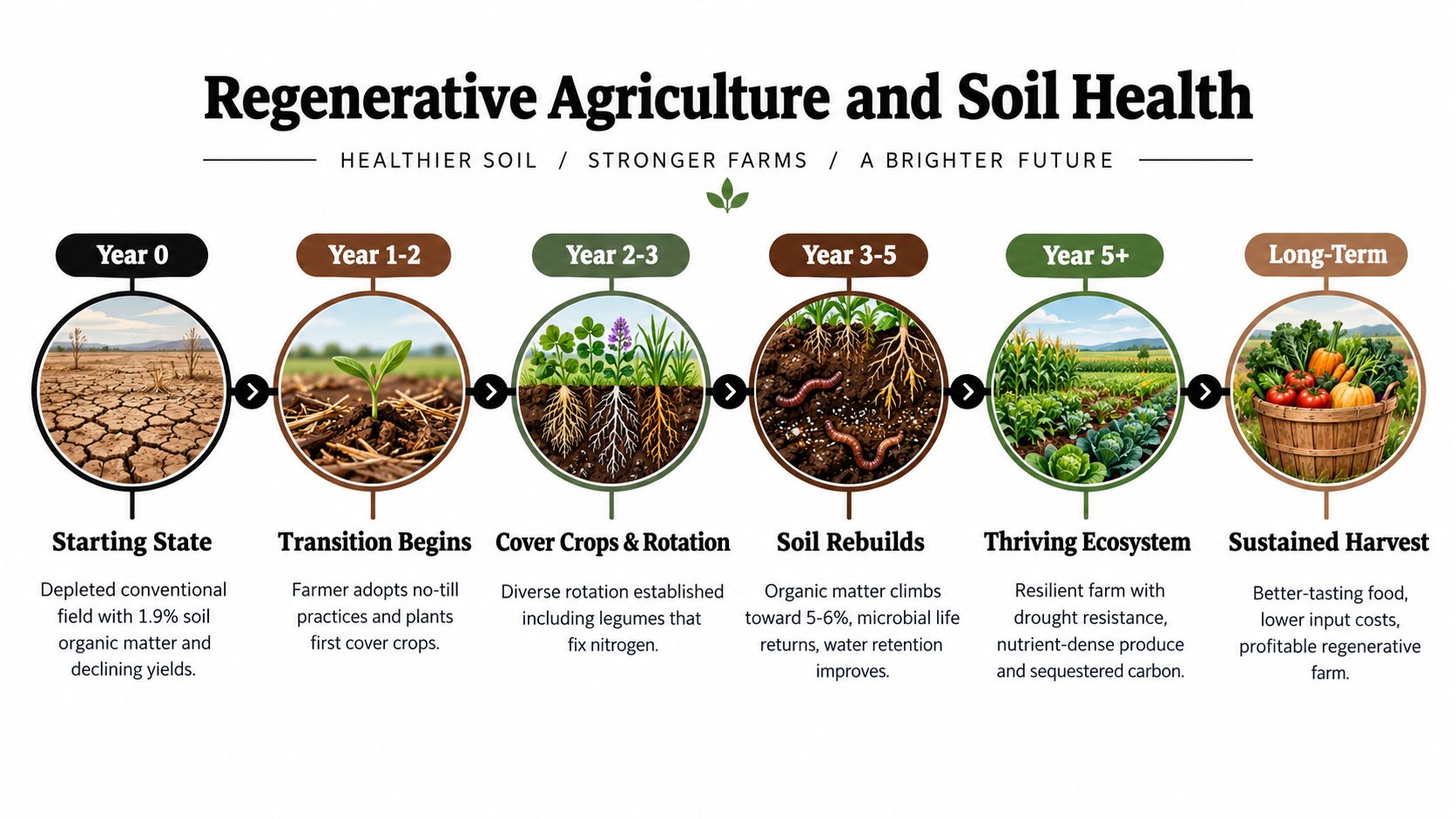
Regenerative agriculture starts with a simple shift in priorities. Instead of treating soil as an inert growing medium, farmers manage it as a living system through cover crops, crop rotation, compost, grazing decisions, and minimal soil disturbance.
The approach has practical appeal, but it isn't a magic label. USDA describes regenerative agriculture as a collection of practices focused on rebuilding soil health and the wider farm ecosystem, including cover cropping, rotation, low- to no-till, composting, and avoiding persistent chemical pesticides and fertilizers in the relevant system. The exact mix depends on the crop, climate, equipment, and farm finances.
What producers can measure
A producer testing regenerative methods should begin with a manageable area, such as one field or a defined group of beds. Track cover-crop establishment, soil structure, water infiltration, weed pressure, input use, yields, and labor. Soil organic carbon is useful, but it shouldn't be the only measure. A credible program may also track restored habitat share and blue water withdrawal, as shown in the WBCSD outcome-based metrics framework.
That framework reported an 18% improvement in water productivity, a 9% increase in yields, and a 20% rise in farmer revenue within the first two years of a multi-country program. Those results belong to that program, not to every regenerative farm, so producers should avoid turning them into a universal promise.
Practical rule: Describe the practice before using the label. “We plant a winter cover crop and leave crop residue on the soil” gives buyers something they can understand and verify.
Buyers can ask what “regenerative” means on a particular farm. Look for field updates, rotation notes, cover-crop photos, and clear explanations of what the farmer is still testing. A grain, tea, or baked product such as Einkorn Tea Biscuits becomes easier to evaluate when the maker explains the ingredient's farm practices instead of relying on a broad claim.
2. Crop Rotation and Polyculture Systems
A field planted with the same crop repeatedly asks the soil, pest-management plan, and farm budget to solve the same problem over and over. Crop rotation changes the sequence. Polyculture changes the field at the same time by combining different crops or varieties.
The classic Three Sisters system, corn, beans, and squash, shows why diversity can be practical. Corn provides vertical structure, beans use that structure, and squash covers ground. Modern producers might rotate legumes, brassicas, grains, and root crops across seasons rather than growing them together, especially when harvesting equipment or market demand makes mixed planting difficult.
How the system works
Different roots explore different soil layers. Legumes can contribute nitrogen through biological fixation, while crop changes interrupt some pest and disease cycles. Diverse plantings can also spread production risk, but they require stronger planning. A mixed field may complicate cultivation, harvesting, storage, and labeling. Rotation can reduce certain problems without eliminating them, and crop diversity won't rescue a farm with weak drainage, poor timing, or no reliable market.
For producers, start with a rotation that matches what customers buy. A vegetable farm might alternate a heavy-feeding crop with a legume cover, then follow it with a crop from a different plant family. Keep records of planting dates, disease pressure, harvest volume, and bed performance. If polyculture is too complex for the whole farm, trial it in a defined area and sell the harvest as a seasonal product.
Buyers can ask whether a farm changes its crops from season to season, grows several crop families, or uses companion planting. A CSA box with rotating seasonal crops may reflect a more diverse production plan, but the box alone doesn't prove how the farm manages its fields. Ask directly, then share the answer when recommending the producer to friends or posting about the product.
For an independent maker, the strongest marketing language connects diversity to the product's origin. “Our beans come from a rotation that includes cover crops and vegetables” is more useful than “farm fresh.” It gives buyers a reason to choose the product without promising an outcome the farm hasn't measured.
3. Organic and Chemical-Free Farming
Organic farming is one of the clearest recognizable models because certification creates defined rules. The term “chemical-free,” however, needs care. Everything in agriculture involves chemistry, so a producer should explain which synthetic inputs are restricted, which approved materials are used, and whether the farm is certified.
Organic systems commonly combine compost, crop rotation, mechanical or cultural weed control, and biological pest management. Certification can support traceability and market differentiation, but it also brings recordkeeping, inspection, fees, and compliance work. A farm may use careful soil and pest practices without holding certification, while a certified operation still needs to explain its specific methods if buyers want more detail.
Buying with a real budget
You don't need to turn every purchase into a purity test. Ask what matters most for your household, then compare the options available in your region. Seasonal produce may be easier for a local organic farm to supply than off-season items. For shelf-stable goods such as coffee, grains, and supplements, direct purchasing lets you read the maker's sourcing information and ask questions about certification and ingredients.
If coffee is part of your daily routine, start by learning how roast style, processing, and origin affect the cup through this guide to different coffee types from Cartograph. Then ask the roaster whether the beans are certified organic, sourced from a particular farm or cooperative, or purchased under another documented standard. Those are different claims and shouldn't be blended together.
Organic certification doesn't automatically establish better taste, nutrition, or affordability. Buyers should also consider freshness, storage, processing, formulation, and the maker's transparency. For skincare, look at the complete ingredient list and the producer's explanation of each agricultural claim. For pet food and supplements, ask about ingredient sourcing and testing rather than assuming the word organic answers every quality question.
Independent brands can make the story concrete by showing certification details, farm names, harvest information, and production notes. Avoid saying “clean” without defining it. Buyers respond better when a maker explains what the product contains, what it leaves out, and where the limits of the claim sit.
4. Precision Agriculture and Data-Driven Farming
Precision agriculture makes sustainability less about applying the same treatment everywhere and more about matching an action to a specific field condition. GPS guidance, soil sensors, satellite imagery, drones, yield records, and variable-rate equipment can help a producer decide where water, fertilizer, or crop protection is needed.
A mid-size grain farm might divide a field into management zones and vary applications rather than treating every acre identically. A vegetable grower might use drone imagery to identify stressed areas for in-person scouting. A fruit producer can use soil-moisture sensors to adjust irrigation around the root zone instead of relying only on a fixed schedule.
Data needs a decision behind it
Technology doesn't make a farm sustainable by itself. Sensors need calibration, data needs interpretation, and a targeted application can still be poorly timed or unnecessary. Equipment costs, connectivity, training, and maintenance can also put these tools out of reach for some independent producers.
A sensible first step is to choose one costly or waste-prone decision. A grower might monitor irrigation in one orchard block, map weeds before a treatment, or compare variable-rate fertilizer with a standard application. Record the decision, the input used, the crop response, and the labor involved. That evidence is more valuable than merely listing a drone or sensor on a product page.
Here's a visual explanation of how data tools can support farm decisions:
Producers can explain the process in buyer-friendly language: “We use soil-moisture readings to decide when this block needs irrigation” is clear. “Our farm uses smart technology” isn't. If the farm has a field map, scouting note, or seasonal update, share it with permission and remove details that create security concerns.
Buyers should ask what the data changes. A producer using precision tools should be able to describe the resource being managed, the problem being addressed, and what happens when the data indicates no action is needed. For broader background on aerial tools, see this overview of drone solutions for Australian agriculture, while remembering that local conditions determine whether a particular tool makes sense.
5. Agroforestry and Perennial Systems
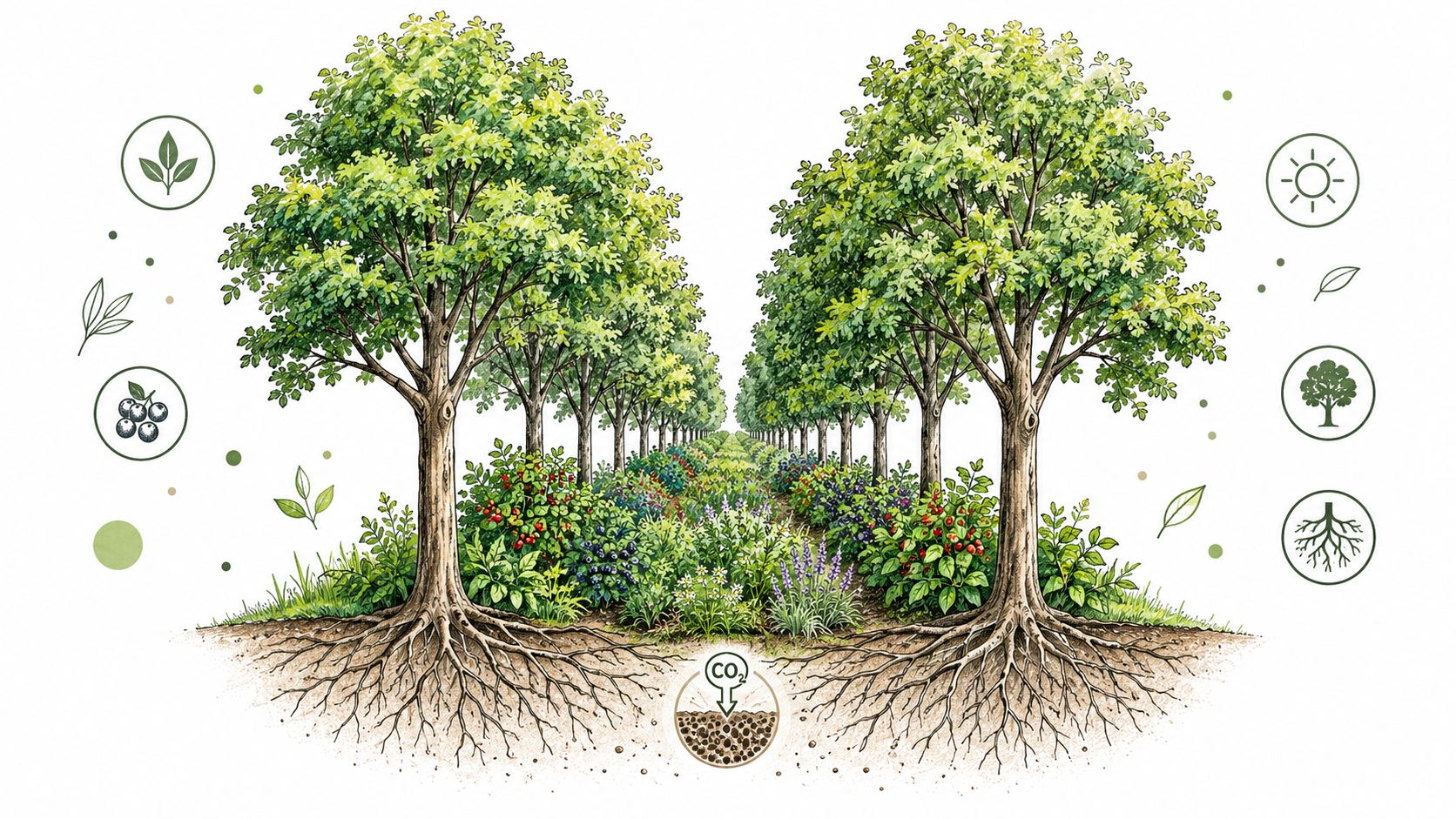
Agroforestry brings trees into farming rather than separating forestry from agriculture. A producer might grow nuts beneath managed pasture, establish berries along tree rows, raise livestock among trees, or cultivate mushrooms and medicinal plants in a forest setting. Perennial systems add plants that don't need to be replanted every season.
The model creates a longer planning horizon. Trees take time to establish, shade changes across the farm, equipment routes need redesigning, and harvests may arrive at different times. A producer also has to manage competition for water and light. Those constraints make agroforestry a poor fit for every crop, but they can create valuable diversification where the site and market support it.
The product story starts in the landscape
Shade-grown coffee, cacao, nuts, fruit, honey, forest-grown mushrooms, and understory crops can all carry a place-based story. That story should identify the actual relationship between trees and production. “Grown beneath native trees” is more informative than “nature-friendly,” especially when a producer can show the planting design or describe how the understory is managed.
A nut orchard integrating grazing may earn from more than one enterprise, but livestock introduces fencing, animal-health, and timing requirements. A forest farm may protect an existing canopy while producing high-value crops, yet harvesting and transport can be labor-intensive. These trade-offs belong in the explanation. Honest detail helps buyers distinguish a genuine system from packaging that borrows the language of forests.
Buyers can look for shade-grown or forest-farmed claims supported by location, producer notes, and certification where relevant. Ask whether the trees were preserved, planted, or managed as part of the farm, and whether the product comes from the described site. For local US producers, nuts, berries, honey, and orchard products may be easier to source directly than tropical crops, while independent roasters can provide more specific information about overseas agroforestry systems.
Marketing works best when it starts with the product people want. Lead with the coffee, honey, nut butter, or fruit, then show how the trees shape the production system. That order keeps sustainability connected to a real purchase rather than turning it into an abstract badge.
6. Water Conservation and Efficient Irrigation
Efficient irrigation puts water where crops can use it and gives farmers a way to adjust decisions as conditions change. Drip lines, rainwater storage, soil-moisture monitoring, scheduling, mulches, and carefully selected crop varieties can all play a role.
The right system depends on soil, crop, slope, climate, water rights, and infrastructure. Drip irrigation may reduce evaporation and wetting between rows, but it still requires filtration, maintenance, pressure management, and replacement parts. Rainwater harvesting can help a small grower, but storage capacity and local regulations determine how useful it is. A water-saving device won't compensate for leaks, poor timing, or a crop that doesn't fit the site.
Start where the waste is easiest to see
A producer can trial drip irrigation on one block, install a moisture sensor in a representative bed, or audit the irrigation system for leaks before buying new equipment. Record irrigation timing, weather, soil readings, crop condition, and harvest results. These notes help distinguish a real improvement from a system that just looks technical.
FAO identifies water use as one dimension within its broader sustainable agriculture measurement framework, alongside soil health, biodiversity, resilience, profitability, and other factors. That matters because water efficiency is not the only test. A crop can use water carefully and still create economic or ecological problems elsewhere.
Buyers can ask where the crop is grown, how the producer decides when to irrigate, and whether the farm measures moisture or relies on a fixed schedule. If you grow houseplants, a simple product such as a slow-drip plant waterer can make the same principle visible at home, though household watering isn't a substitute for farm-level water management.
For marketing, lead with reliability and care, not a sweeping claim that the product “saves water.” Explain the specific decision: “We irrigate according to soil moisture in the orchard's root zone.” Add photos of the system, seasonal updates, and a candid note about what the farm is still improving.
7. Integrated Pest Management
Integrated Pest Management, or IPM, replaces routine blanket spraying with observation and a sequence of increasingly targeted responses. Farmers scout crops, identify the pest accurately, protect beneficial insects, manage habitat, and intervene when the threat justifies it.
An apple grower may use mating disruption to interfere with a pest's reproduction rather than applying a broad-spectrum insecticide across the orchard. A vegetable producer may release parasitic wasps against aphids, while a berry grower may manage flowering habitat that supports beneficial insects. Cotton and corn producers can use scouting programs to reduce unnecessary applications.
Monitor first, act second
IPM isn't the same as never using a pesticide. A targeted treatment can be the responsible choice when a crop faces a serious threat, especially if the producer chooses a material, rate, timing, and application method carefully. The trade-off is management intensity. Scouting takes time, identification requires knowledge, and biological controls can be affected by weather, crop stage, and surrounding land use.
A producer can make the approach visible through a simple field log:
- Scout consistently: Record crop stage, pest identity, location, and severity.
- Protect helpful organisms: Maintain habitat and avoid unnecessary broad-spectrum treatments.
- Set an action threshold: Decide in advance what level of damage warrants intervention.
- Review the result: Note whether the treatment worked and what changed afterward.
Buyers should ask, “How do you decide when to spray?” That question reveals more than “Do you use chemicals?” A serious IPM producer can explain monitoring, thresholds, beneficial organisms, and targeted responses without pretending pests never appear.
Marketing should avoid “pesticide-free” unless the claim is accurate for the entire production and handling process. Instead, describe the management system and connect it to the product people are choosing. An independent berry producer might share a weekly scouting update, while a skincare maker can explain which farm-level ingredients come from IPM-managed crops and which claims apply only to the finished formulation.
8. Direct-to-Consumer and Local Food Systems
A sustainable field practice still needs a viable route to the buyer. Direct-to-consumer sales, farmers markets, farm stores, local ordering, regular delivery, and producer-led online shops can give independent growers and makers more control over how they explain a product and earn from it.
This is different from a field practice. Direct sales don't automatically mean a farm uses regenerative methods, organic certification, efficient irrigation, or IPM. They create the relationship that lets a producer show those methods, answer questions, test demand, and build a product around what the farm can supply.
Make the relationship part of the product
A local meat producer may sell through a farm store and explain feed, animal care, processing, and pickup dates. An independent coffee roaster can sell online while naming the origin, roast approach, and shipping schedule. A wellness maker can publish ingredient sourcing and production notes instead of asking buyers to accept a vague “natural” claim.
Direct sales have trade-offs. Producers handle customer service, packing, delivery, refunds, inventory, and marketing. Buyers may need to work around seasonal availability, pickup windows, or limited quantities. Those constraints aren't flaws, but sellers should make them easy to understand.
For buyers, start with the producer, not the reseller:
- Ask who made it: Confirm whether the seller grows, produces, roasts, or formulates the item.
- Check the practice: Ask what sustainable method is used.
- Understand availability: Learn what's seasonal, made to order, or available for regular delivery.
- Buy with context: Read harvest notes, ingredient details, and pickup instructions before ordering.
Platforms such as Loyaltie help connect local makers directly with buyers while keeping online ordering convenient. Sellers can use clear photos, producer profiles, and plain-language practice descriptions to turn sustainability into a reason to choose a product, not a vague promise attached after the fact.
9. Urban and Community-Based Agriculture
Urban agriculture brings production closer to the people who buy it. Community gardens, rooftop growing, city farms, microgreen operations, neighborhood pickup points, and local ordering can all shorten the distance between cultivation and consumption.
These systems work within real constraints. Space is limited, leases can change, water access may be complicated, and distribution can take as much planning as growing. A rooftop grower may have excellent proximity but limited crop range. A community garden may produce meaningful neighborhood value without operating as a conventional commercial farm. Buyers should understand what each producer grows, where it grows, and how orders reach them.
Match the crop to the place
Urban producers should begin with crops that suit the available light, growing medium, water system, labor, and local demand. Microgreens, herbs, salad crops, seedlings, and specialty greens can fit compact spaces, but the producer still needs a reliable harvest schedule and a clear food-safety process.
For a seller, proximity becomes valuable when the details are visible. Show the growing area, name the harvest window, explain the growing method, and publish pickup or delivery instructions. A focused range is often easier to manage than a long catalog of crops that the site can't consistently supply.
Buyers can look for a fresh microgreens variety box and then ask practical questions about harvest timing, growing location, packaging, and delivery. "Local" should identify a real place and route, not merely suggest that the brand operates somewhere nearby.
Urban systems also show why production and sales models need separate evaluation. A rooftop farm may use efficient irrigation but sell through a wholesale distributor. A community grower may sell directly but have limited capacity. The best buyer experience comes from matching the product, practice, and fulfillment method accurately.
9-Point Sustainable Agriculture Comparison
| Practice | Implementation Complexity 🔄 | Resource Requirements & Cost 💡 | Speed / Efficiency ⚡ | Expected Outcomes ⭐📊 |
|---|---|---|---|---|
| Regenerative Agriculture and Soil Health | Moderate–High; multi-year planning and management 🔄 | Moderate upfront (cover-crop seed, equipment); lower inputs over time 💡 | Slow to medium; measurable gains in 3–5 years ⚡ | Improved soil organic matter, resilience, nutrient-dense crops ⭐ |
| Crop Rotation & Polyculture Systems | Moderate; requires crop planning and sequencing 🔄 | Low–Medium; diverse seed mix and planning, minimal tech 💡 | Medium; benefits accrue each season ⚡ | Fewer pests, reduced fertilizer need, more stable yields ⭐ |
| Organic & Chemical‑Free Farming | Moderate–High; certification and strict practices 🔄 | Higher labor and certification costs; compost/manure inputs 💡 | Medium; yields often 10–25% lower but consistent practices ⚡ | Low chemical residues, pollinator/soil benefits, verified label ⭐ |
| Precision Agriculture & Data‑Driven Farming | High; tech integration, training, data workflows 🔄 | High upfront (sensors, drones, VRT, ~$50k+); ongoing data costs 💡 | High efficiency; cuts inputs and improves targeting ⚡ | Increased yields, reduced inputs, timely interventions ⭐ |
| Agroforestry & Perennial Systems | High; long-term design and species planning 🔄 | Medium–High; land use changes, tree establishment costs 💡 | Slow; establishment often 3–10+ years before full returns ⚡ | Long-term carbon storage, diversified income, resilient systems ⭐ |
| Water Conservation & Efficient Irrigation | Medium; system design and maintenance required 🔄 | High initial infrastructure (drip, tanks, sensors); maintenance costs 💡 | High; can reduce water use 30–60% and improve water use efficiency ⚡ | Lower water use/costs, better plant health, drought resilience ⭐ |
| Integrated Pest Management (IPM) | Moderate; monitoring and decision-making routines 🔄 | Low–Medium; scouting, traps, beneficial releases, habitat management 💡 | Medium; reduces pesticide use substantially with targeted actions ⚡ | 50–80% pesticide reduction, preserved beneficials, lower residues ⭐ |
| Direct‑to‑Consumer & Local Food Systems | Low–Medium; sales/logistics setup and customer relationships 🔄 | Low–Medium; market fees, distribution logistics, marketing 💡 | High for freshness; variable seasonality and convenience tradeoffs ⚡ | Fresher products, better farmer income, strong traceability ⭐ |
| Urban & Community‑Based Agriculture | Low–Medium; space optimization and distribution planning 🔄 | Low; intensive use of small spaces, some infrastructure (beds, rooftops) 💡 | Medium; rapid local access but limited scale ⚡ | Increased local access, community engagement, hyper-local freshness ⭐ |
How to Choose and Market Sustainable Farm Products
Buyers don't need to master every farming method before making a better purchase. Start by asking what the producer does. “Do you use cover crops?” “How do you decide when to irrigate?” and “What happens when pests reach a damaging level?” invite specific answers. A producer who can explain the practice, its limits, and the current season's conditions gives you more useful information than a product page filled with broad sustainability language.
Separate certified claims from broader descriptions. Organic certification has defined requirements, while “regenerative,” “soil-friendly,” “local,” and “chemical-free” may mean different things from one producer to another. That doesn't make broader practices unimportant. It means you should look for the evidence behind them, such as field notes, crop rotations, ingredient sourcing, harvest updates, or a clear explanation of what the farm measures.
Seasonality matters too. A local farm may offer one crop abundantly for a short period and another later in the year. A direct-to-consumer coffee, supplement, skincare, or pet product maker may have steadier availability, but ingredients can still vary by harvest and supplier. Compare the product you want, the practice used to produce it, the availability you can live with, and the information the seller shares.
When possible, buy directly from the producer. Farmers markets, farm stores, local pickup, regular delivery, and online ordering can help you ask questions and understand the product's origin. You don't have to treat every purchase as a moral test. Choose the categories where quality, ingredients, traceability, or producer access matter most to you.
Sellers should make sustainability easy to understand:
- Lead with the product benefit: Start with the coffee, vegetables, soap, honey, supplement, or pet product buyers already want.
- Name the practice plainly: Explain cover cropping, drip irrigation, IPM, organic certification, agroforestry, or the specific method used.
- Show evidence: Share field updates, harvest notes, photos, certification details, and production dates.
- Explain trade-offs: Mention seasonal limits, changing availability, labor needs, or the parts of the system still under evaluation.
- Use direct channels: Meet buyers at farmers markets, offer regular delivery, run a farm store, or list through Loyaltie, a marketplace where people discover and buy directly from the best independent brands in the US.
The strongest sustainable agriculture story is specific, verifiable, and connected to a product people want. A buyer should be able to understand what changed in the field, why it matters, and what they're receiving. A seller should be able to make that explanation without exaggeration.
Loyaltie gives you a convenient way to discover and buy directly from independent US brands, local makers, growers, and producers across food, coffee, wellness, skincare, pet products, and more. Visit Loyaltie to find products with clearer origins and connect your everyday purchases to the people and practices behind them.