

Yes, one medium raw stalk of broccoli (148 g) has 3 g of fiber, 12% of the label Daily Value, and one cup of chopped boiled broccoli has about 5 g. The useful question isn't whether broccoli counts, but which portion you're eating.
A whole stalk, a loose handful of raw florets, and a packed cooked cup aren't interchangeable measurements. Once you separate serving size from preparation, the numbers become easier to use, whether you're planning dinner or choosing vegetables from a local grower.
Table of Contents
- Does Broccoli Have Fiber by the Serving
- How Far One Serving Gets You
- Soluble, Insoluble and Your Gut
- Fresh Frozen Steamed or Boiled Fiber
- Broccoli on the Plate This Week
- Pick a Bunch and Eat It on Purpose
Does Broccoli Have Fiber by the Serving
Yes, broccoli has dietary fiber in both its florets and its stalk. It isn't as fiber-dense as beans, lentils, or bran cereals, but it makes a meaningful contribution without needing to become the centerpiece of every meal.
The FDA's raw vegetable nutrition chart lists a medium raw stalk at 148 g, with 3 g of fiber and 12% of its label Daily Value. That portion also provides 45 calories, 8 g of total carbohydrate, 80 mg of sodium, and 460 mg of potassium.
For comparison, USDA FoodData Central's raw broccoli entry puts total fiber at approximately 2.6 g per 100 g. The Mayo Clinic high-fiber food chart lists a cup of chopped, boiled broccoli at about 156 g and 5 g of fiber.
Broccoli fiber by the portion you eat
| Serving | Weight | Total fiber | Also in that portion |
|---|---|---|---|
| Raw broccoli, per 100 g | 100 g | About 2.6 g | USDA reference amount |
| 1 medium raw stalk | 148 g | 3 g | 45 calories, 8 g carbohydrate, 460 mg potassium |
| 2 medium raw stalks | About 296 g | About 6 g | About 90 calories if the stalks match |
| 1 cup chopped, boiled | About 156 g | About 5 g | A standard cooked cup, not a huge platter |
The doubled-stalk row is simple arithmetic using matching FDA-sized stalks, not a separate measured serving. Grocery-store heads aren't all the same size, so weighing your portion is more useful than counting any random pair.
Match the measurement before comparing
Start with the row that resembles what's on your plate. Use the raw weight when you're chopping uncooked broccoli, and the cooked-cup description when you're measuring boiled, chopped pieces.
Don't assume that cooking created extra fiber because the cooked-cup figure is higher. These entries describe different portions and preparations, and the FDA and USDA figures aren't perfectly interchangeable conversions.
Practical rule: Compare like with like. A raw stalk and a cooked cup describe different servings, not competing claims about the same bite.
Fiber is built into the plant's structure. Cutting off the florets doesn't leave you with a fiber-free stem, and heating broccoli doesn't make its fiber disappear.
That's good news if you buy whole heads. You can use the tender stem instead of paying for a vegetable and throwing a substantial edible part into the compost. The important distinction is between the tough outer surface you may want to peel and the usable flesh underneath.
How Far One Serving Gets You
Broccoli helps with daily fiber intake, but your target isn't necessarily the same as someone else's. Calorie needs, age, and sex all affect the benchmark.
The Dietary Guidelines for Americans use 14 g per 1,000 calories, or about 28 g for a 2,000-calorie eating pattern, with listed age- and sex-specific targets running roughly 17 to 34 g. A common adult shorthand is 25 g for women and 38 g for men, as summarized in the fiber intake reference.
What one broccoli portion covers of a daily fiber target
| Eating pattern | Daily fiber target | One medium stalk (3 g) | One cooked cup (about 5 g) |
|---|---|---|---|
| Lowest listed age and sex group | About 17 g | 18% | 29% |
| Common target for women | 25 g | 12% | 20% |
| 2,000-calorie pattern | About 28 g | 11% | 18% |
| Common target for men | 38 g | 8% | 13% |
These percentages are rounded calculations using the serving figures and target references above. They're a way to put a portion in context, not a personalized prescription.
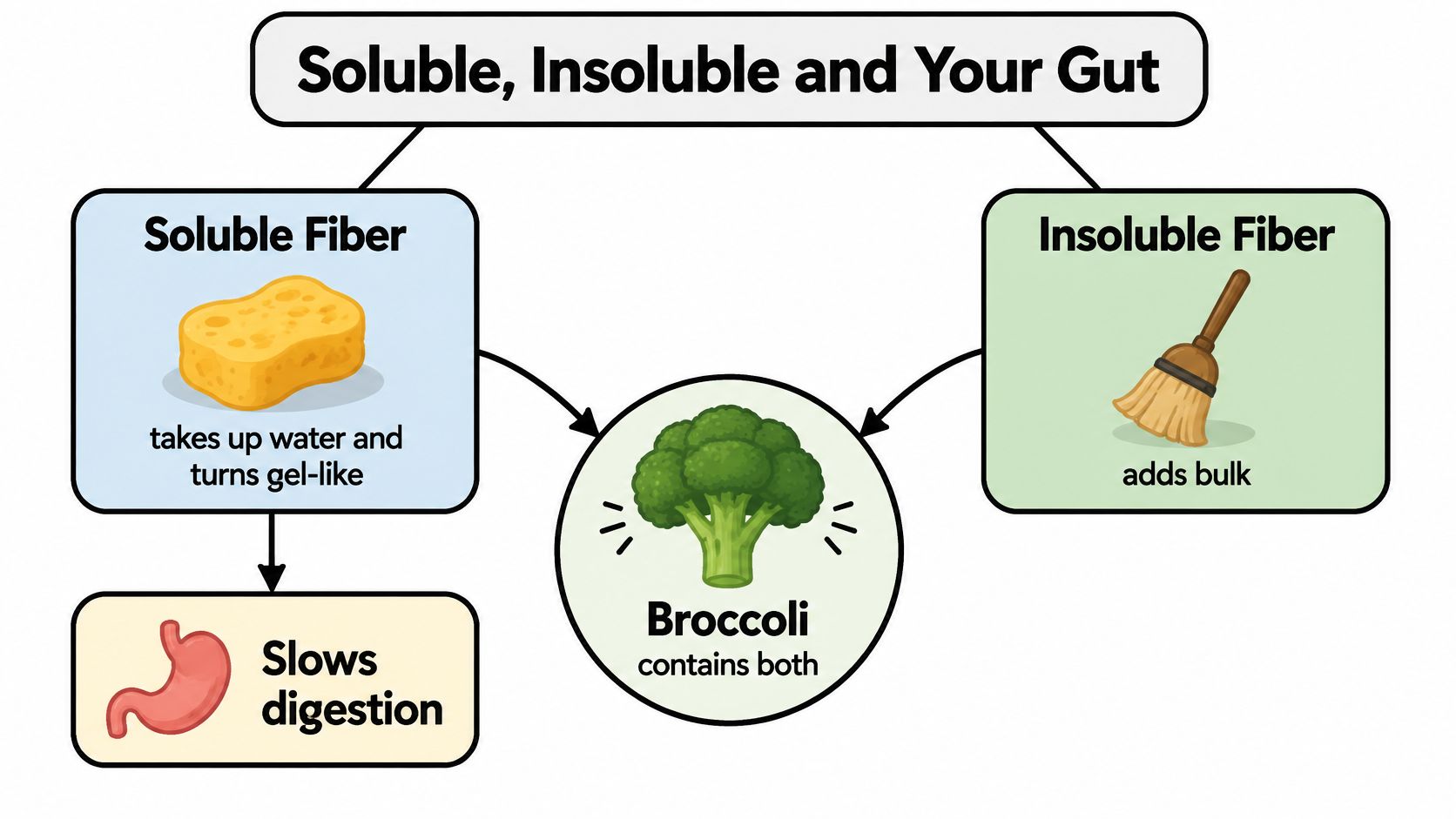
Fiber also has different jobs inside your digestive system, which this diagram separates visually.
Build a day, not a broccoli challenge
The table makes the practical limit clear: broccoli contributes, but it won't finish the day alone. Fruit, beans, whole grains, nuts, and seeds belong in the picture too.
Doubling a matched raw-stalk serving would cover about 24% of the women's shorthand target and 16% of the men's, using the same serving arithmetic. That's helpful, but eating more broccoli isn't your only option, or necessarily the most enjoyable one.
You can also compare packaged plant foods by their actual serving labels. For example, check the label on All Y'alls Foods plant-based jerky variety pack rather than assuming every plant-based snack contributes the same amount.
For a video companion, you can watch below.
If you eat more calories, the calorie-based benchmark rises; if you eat fewer, it falls. Choose the broccoli portion you'll eat, add the fiber from another plant food using its label or food entry, and notice what's still left for your other meals.
Soluble, Insoluble and Your Gut
Say you're making a broccoli bowl and wondering whether to keep the stem. That kitchen decision is a useful way to understand why total fiber doesn't tell the whole story.
Broccoli contains both soluble and insoluble fiber. Think of soluble fiber as a sponge that takes up water and becomes gel-like, and insoluble fiber as a broom that adds bulk, while remembering that neither works exactly like a household tool.
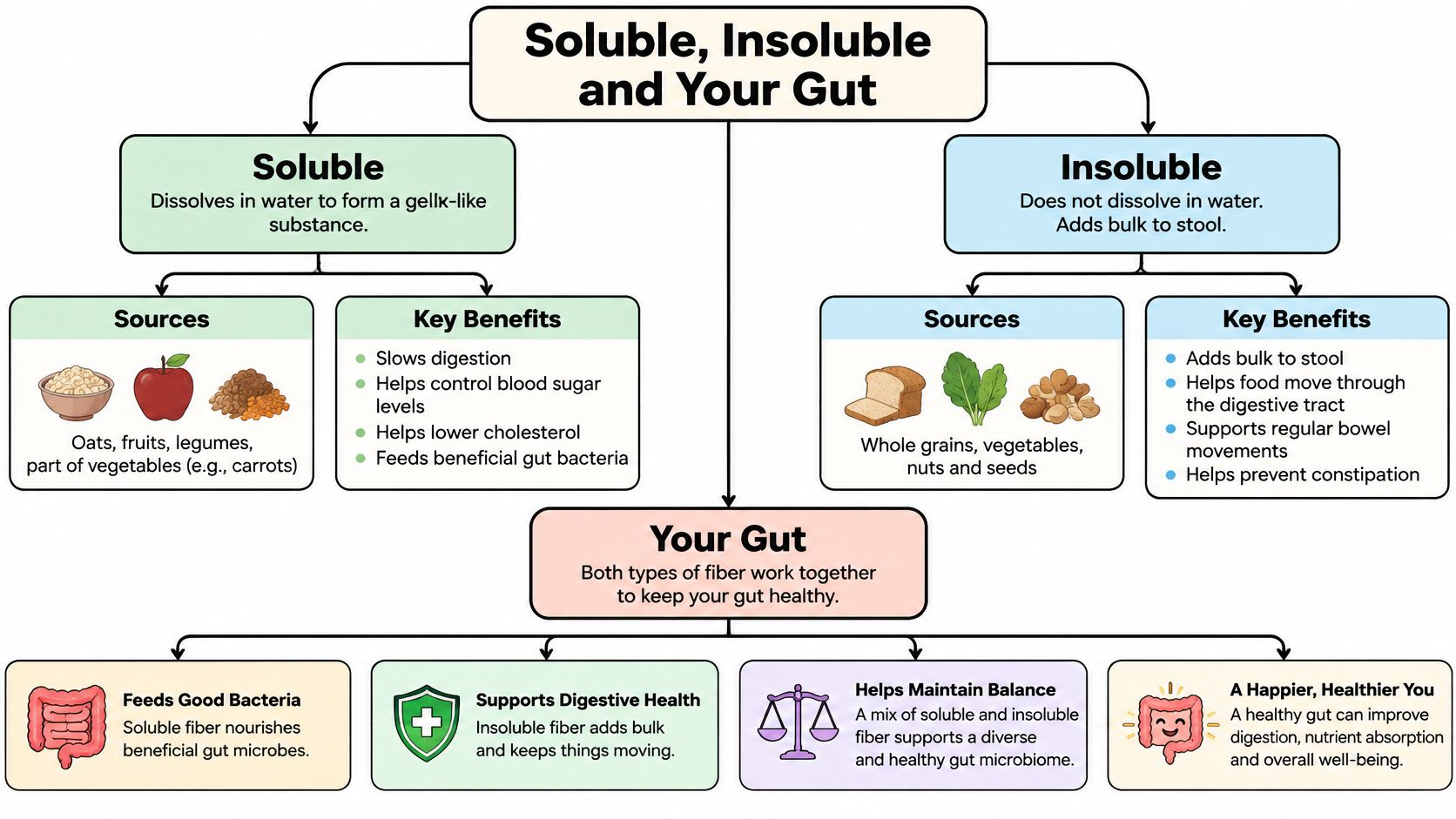
The NCBI Bookshelf clinical reference on dietary fiber describes soluble fiber's ability to slow stomach emptying and delay glucose absorption after meals, while insoluble components such as cellulose, hemicellulose, and lignin support stool bulk and intestinal transit. It identifies broccoli among soluble-fiber vegetables and broccoli stems among insoluble-fiber vegetables.
The diagram shows those complementary roles.
What happens after you eat it
Keeping the tender stem gives you a reason to think beyond florets alone. Trim the dry end, peel away stringy outer skin, and slice the interior into pieces that cook alongside the florets.
Soluble fiber is associated with fullness and provides material that gut microbes can use. Insoluble fiber is more directly associated with adding bulk, so describing all fiber as having a single job misses an important distinction.
A review of broccoli and gut health describes how undigested carbohydrates reach the colon, where microbial fermentation can produce short-chain fatty acids, and how microbes can transform broccoli's glucosinolates into other biologically active compounds. Those are related pathways within the same food, not evidence that broccoli acts like a medication.
Broccoli-specific microbiome outcomes are less firmly established than its basic fiber content. You can reasonably eat it as part of a varied plant-rich diet without expecting a particular change in your gut bacteria or relief from a diagnosed condition.
Broccoli supports bulk and fermentation, and it is not a gut treatment.
Let comfort set the pace
Suppose you usually eat few vegetables, then add a large raw broccoli salad at lunch. Gas or bloating doesn't mean broccoli has failed you, but it may mean that the portion or sudden change wasn't comfortable.
Try a more manageable approach:
- Start modestly. Choose a portion you tolerate rather than chasing the biggest possible fiber number.
- Keep fluids available. Drink adequately as you increase fiber instead of changing food intake while ignoring hydration.
- Try a softer texture. Cooked broccoli may feel easier to eat than firm raw florets.
- Personalize for symptoms. If you have irritable bowel syndrome, your comfortable portion may differ from someone else's.
Persistent pain, troublesome bowel changes, or a medically restricted diet call for individualized clinical advice. Don't keep pushing larger servings because a nutrition chart makes them look desirable.
Texture isn't the only difference between raw and cooked broccoli, either. Freshness, freezing, and heating can also change the mix of fiber fractions you eat, without turning any form into an empty vegetable.
Fresh Frozen Steamed or Boiled Fiber
Broccoli remains a source of fiber whether you buy it fresh or frozen, or eat it raw or cooked. The form changes more than texture: stalk versus cup, fresh versus cooked, and steaming versus boiling can affect how much broccoli you eat and the mix of fiber in a meal.
| Form | Fiber takeaway | A practical reason to choose it |
|---|---|---|
| Fresh | Provides fiber in its natural plant structure | Choose it when you want crisp florets or raw stalks |
| Frozen, then steamed | Still provides fiber after cooking | Keep it on hand for a quick cooked side |
| Steamed fresh | Still provides fiber after cooking | Use it when you prefer tender florets |
| Boiled and drained | A cooked cup lists 5.1 g of fiber in USDA FoodData Central's boiled, drained broccoli entry | Choose it when you like a softer texture |
Cooking and freezing can shift the balance between soluble and insoluble fiber. Total fiber is the overall amount; those two fractions describe different parts of it. A food entry may list total fiber without showing how much falls into each fraction.
Choose the form that fits the meal
A stalk and a cup are different ways to serve broccoli, so the fiber you get depends partly on how much you eat. A cooked cup gives you a useful portion to compare, while a raw stalk can be sliced into the same meal as crisp pieces. Preparation changes the bite and may change the fiber mix, but it doesn't make broccoli fiber-free.
Boiling and draining is still a reasonable option. Season the broccoli after draining, and choose the texture you'll enjoy eating. The best fit is the one that works in your meal, whether that means fresh florets, frozen broccoli steamed straight from the freezer, or a boiled cup.
Broccoli on the Plate This Week
Put broccoli into a meal you already make. A cooked cup is an approachable default, but there's no need to force down a huge raw pile to make dinner worthwhile.
The easiest way to add variety is to change the plate around it, rather than preparing a separate vegetable project every night.
Five plates worth repeating
- Weeknight stir-fry. Cut florets small and slice peeled stems into thin coins. Cook the stems first if they're firmer, then add florets and your usual sauce.
- Bean and grain bowl. Toss cooked broccoli with beans and a whole grain, then add a lemony dressing. The other plant foods contribute fiber without requiring another broccoli serving.
- Broccoli soup. Add chopped pieces toward the end of simmering so they soften without becoming dull and mushy.
- Garlic-lemon pasta. Fold bite-size broccoli through pasta with olive oil, garlic, lemon zest, and a squeeze of juice.
- Roasted vegetable tray. Include peeled stem pieces, spread everything out, and roast until the edges brown instead of steaming in a crowded pan.
For a fresh finishing layer on bowls or pasta, consider a Coastal Microgreens variety box. Treat those greens as a separate ingredient, not a gram-for-gram replacement for mature broccoli in the serving chart.
Make the portion enjoyable
Peel only the woody outside of the stalk and keep the tender center. Cut pieces to similar sizes, salt to taste, and add lemon juice or vinegar after cooking for brightness.
If boiled broccoli always seems watery, try steaming or roasting instead. Finish with nuts or seeds for crunch, and choose a preparation you'd happily eat again rather than one you merely tolerate.
Pick a Bunch and Eat It on Purpose
Choose a portion you'll finish before reaching for the biggest head on display. A whole stalk suits raw or lightly cooked meals; chopped broccoli works well when you want a tender serving.
Fresh broccoli gives you a less-processed starting point, but it's no help if it wilts before you cook it. Buy what fits the meals you already enjoy.
Buy for condition and flavor
Look for tight florets, a head that feels heavy for its size, and a cut stem that isn't dried out. Pass over yellowing clusters and limp stems when better-looking options are available.
Ask the grower or seller how they recommend storing and preparing the broccoli. Their advice can help you decide when to cook it and how to serve it.
Buying directly from a nearby maker or grower also gives you a chance to ask about freshness, handling, and what's available. Choose the bunch that fits your plans.
Buy the bunch you have a meal for, not the bunch you hope will inspire a meal later.
Keep the edible stem, serve broccoli beside food you already like, and choose a preparation that suits your appetite. A cup or a stalk can both make a satisfying serving.
Buy a bunch this week, prepare it the way you'll enjoy eating it, and count that serving toward your day.
Loyaltie is a marketplace for buying directly from nearby independent makers, growers, and producers. Browse local ingredients for your next broccoli bowl, compare what each seller offers, and choose something you'll enjoy putting on the table.