
You order a bag of coffee, a face-oil set, or a hand-thrown kitchen piece because you want something made with care, not another indistinguishable mass-produced replacement. Then the package arrives late, damaged, incomplete, or different from the listing. The seller feels accused, you feel ignored, and a simple order problem turns personal fast.
A good dispute resolution process keeps that moment from becoming a guessing game. It gives buyers and sellers a predictable way to identify the issue, share evidence, propose a fix, and escalate only when direct conversation fails. That structure matters across independent-brand marketplaces, where products may be made in small batches, shipped by the maker, or prepared to order.
Table of Contents
- Step 1, identify the issue
- Step 2, submit the dispute
- Step 3, wait for the seller's response
- Step 4, exchange evidence
- Step 5, negotiate
- Step 6, resolve or escalate
When a Marketplace Order Goes Sideways
Maya ordered a hand-thrown ceramic coffee maker from an independent ceramicist on Loyaltie. She was excited to use it for her morning pour-over, but the box arrived with a chip along the rim. Maya took photos immediately. The ceramicist saw the images and felt frustrated because the piece had left the studio intact and had been packed carefully.
Neither person was unreasonable. Maya wanted the item she paid for. The maker wanted a fair review of what happened. Their first messages, however, were rushed and emotional. That's common when a buyer sees damage or a seller feels blamed.
The calmer path is a documented sequence. Maya can report the problem, preserve the packaging, upload clear photos, and explain the outcome she wants. The seller can check packing records, shipping details, and the original listing before responding. Instead of arguing about intent, both sides work through facts and possible remedies.
Practical rule: Describe what happened before explaining who you think caused it.
In plain language, the dispute resolution process is a workflow for solving an order problem. The people involved identify the issue, notify one another, exchange evidence, negotiate a remedy, and seek neutral help if they can't agree. A useful overview of the broader legal landscape is this commercial dispute resolution framework 2026, but marketplace cases usually begin with a much simpler question: what happened to this order, and what would make it right?
For sellers building clear policies and reliable order handling, Loyaltie's seller page provides a place to manage a direct-to-buyer marketplace presence. The same practical habits apply whether the issue involves a chipped coffee maker, a delayed craft order, a missing parcel, or a product that doesn't match its description.
The Four Paths a Dispute Can Take
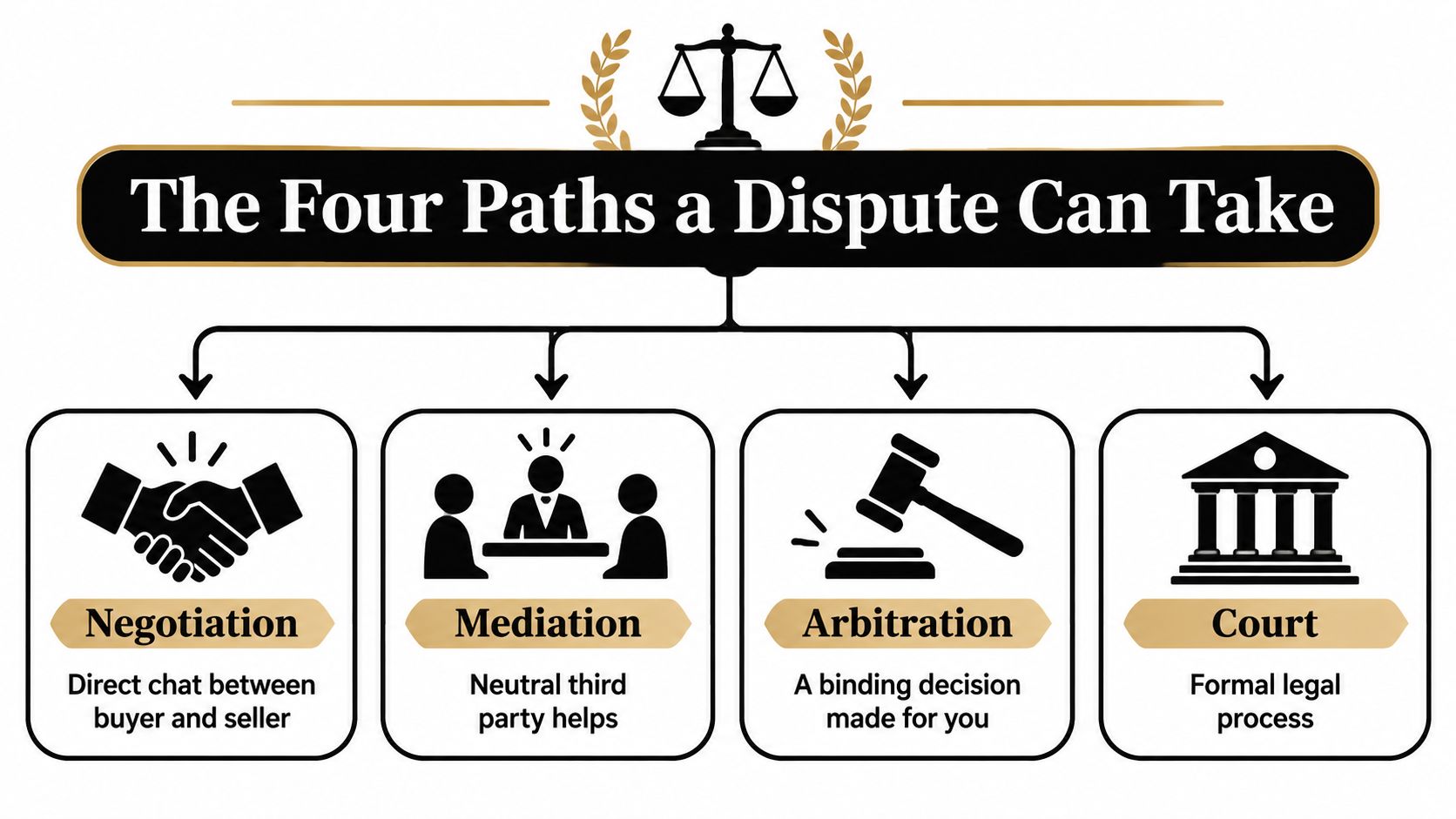
Most order problems don't need a courtroom. They usually move through four possible paths, each adding more structure and less control for the people directly involved.
Negotiation
Negotiation is the direct chat. The buyer explains the issue, the seller reviews it, and both suggest a practical fix. A replacement, return, refund, or partial credit can often be discussed without a third party.
This is usually the best first stop because the buyer and seller understand the order better than anyone else. It's also the least formal route, so the conversation can stay focused on solving the problem rather than proving a legal position.
Mediation
Mediation is a guided conversation. A neutral Loyaltie resolution specialist reviews the information and helps both sides find middle ground. The specialist doesn't act like a courtroom judge. Instead, they clarify the disagreement and help the parties assess options such as a replacement, refund, or partial credit.
Mediation helps when evidence is incomplete, the listing is open to interpretation, or both sides have stopped hearing one another.
Arbitration
Arbitration is a formal review by a third party. The parties submit the relevant evidence, and the arbitrator examines the record before issuing a binding decision. That makes arbitration different from negotiation or mediation, where the people involved generally create the outcome themselves.
It's more structured and final, so it belongs later in the process, especially when direct efforts haven't resolved a serious disagreement.
Litigation
Litigation takes the dispute to court. A judge applies the relevant law and the parties follow formal legal procedures. Court action is unusual for ordinary marketplace orders, but it can become relevant when allegations involve fraud, substantial sums, or repeated misconduct.
Loyaltie is designed to resolve most order issues through negotiation, mediation, or arbitration before anything approaches a courtroom. Its terms favor mediation and arbitration as efficient, lower-cost alternatives, but you should still read the applicable terms for the specific order and dispute.
Choosing the Right Method for Your Situation
The right path depends less on how angry a dispute feels than on four practical factors: control, cost, speed, and finality. A damaged mug may feel urgent, but it usually doesn't need the same process as a serious allegation of fraud.
| Method | Control | Cost | Speed | Finality |
|---|---|---|---|---|
| Negotiation | Highest. Both sides shape the remedy. | Usually lowest, with little formal overhead. | Can be resolved through a focused exchange. | Flexible. The parties agree to the result. |
| Mediation | Shared control, with neutral guidance. | Moderate, because a specialist reviews the case. | Usually faster than formal adjudication. | Depends on the agreement reached. |
| Arbitration | Limited. A third party decides. | Higher than direct negotiation, depending on the case. | More structured and often slower than chat-based resolution. | The decision is binding under the applicable terms. |
| Litigation | Lowest for the parties. The court controls the process. | Often the heaviest financial and time burden. | Can extend over a long period. | Formal court judgment, subject to applicable legal rights. |
Negotiation gives you the most influence over the result. If the seller can replace a damaged item and the buyer can return the original, there may be no reason to add another layer.
Mediation is the useful middle ground when the facts are clear enough to discuss but not clear enough for easy agreement. Arbitration and litigation remove more control, yet they can provide a definite outcome when the parties remain stuck. For a broader explanation of how to resolve business conflicts legally, look for guidance that distinguishes informal settlement from formal legal remedies.
Cost also includes time, attention, and frustration. A fast, respectful message can be cheaper than a long argument even when both parties technically have a strong position. Finality matters too. Before accepting a binding result, confirm what the applicable marketplace terms say about the process and available review rights.
How the Dispute Resolution Process Works Step by Step
A marketplace dispute becomes easier to manage when every action has a clear place. The workflow below turns a stressful order problem into a case file that both parties can understand.
Step 1, identify the issue
The buyer notices that the order is damaged, missing, late, incomplete, or not as described. Start by checking the product listing, order details, delivery information, and seller policy. Keep the packaging instead of throwing it away, especially when damage could have occurred during transit.
Step 2, submit the dispute
The buyer raises a formal dispute through the platform's order center. The platform then pauses the payout to the seller while the claim is reviewed. That pause gives both sides time to address the issue without treating the seller's silence or the buyer's frustration as a final decision.
Step 3, wait for the seller's response
The seller has forty-eight hours to acknowledge the claim and propose a resolution. A useful proposal might involve a partial refund, replacement shipment, or return authorization. Even when the seller disagrees with the buyer's explanation, acknowledging the report keeps the case moving.
Step 4, exchange evidence
Both parties upload photos, tracking numbers, and relevant chat logs into the centralized case file. One case file is better than scattered screenshots across email, direct messages, and personal notes because it gives everyone the same record.
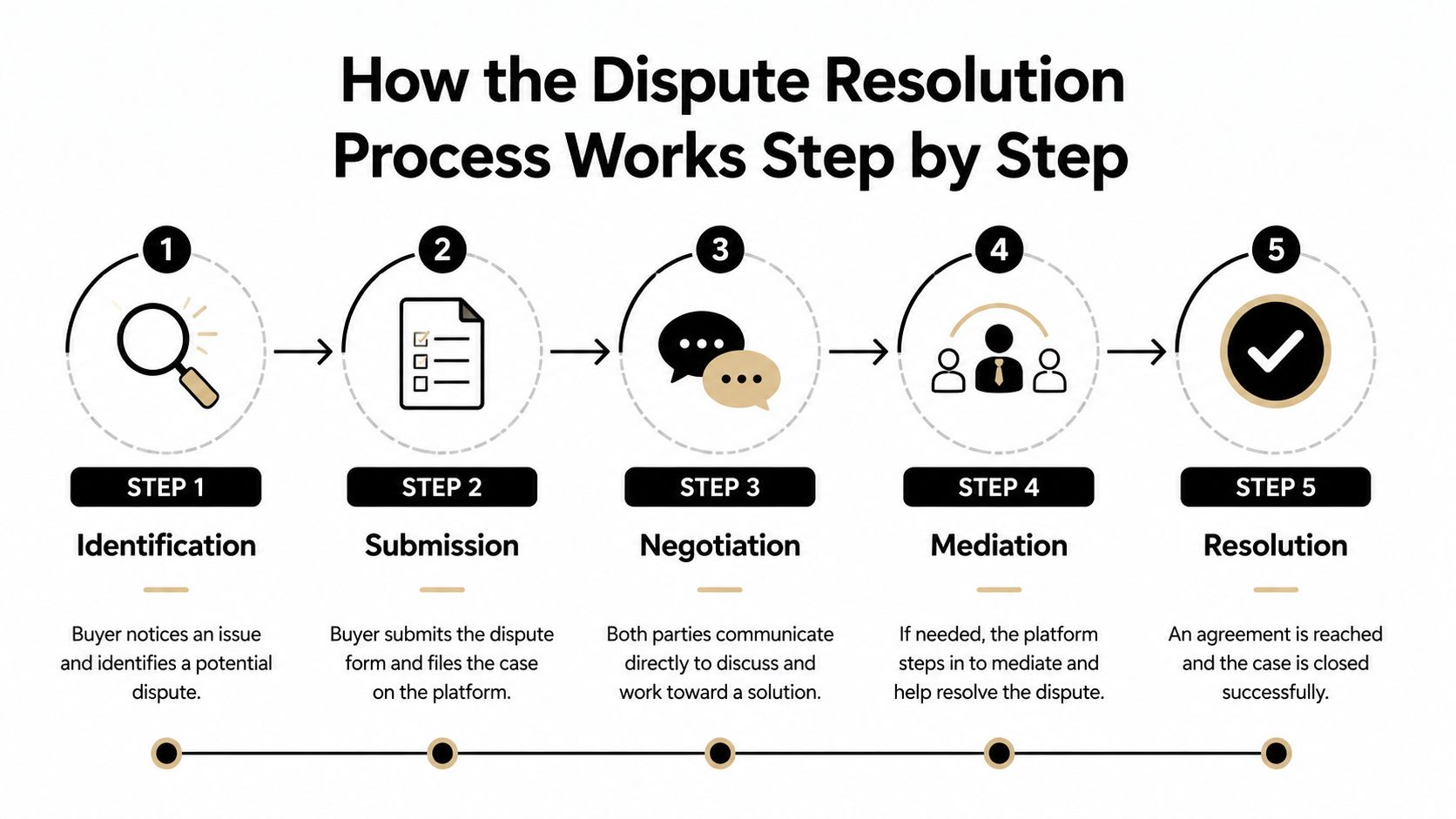
Step 5, negotiate
The platform facilitates a focused exchange. The buyer states the remedy they'll accept, while the seller explains what they can provide and why. Keep proposals specific. “I want this fixed” is less useful than “I'd accept a replacement shipped with tracking or a refund after return.”
Step 6, resolve or escalate
If both sides agree, the resolution is enforced immediately under the platform process. If they can't agree, the case advances to platform mediation, where a neutral specialist reviews the record and helps identify a workable outcome.
The process works best when each person responds to the actual evidence rather than repeating the original accusation. A damaged item, for example, needs photos of the item and packaging, not a long argument about whether either party is trustworthy.
Here's a short visual explanation of the workflow:
What to Send and What to Save
Evidence is the useful currency of a dispute. Maya's photos of the chipped coffee maker were stronger because they showed the damage from several angles and included the surrounding packaging. A close-up alone might prove that a chip exists, but it won't help much with questions about transit damage or inadequate packing.
Buyer checklist
Save these items before opening the case:
- High-resolution photos: Capture the defect from multiple angles, plus the outer box, inner packaging, shipping label, and any visible impact marks.
- A short video: Show the problem in action when a still image can't explain it, such as a leaking vessel or a mechanism that won't operate.
- The original listing: Save screenshots showing the description, measurements, materials, stated lead time, and product images.
- Order confirmation: Keep the confirmation email and order details together.
- Communication records: Include relevant messages, especially any promise about dispatch, customization, replacement, or delivery.
- Unboxing condition: Photograph the package before cutting seals or removing protective materials when possible.
For example, a buyer reviewing the Skincare Starter Kit, Tsubaki Camellia + Jojoba Face Oil, Fragrance-Free Glow & Texture Smoothing, 5-Piece Set (2 Fu | Finally All Natural by Loyaltie can save the listing and photograph the received contents if something appears incomplete or different from the order.
Seller checklist
Sellers should preserve timestamped photos of the item before shipping, packing-scale weight and dimensions, postal tracking confirmation showing delivery to the correct address, and messages where the buyer acknowledged receipt or satisfaction. The original listing matters for sellers too because it establishes what was promised.
Use this simple evidence hierarchy:
- Direct visual or delivery proof, such as clear photos, video, tracking, and packaging images.
- Order records, including the listing, confirmation, and shipping information.
- Written communications, especially specific promises or acknowledgments.
- Personal interpretations, which can provide context but rarely settle the factual question alone.
A buyer can write:
“Hi, my order arrived today with a chip along the rim. I've attached photos of the item, box, and packing materials. I'd prefer a replacement, but I'm open to a return and refund. Please let me know which option works for you.”
A seller might reply:
“Thanks for sending the photos. I'm sorry the piece arrived damaged. I'm checking the packing and tracking details now. I can arrange a replacement or authorize a return for a refund. Please confirm which option you prefer.”
Escalation Paths and Realistic Timelines
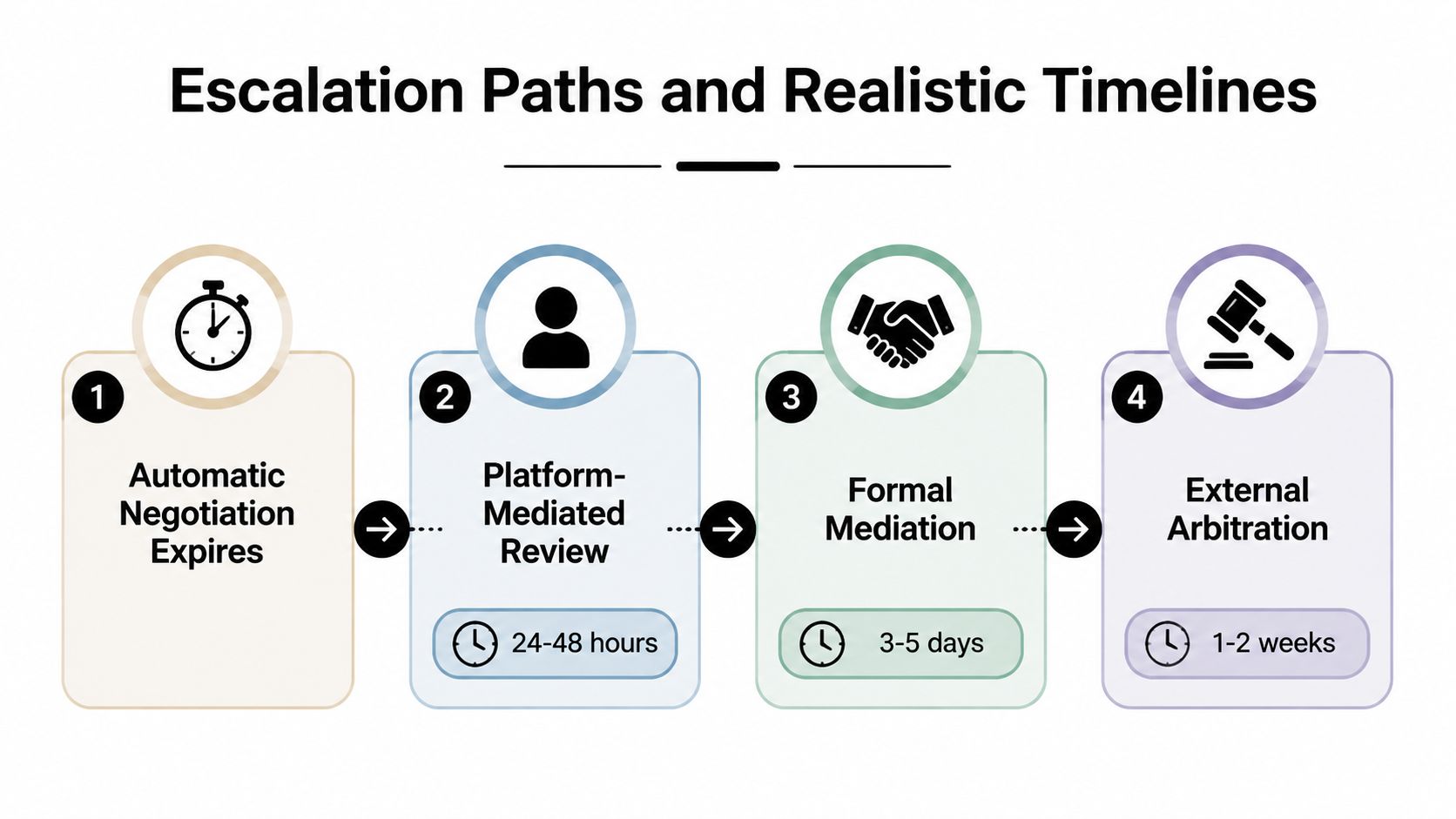
Escalation isn't a punishment. It's the next operating step when the first attempt doesn't produce an agreement. If the automatic negotiation period expires without a resolution, the case enters platform mediation within five business days.
A dedicated support specialist reviews the uploaded evidence and proposes a fair compromise based on Loyaltie's marketplace policies. That review is more useful when the case file contains a clear timeline, complete images, tracking information, and a specific requested remedy.
The practical sequence looks like this:
- Initial response: The seller acknowledges the claim within forty-eight hours.
- Mediation assignment: If negotiation stalls, the platform assigns the case within five business days.
- Mediated review: The specialist assesses the record and works toward a compromise.
- Arbitration option: If mediation fails, a qualifying dispute may move to binding arbitration, with filing required within thirty days if necessary under the applicable process.
If the seller goes silent, the buyer should keep the case open, upload all requested evidence, and avoid sending repeated emotional messages. The platform can review the record and apply its process to the available evidence. If the buyer disappears after receiving a refund, the seller should document the refund, delivery, and follow-up attempts rather than canceling the case informally.
The timeline can still vary. Broader ADR data show why “fast” shouldn't be confused with “instant.” The Financial Ombudsman handled 293,155 complaints in 2024–2025, with an average processing time of 60.81 days according to its Alternative Dispute Resolution annual activity report. ACCA's 2025 activity report recorded 98 suitable complaints, 91 accepted for conciliation, 61 resolved, and an average of 157 days from complaint receipt to conclusion for domestic disputes. Those figures concern other ADR settings, but they make one operational point clear: complete files and prompt responses reduce avoidable delay.
Sellers can review the applicable Loyaltie terms and conditions before a dispute arises so escalation rules aren't being read for the first time under pressure.
Stopping Disputes Before They Start
Prevention costs less than resolution. A precise listing answers the questions that otherwise become complaints: What are the dimensions, materials, weight, lead time, care requirements, and limitations? For international orders, state who handles customs or duties instead of leaving the buyer to guess.
Sellers should use tracked, insured carriers when appropriate, photograph the packed order, confirm the address before creating the label, and publish realistic dispatch and response windows. Care instructions matter too. A buyer needs to know how to use and maintain a coffee grinder, pouring kettle, or apparel accessory before an avoidable misunderstanding becomes a claim.
Use the order notes field to confirm preferences such as burr setting, freshness date, or gift wrapping before shipment. A short FAQ on the seller page, repeated on the packing slip, can answer recurring questions at the moment buyers need the information. Loyaltie's seller resources can help sellers build those operating habits into their shop routine.
Buyers have a role as well. Read the full listing, policies, and reviews, then message the seller before ordering if a material, size, delivery expectation, or customization detail isn't clear. Clear expectations remove many order problems before anyone has to open a dispute.
Your Quick-Reference Toolkit and Common Questions
Bookmark this compact checklist:
- Prevent confusion: Read the listing and policies, confirm unclear details, and state preferences in order notes.
- Save proof: Keep photos, the order confirmation, listing screenshots, tracking details, and relevant chat history.
- Start calmly: Send a specific message that describes the problem and names an acceptable remedy.
- Escalate in order: Try negotiation, then mediation, then arbitration when the applicable terms allow it.
- Respond promptly: If the other party sends two unanswered messages, request platform intervention rather than continuing an unproductive exchange.
Common questions
How long does a buyer have to open a case? Raise the dispute within seven days of delivery under the workflow described here.
What's the standard seller response window? The seller should acknowledge the claim within forty-eight hours.
When should evidence be submitted? Upload photos, screenshots, tracking data, and other relevant records when the dispute is opened, then add requested material promptly.
What if the seller stops responding? Keep the case active, document unanswered messages, and request platform intervention after two unanswered messages.
When does the resolution team review it? The case is reviewed after negotiation fails or the automatic negotiation period expires. Litigation remains rare and generally comes last, after negotiation, mediation, and arbitration have been attempted.
Loyaltie gives you a place to discover and buy directly from independent brands across the US, with an order workflow that helps buyers and sellers address problems clearly. Visit Loyaltie to find better everyday options in coffee, wellness, skincare, food, supplements, pet products, and other goods made by real people.