
You're probably doing something very normal right now. Packing orders at the kitchen table. Printing labels between emails. Maybe checking whether a customer's address came through correctly before you ship out a bag of coffee, a skincare order, or a refill for regular delivery.
That small moment carries more responsibility than it seems.
When someone buys directly from a real maker, they aren't only choosing a product. They're trusting you with a few personal details that make the purchase possible. Their name. Their address. Their email. Sometimes a phone number. Customer data protection starts there. Not with legal jargon. With the simple idea that trust should be handled with care.
For independent brands, that can be an advantage. Big companies often make people feel like a data point. A thoughtful maker can make people feel known, respected, and safe.
Table of Contents
- Three simple principles that make the rules easier
- What responsible handling looks like in daily work
Protecting Customers Is Protecting Your Brand
A lot of makers hit the same moment. The first wave of orders comes in, and it feels great. Then you look at the order dashboard and realize you now hold a list of real people's names, emails, shipping addresses, and order details.
That shift matters.
If you make products people love, they'll often forgive a delayed shipment or a packaging hiccup. They're much less forgiving if they feel careless handling touched their personal information. Consumer behavior data shows that 52% of Americans said personal data collection concerns caused them to opt out of purchasing products and services, while 86% of the general population says data privacy is a significant concern, according to Countly's privacy statistics roundup.

For an independent brand, this isn't just about avoiding a mess. It's part of the product experience. If someone buys a thoughtfully roasted coffee, a carefully made supplement, or a well-formulated balm, they expect the same level of care in the way their order is handled behind the scenes.
Trust shows up in the invisible parts
People rarely say, “I loved how carefully you handled my address.” But they notice the opposite fast.
They notice when:
- An email feels too invasive because you collected more than they expected.
- A support message exposes personal details that didn't need to be included.
- An old customer list sits around forever with no real reason to keep it.
Practical rule: If a customer would be surprised to learn you stored something, pause and ask whether you need it.
That's why customer data protection fits independent brands so well. You already compete on closeness, quality, and trust. Handling data respectfully is the digital version of remembering a customer's preferences without crossing a line.
Better care creates a better buying experience
Mass-market retail often feels impersonal. Buy, track, repeat. When you buy directly from the maker, the relationship feels different. There's no middleman. That can be a strength if you treat personal information with the same respect you bring to ingredients, packaging, and customer service.
A clean privacy habit says something subtle but powerful: you're not just taking orders. You're taking care of people.
What Is Customer Data and Why Does It Matter
“Customer data” can sound abstract, but most of it is ordinary information you work with every day.
A shipping address is customer data. An email used for order confirmation is customer data. A phone number added for delivery issues is customer data. Even order notes can become customer data if they reveal something about a person.
The easy way to think about PII
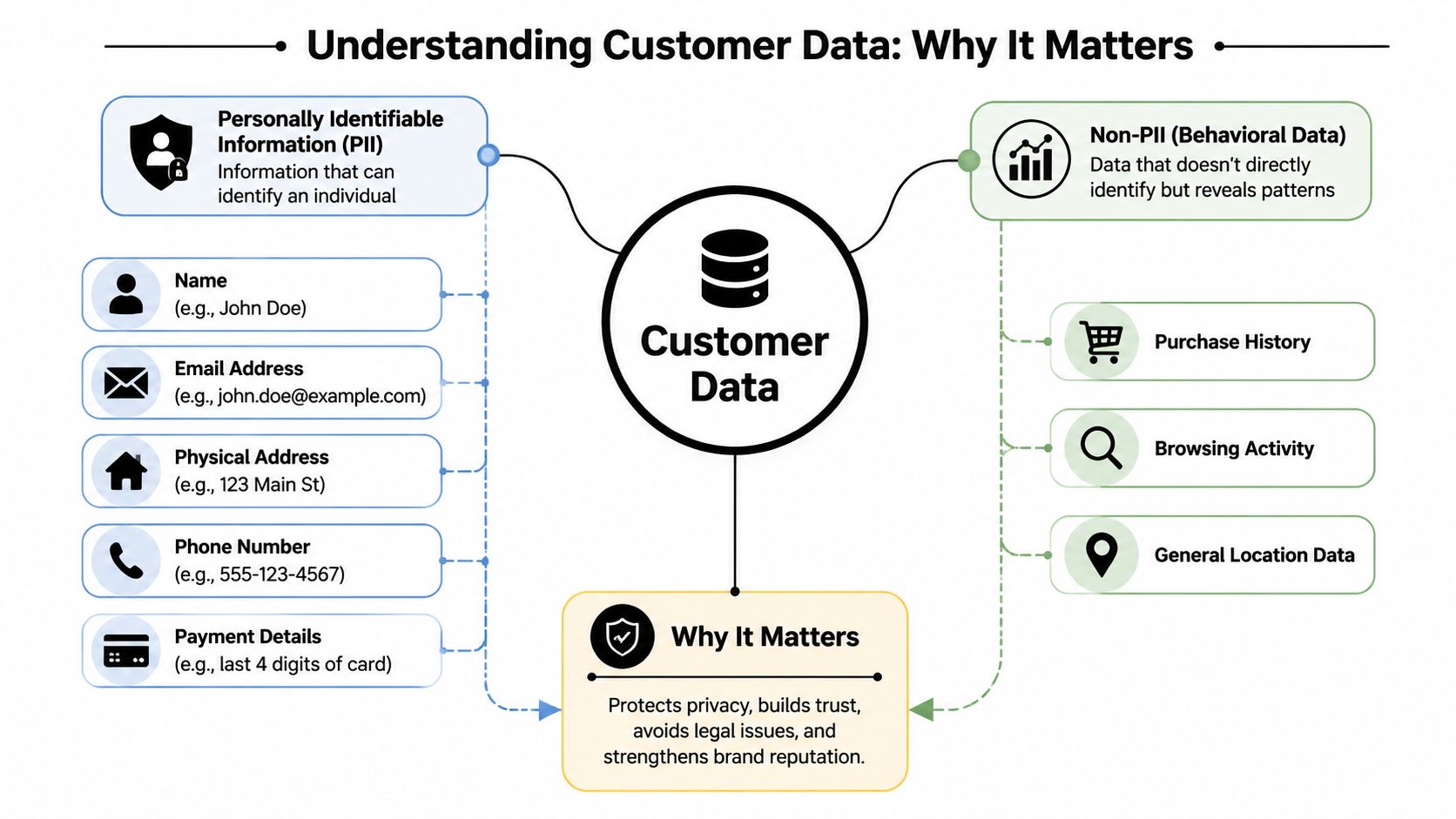
The term personally identifiable information, often shortened to PII, means information that can identify a real person.
A useful analogy is this: when someone places an order, they're giving you a key to a tiny part of their private life. Not to snoop around, just to complete a job. You use that key to deliver the product, answer a question, or solve a problem. You don't copy it, leave it on the counter, or hand it to someone who doesn't need it.
For most independent brands, common PII includes:
| Data type | Everyday example | Why it needs care |
|---|---|---|
| Name | Full name on an order | It identifies the buyer directly |
| Email address | Used for receipts or support | It connects to a real person and their inbox |
| Physical address | Shipping location | It reveals where someone lives or receives packages |
| Phone number | Delivery follow-up | It creates a direct contact channel |
| Payment-related details | Card information handled through checkout systems | It's highly sensitive and should be tightly controlled |
Even simple products still involve personal information. If someone orders a Kids Cotton Graphic T-Shirt, 5.3 oz Midweight, Classic Fit Crewneck, Tear-Away Label, Sizes XS–XL | Kissing Rock Coffee by Loyaltie, the product itself is straightforward. But the order still includes a child-related purchase, a household address, and contact details. That deserves careful handling, even when the item feels low-risk.
Not all customer data feels personal at first
Some data doesn't obviously identify someone on its own, but it still says a lot.
That can include:
- Purchase history such as what someone buys repeatedly
- Browsing behavior like which products they viewed
- General location signals that help estimate where shoppers are coming from
None of that means you should panic about every spreadsheet or dashboard. It means you should stay aware that patterns can become personal very quickly when combined with names, emails, or addresses.
Customer data matters because it reflects a real person's habits, preferences, and routines, not just a transaction.
For makers, this mindset helps. Instead of asking, “Is this technically allowed?” start with, “Would this feel respectful if it were my information?” That question usually leads you in the right direction faster than a pile of legal terms.
Understanding Your Privacy Responsibilities
Most privacy rules sound more complicated than the day-to-day behavior they're trying to create.
At the human level, your responsibilities are pretty understandable. Be clear about what you collect. Only collect what you need. Respect the choices people make. That's the heart of it.
Regulators are taking this seriously. As of January 2026, cumulative GDPR fines reached €7.1 billion, with authorities recording over 400 personal data breach notifications per day, according to StationX's data privacy statistics analysis. You don't need to memorize every law to understand the message. Privacy has become an operational reality, not background paperwork.
Three simple principles that make the rules easier
Transparency
Tell people what you collect and why in plain English.
If you need an email for receipts, say that. If you use an address to ship physical goods, say that. If you keep order history for support, say that too. People usually don't mind sharing necessary information when the reason is obvious.
Purpose
Use data for the reason it was collected.
If someone gives you a shipping address to receive a package, that doesn't automatically mean they expected unrelated marketing or broad internal sharing. A good rule is to connect every field you collect to a real business purpose you can explain out loud.
Respect
Honor customer preferences and handle their information like borrowed property.
If someone asks what you store, answer clearly. If they ask you to stop using a piece of information you no longer need, take that seriously. If you decide to delete records, do it in a way that removes them completely from devices and storage, not just from sight. Practical guidance around proper disposal can help, and NIST SP 800-88 is a useful plain-language starting point for understanding secure data destruction practices.
What responsible handling looks like in daily work
Privacy responsibility often shows up in very small decisions.
- Checkout design: Don't ask for a phone number unless you have a real use for it.
- Customer service: Don't paste full personal details into messages when a partial reference will do.
- Record keeping: Don't keep exports of customer lists on random laptops forever.
- Platform awareness: Read the rules of the system you sell on so you know what the platform handles and what remains your job. If you sell through Loyaltie, start with the seller terms and conditions.
A lot of privacy mistakes don't come from bad intent. They come from convenience that was never questioned.
That's why the ethical framework matters. It keeps you from treating customer data like free raw material. It reminds you that information shared for one purpose shouldn't casually drift into another.
For independent brands, that kind of restraint can feel refreshingly human. Customers notice when you only ask for what's necessary and don't behave like every large retailer trying to gather more than the purchase requires.
Simple Ways to Secure Customer Information
Good security doesn't have to feel mysterious. It helps to think in physical terms.
If you had handwritten order forms in a workshop, you wouldn't leave them on the sidewalk. You'd lock them up, limit who could see them, and throw them away once you no longer needed them. Digital protection follows the same logic.
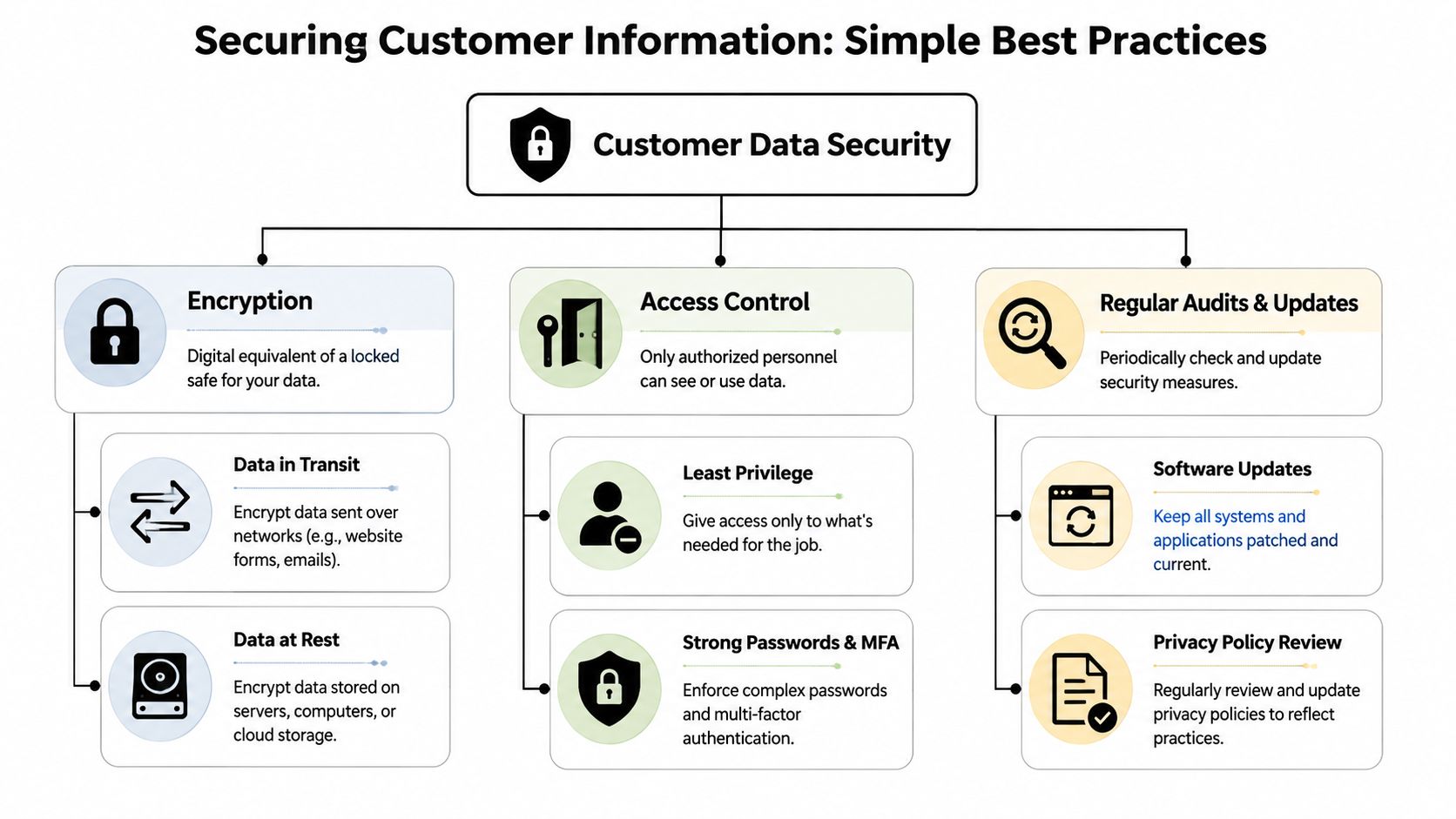
One technical baseline matters more than many people realize: data minimization and least-privilege access, paired with encryption in transit using TLS and encryption at rest using 256-bit AES, as explained in ExpressVPN's customer data protection guide. In plain language, that means keep less data, give fewer people access, and lock the data whether it's moving or sitting still.
Think locked safe not hidden folder
Encryption is the locked safe.
If customer information travels through a checkout form or support system, encryption in transit helps protect it while it moves. If it sits in storage, encryption at rest helps protect it there too. You may not personally configure all of this, especially if you sell through established tools, but you should know whether the services you use take it seriously.
That includes your own devices. A password on your laptop is useful. Full-device encryption is better. Screen locking matters. So does keeping software updated so known weaknesses get patched.
For a practical outside resource written for founders, South Florida founder data security offers a straightforward overview of habits worth reviewing.
A quick explainer can make this easier to picture:
Who actually needs access
A common mistake is over-sharing inside a business.
If one person packs orders and another handles bookkeeping, they may not need access to the same customer details. Least privilege means each person gets access only to the information required to do their job.
That can look like:
- Role-based access: A fulfillment helper sees shipping info, not every export you've ever saved.
- Periodic review: You check who still has access when roles change.
- Fast removal: If someone no longer works with you, their access gets removed right away.
- Separate duties: Sensitive tasks aren't all concentrated in one account or device.
Worth remembering: Hidden isn't the same as secure. A file buried in old folders is still exposed if the wrong person can open it.
If you use a marketplace where people discover and buy directly from the best independent brands in the US, some of the checkout and account security work may be handled at the platform level. For sellers using Loyaltie, the seller resource center is where to review what the platform covers and what practices sellers should follow on their own devices and workflows.
The records you should stop keeping
Retention is the part people forget.
Many brands hold onto old exports, spreadsheets, and shipping notes because deleting them feels risky. In reality, keeping unnecessary records often creates the bigger risk. Old data can be exposed just as easily as new data, and it's often protected less carefully.
Use this simple filter:
| Keep it if | Delete it if |
|---|---|
| You need it to fulfill an order | The order is complete and the extra copy serves no purpose |
| You need it for support or required records | It's a duplicate export sitting on a desktop |
| You need limited access for a defined task | Nobody can explain why it still exists |
Security gets much easier when your digital workspace isn't cluttered with years of unnecessary customer information.
Your Data Protection Checklist
You don't need a huge compliance program to start behaving carefully. You need a short list you'll use.
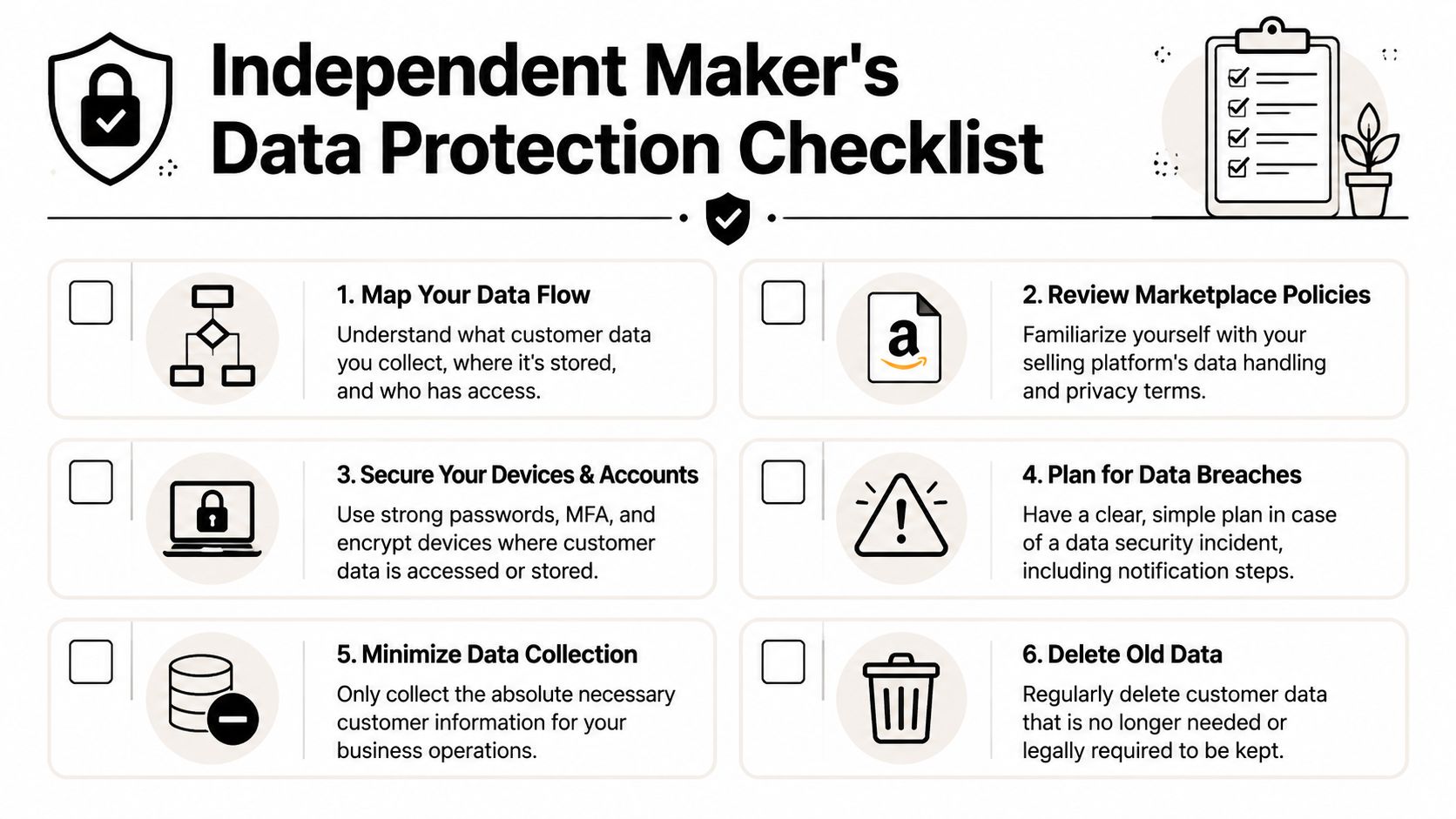
One idea belongs at the center of this checklist: guidance from industry experts emphasizes that a key risk is often overcollection, not just hacking. The strongest move is to reduce your data footprint by collecting only what's necessary and deleting it when it's no longer needed, as discussed in Flexential's guidance on protecting customer data.
A working checklist for independent makers
Map your data flow
Write down what customer information you collect, where it lands, and who touches it. Include your marketplace dashboard, email inbox, shipping tool, cloud folders, and any downloaded spreadsheets.Review marketplace policies
Know which parts of checkout, payments, and account handling live with the platform and which parts are still yours to manage. This keeps you from assuming a tool covers something it doesn't.Secure your devices and accounts
Turn on screen locks, use strong passwords, enable MFA where available, and keep your phone and laptop updated. If you ever access customer records from a personal device, treat that device like part of your storefront.Plan for simple incidents
Decide now what you'd do if you emailed the wrong person, lost a laptop, or exposed a customer list by mistake. A basic response plan is far better than improvising under stress.Trim what you collect
Go field by field. Ask whether each one is needed for checkout, fulfillment, fraud prevention, or customer support. If the answer is fuzzy, remove it or stop storing it.Delete old data on purpose
Set a recurring reminder to clean out duplicate files, stale exports, and old notes. Don't leave customer information scattered across downloads folders because it might be “useful someday.”
The easiest customer record to protect is the one you never collected, or the one you've already deleted when it stopped serving a clear purpose.
This checklist works because it's practical. You can do most of it in an afternoon, and each step reduces confusion for future you.
A Simple Plan for Data Incidents
Even careful brands run into mistakes. A package confirmation goes to the wrong person. A spreadsheet gets saved in the wrong place. A laptop disappears from a car seat.
The worst response is panic. The better response is calm, fast, and honest.
Step one assess and contain
Start by figuring out what happened.
Was it one mistaken email, or a broader exposure? Did the information include only a name and order number, or more sensitive details? Can you revoke access, change a password, remove a shared file, or wipe a missing device remotely?
Focus on stopping further exposure before you do anything else.
Step two communicate clearly
Then decide who needs to know.
That may include your platform, a service provider, affected customers, or legal counsel depending on the situation. Keep the message plain. Say what happened, what information may have been involved, what you've already done, and what customers should do next if any action is needed.
A clear message builds more trust than a defensive one. People understand that mistakes happen. What they want to see is responsibility.
Step three learn and improve
After the immediate issue is under control, fix the process that allowed it.
If the problem came from too many exported files, reduce exports. If it came from shared logins, stop sharing them. If it came from keeping old records too long, shorten your retention habit.
A useful post-incident review can be as simple as this:
- What happened
- What data was involved
- What we changed
- Who owns the new process
That turns an uncomfortable moment into a stronger system. Customers don't expect perfection. They do expect care, clarity, and follow-through.
Privacy Policy and Communication Templates
A plain-English privacy policy is one of the easiest ways to show respect before anyone has to ask. It tells customers you've thought about how their information moves through your business.
If you need a reference point for marketplace language, review the Loyaltie privacy policy. For your own records, especially when cleaning up old hardware or storage media, it can also help to download asset disposal template documentation so deletion and disposal aren't handled casually.
Simple privacy policy template
You can adapt this for your shop page or site:
Privacy Policy
We collect the information needed to process and fulfill your orders, such as your name, email address, shipping address, and order details.We use this information to provide customer service, send order updates, and complete delivery. We only collect information that is relevant to these purposes.
We limit access to customer information to the people and tools needed to run our shop. We use reasonable security practices to protect stored information and account access.
We do not keep customer information longer than necessary for business, support, or required recordkeeping purposes. When information is no longer needed, we delete it from our active records.
If you have questions about what information we hold or want to request an update or deletion where appropriate, contact us at [your email].
Short customer email template
If you update your privacy language, keep the note simple:
Subject: A quick update on how we handle your information
Hi [First Name],
We've updated our privacy policy to make it clearer what information we collect, why we collect it, and how we protect it.Our goal is simple: only use the information needed to serve you well and handle it with care.
You can read the updated policy here: [link]
If you have any questions, just reply to this email.Thank you,
[Brand Name]
Short beats formal here. Clear beats impressive. If people can understand your policy without rereading it, you're already ahead.
If you care about building a more personal, trustworthy buying experience, Loyaltie is a marketplace where people discover and buy directly from the best independent brands in the US. It gives makers a practical way to sell online while keeping the experience closer, more human, and easier to trust.