
It's 6:40 on a Tuesday, and dinner has to come out of a fridge holding three zucchini, a bunch of chard, and whatever else arrived in this week's share. You didn't choose any of it. Half of it will still be sitting there on Friday.
Now the other version. It's Saturday, you've got twelve minutes between errands, and you walk out of the market with two peppers, a dozen eggs, and a loaf of bread. Nothing wasted. Nothing planned.
Both are good ways to get food from people who grow it. They're just not interchangeable, and the difference that matters isn't price per pound. It's how you pay, how much of it gets eaten, and whether the pickup fits your week. Get those three right and either model works. Get them wrong and beautiful produce turns into an expensive pile of guilt.
Table of Contents
- CSA and Farmers Market Side by Side
- How Each Model Works and Who Takes the Risk
- What You Really Pay Once Waste and Pickup Count
- Commitment, Variety and Freshness in a Real Week
- Access, SNAP and Pickup Logistics
- Which Model Fits Your Week and Household
- Where Your Money Goes and What to Try Next
CSA and Farmers Market Side by Side
A CSA is a planned relationship with one farm. A farmers market is a walk past many makers, most of whom you'll never commit to. Both send your money to a grower instead of a distributor, and they get there by opposite routes.
| Criterion | CSA | Farmers market |
|---|---|---|
| How you pay | Commit and pay before the season or on a plan | Pay at the stall for what you pick |
| What you get | A planned share from one farm | Whatever each vendor has that day |
| Commitment | Season or plan with set pickups | None; come when you want |
| Variety | Narrower, seasonal mix from one farm | Wide mix across many growers and makers |
| Freshness | Often harvested close to pickup; ask the farm | Varies by vendor; ask when it was picked |
| Pickup | Fixed site and time window | Market days and hours |
| SNAP | Depends on the farm's own payment policy | Accepted by many authorized vendors |
| Who takes harvest risk | Shared; a poor crop can shrink your share | Vendor carries any unsold product |
Read every cell as a default rather than a law. Plenty of farms now run flexible shares with skip weeks and swap credits, and plenty of markets run one Sunday a month in a parking lot. The pattern still holds for most of what you'll meet.
On scale, the two channels aren't close. The USDA National Farmers Market Directory listed 8,268 markets in 2014, a 76% increase from 2008, according to USDA farmers market program highlights. CSA stayed specialized: 7,244 farms reported CSA sales totaling $225 million in 2020, per USDA's community-supported agriculture overview.
Markets are also the easier front door. In 2025, 80.30% of 5,141 U.S. survey respondents reported attending a farmers market at least once per year, including 41.78% who went six or more times annually, according to a study published in the Journal of Agriculture, Food Systems, and Community Development. You can try a market in a single morning. A share asks for a season.
Use that table as a starting point and skip ahead to whichever row is already nagging at you. Payment timing, waste, and pickup rules decide the answer for most households.
How Each Model Works and Who Takes the Risk
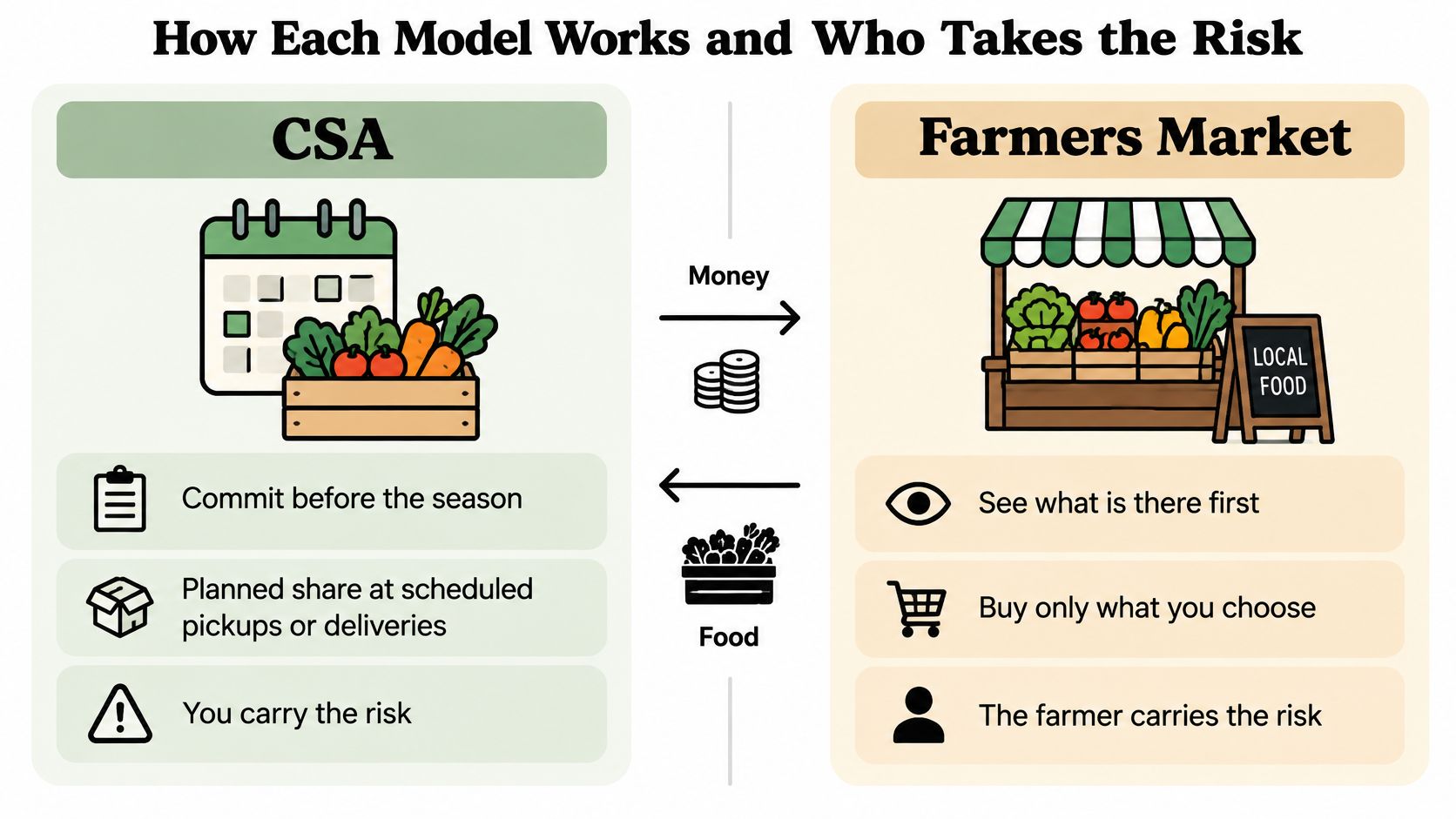
In late winter, a CSA grower sits down with a seed catalog and a member list. The count on that list decides how many rows of tomatoes get planted, how much labor gets hired for June, and how much of the farm goes to people who have already said yes. The money a member pays in March is what lets a farm make those decisions before anything goes in the ground.
USDA counts both channels as direct-to-consumer sales and reports them as separate methods. In 2020, U.S. farms sold $2.9 billion in food directly to consumers, and on-farm stores plus farmers markets accounted for $1.7 billion, or 59% of that total, per USDA's local foods highlight. Most of that money moved the way any retail sale does: the buyer saw the product, then paid for it.
Why farms want your money in March
An early check buys seed, soil amendments, and labor months before the first tomato. It also fixes the farm's plan for the season: a grower who knows how many households have paid can plant to that number and spend the summer growing food instead of chasing sales week to week.
Joiners are out there. A Taiwan farmers-market study of 320 respondents found consumers willing to become CSA members and to share the risk that upfront payment creates, with a distinct higher-budget group willing to pay more for a share than they spent at the market.
The one thing no early payment can fix is the weather. When hail or a cold spring cuts a crop short, the farm's written policy decides what lands in your box instead: credits toward a future week, produce swapped in from a neighboring grower, or a lighter share with nothing in return. That policy matters more than the sticker price.
Five terms to read before you pay
- Start and end dates. A season ending in late October is a different commitment from one that runs to December.
- Pickup site and window. Note the closing hour. A two-hour window on a weekday afternoon rules out a lot of jobs.
- Share size. Small, medium, and family boxes can differ by a factor of two. Ask what a typical week looks like in July, not in April.
- Substitution rules. Find out whether you can swap an item you'll never cook, or skip a week you're traveling.
- Crop-failure policy. Ask plainly what happens if a crop disappoints. Some farms issue credits, some substitute from another grower, and some do neither.
A share suits the cook who can commit money before the season and will happily use whatever July delivers. A market suits the shopper whose budget and schedule move week to week and who wants to see the tomatoes before paying for them. Pick the one your kitchen can keep, and the person growing your food gets paid for the work either way.
What You Really Pay Once Waste and Pickup Count
Start with the part that's in the market's favor. A study of 12 North Carolina farmers markets found produce savings averaging 18% versus comparable nearby supermarkets, and CSA prices often land close to grocery prices, sometimes below. Most price comparisons stop at that shelf price and call it a draw.
The draw is an illusion, because price per pound measures food you bought rather than food you ate. Before you compare anything, count the costs that never make it onto the price card: the trip, the produce that spoils, the vegetable nobody in the house will touch, and the money sitting with a farm for weeks before a single meal comes back.

A cost per edible meal formula that holds up
Run this on a scrap of paper:
Effective cost per meal = (food cost + travel and parking + any pickup fees) ÷ meals you served from it.
Waste doesn't need its own line item. It cuts the number of meals the food produced, which is how it hits your budget.
Take a made-up two-person household. They pay $620 for a 22-week share and spend about $3 a week on the round trip, so food and travel come to $686. If they serve four dinners a week from the box and compost the rest, that's 88 meals at $7.80 a plate. The same two people buying four dinners' worth at the market each week, call it $25 with travel, spend $550 for those same 88 meals, about $6.25 a plate. Same household, different model, and the share costs more per meal because roughly 43% of what they paid for went into the bin.
Now push the same share through a household that cooks seven nights a week and uses the whole box. Same $686, 154 meals, $4.45 a plate. Nothing about the farm changed. Usage did. That's the whole argument for the share in one line: the box only beats the stall when your kitchen empties it.
If you want a clearer accounting of what spoiled food costs a household, this breakdown of food waste costs for busy households is worth reading before you commit to a whole season of anything.
Who each model usually wins for
A market wins for a two-person household that buys only what it needs. Small quantities, no obligation to finish a pound of turnips, and the option to skip a week without losing money.
A share wins for a household that cooks most dinners and can absorb volume. Bulk tomatoes become sauce, chard becomes a gratin, and the cost per plate drops each time a vegetable gets used instead of binned.
Commitment, Variety and Freshness in a Real Week
What happens when the box lands and dinner is already late? One share drop can mean six zucchini, a bunch of chard, and a bag of beans you did not plan for, with 25 minutes to turn it into food. Saturday at the market can look calmer: two peppers, a dozen eggs, and a loaf, because that is what the week needs.
Commitment is the dividing line. A share rewards a cook who likes improvising with whatever arrives, and it punishes a household that eats out three nights a week and forgets pickup twice a month. The model fits when the pickup rhythm matches the meals you will cook.
Variety follows the same logic. A share reflects one farm's calendar, so zucchini can show up three weeks running and vanish by September. A market draws from many growers, so one lap can cover greens, fruit, dairy, meat, bread, and honey in a single bag.
The spending reflects that difference. A Nevada comparison of 664 farmers-market interviews plus a separate CSA survey found CSA members spent 43% more per week on their basket than market shoppers spent at the market, and they weighed quality, local origin, and organic growing more heavily. Market shoppers put more weight on variety, price, and appearance. Read it as a description of what each model is built to deliver.
The share decides what you cook, while the market lets you decide what to cook.
Freshness is a distance and a clock
The useful freshness measure is the gap between harvest and your kitchen, and that gap varies by farm and vendor far more than by model. Ask any grower two questions: when was this picked, and what came in yesterday. The answers tell you more than any sign on the table.
Both models thin out in February, and that reflects the season. A share may lean on storage crops and greenhouse greens, while a market runs a shorter roster of stalls.
Markets and farm add-on lists also supply the small extras that make a week of chard taste different. A seasonal edible flower assortment box can make a plain salad or a drink look intentional, and the Raw Wildflower Honey, Shenandoah Valley Virginia, Floral Full-Bodied Flavor, Squeeze Bottle, 12 oz from AR's Hot Honey is a 12 oz squeeze bottle of Shenandoah Valley, Virginia honey with a floral, full-bodied flavor. Some of the most useful things you bring home are not produce at all.
Access, SNAP and Pickup Logistics
The model that looks cheaper on paper can still be the one you can't join. A traditional share asks for a lump sum before the season, and that single requirement rules out households on a tight or unpredictable budget before anybody discusses vegetables.
Cost-offset CSA research on low-income households found subsidized shares were generally viewed as affordable, yet upfront payment remained a barrier, while flexible pickup times and locations improved access. Households in that work wanted to know whether they'd get a fair quantity, whether they could swap or refuse items, and whether they could pay weekly instead of monthly. Those are reasonable questions, and they're worth putting to a farm directly.
SNAP works differently in each model
At a market, eligible vendors can take SNAP one transaction at a time. Under USDA rules, a farmers market or direct-marketing farmer generally can qualify under Criterion B when at least 50% of total sales come from staple foods, and authorized direct-marketing farmers can accept SNAP at farm stands and other locations where they sell eligible foods, per USDA's SNAP staple food requirements.
The rule doesn't demand every staple category on the table. It also doesn't count butter, trail mix, jerky, cheese, fruit dips or spreads, or snack bars as staple foods under the updated guidance, and markets have to report changes such as new days, hours, or locations.
With a share, acceptance depends on the farm's own payment setup and program eligibility, so ask before you pay. Some farms run sliding scales, some point you to a sponsor, and some market-run shares have their own arrangement.
Pickup is a logistics problem, not a values problem
One drop-off a week at one site is the standard. Check the distance from work, not just from home, and check whether a neighbor or partner can collect for you on the weeks you can't. Markets are easier here because they're usually already on your route, and you can shop around a shift.
If a fixed pickup window is the thing that breaks your week, a delivered box changes the math, like a microgreens variety box with fresh weekly delivery. That's not a compromise on quality. It's removing the one constraint that was going to make you quit in week five.
The three-step check
- Payment schedule. Does the farm take weekly or biweekly payments, run a sliding scale, or offer a smaller share that fits your monthly budget?
- Pickup trip. Is the site within a reasonable detour from home or work, and can someone else collect when you can't?
- SNAP. Does this farm or this market accept SNAP for eligible foods, and which stalls or vendors participate?
Which Model Fits Your Week and Household
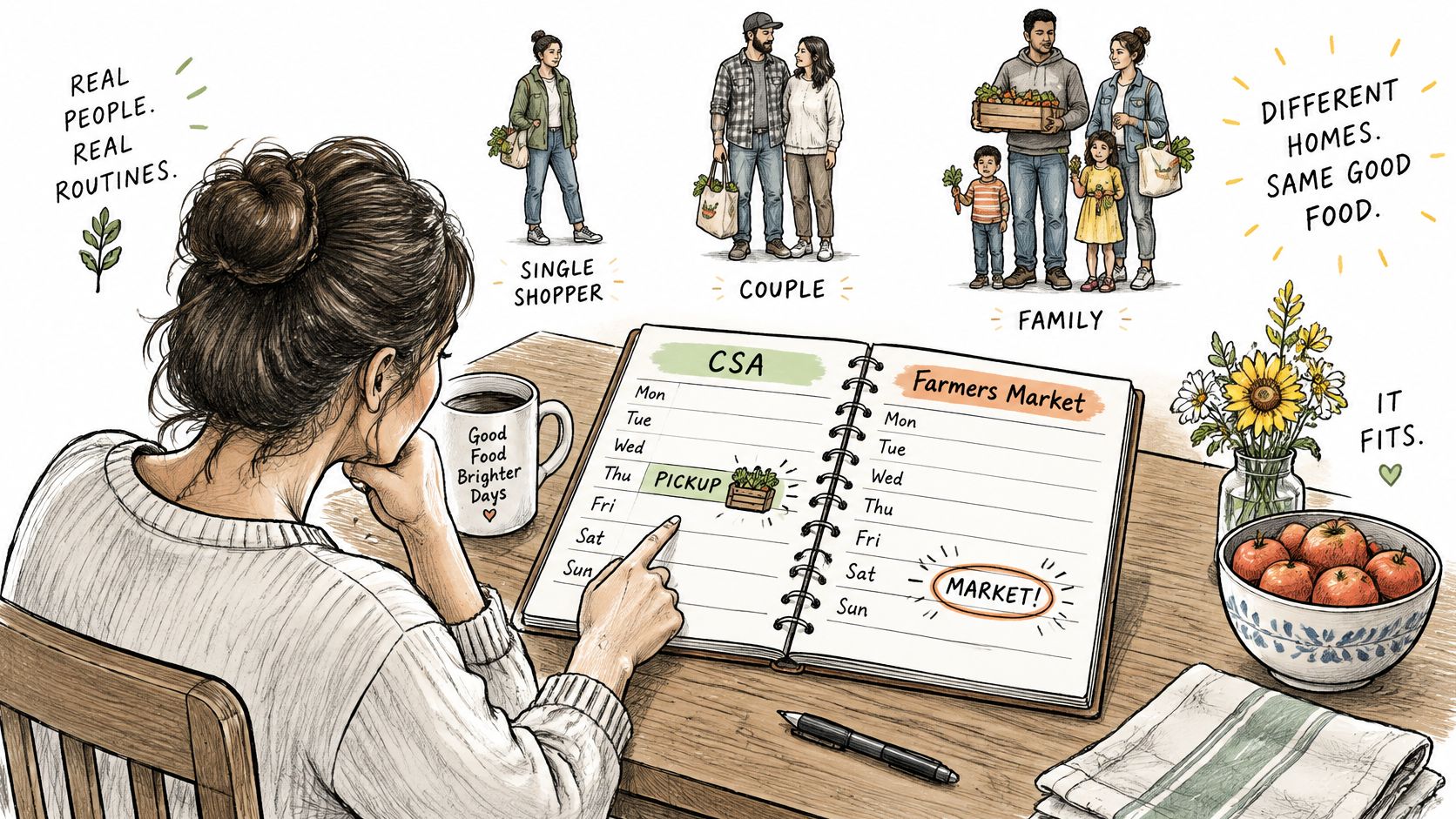
Find the row closest to your life, then read the reason beside it. Two rows often describe the same week. A couple that cooks six nights at home belongs on both the small-household line and the meal-planner line, and the tie-breaker is which constraint bites harder: the volume a share delivers or the control a market gives you.
| Situation | Better fit | Why it fits |
|---|---|---|
| Planner who cooks most dinners at home | CSA share | Steady volume and a predictable weekly supply |
| Two-person or small household | Farmers market | Buy only what you need each visit |
| Shopper who wants to try new produce | Farmers market | Sample and buy single items before committing |
| Household with irregular cash flow | Farmers market | Pay per visit with no lump-sum payment |
| Household using SNAP | Farmers market, after checking the vendor | Many authorized vendors accept SNAP for staple foods |
| Buyer who wants a direct line to one grower | CSA share | Ongoing relationship with one farm |
| Shopper who wants eggs, bread, honey and more in one trip | Farmers market | Many makers and products in one place |
If you sit on two rows, run the cheaper test first. Spend a few Saturdays at the market buying roughly what a share would contain, and track what gets eaten rather than composted. If you finish the bag every week, a share likely fits. If half of it wilts in the crisper, the market was already your answer.
Adoption data backs that order of operations. In 2025, 42.9% of U.S. adults reported buying local food at farmers markets, compared with 4.1% who reported using community-supported agriculture programs, according to Trace One's April 2025 Local Food Survey. Markets are the low-commitment entry point for many shoppers. A share is what some of them move into once they know how they cook.
Here's a short walkthrough of how the two models play out across a season and what to look at before you commit to either.
The rows that get people in trouble
SNAP is the row I'd treat with the most care. Authorization sits with the individual vendor, and a prepared-food stand usually operates under different rules than a produce stall selling staple foods. One seller's absence from the program tells you nothing about the farm at the next table, so verify the specific vendor you plan to buy from before you build a week around them.
Irregular cash flow is the row I'd push hardest on. Paying per visit can cost more per unit in some cases, but a $25 Saturday you can afford beats a $620 season you can't, and no farm benefits from a member who quits in week six. If the lump sum is the only blocker, ask the farm what payment schedule they can run before you count a share out.
Recheck the fit when life changes. A new job, a move, a second child, or a summer of travel can flip the answer, and neither model asks for a lifetime vow.
Where Your Money Goes and What to Try Next
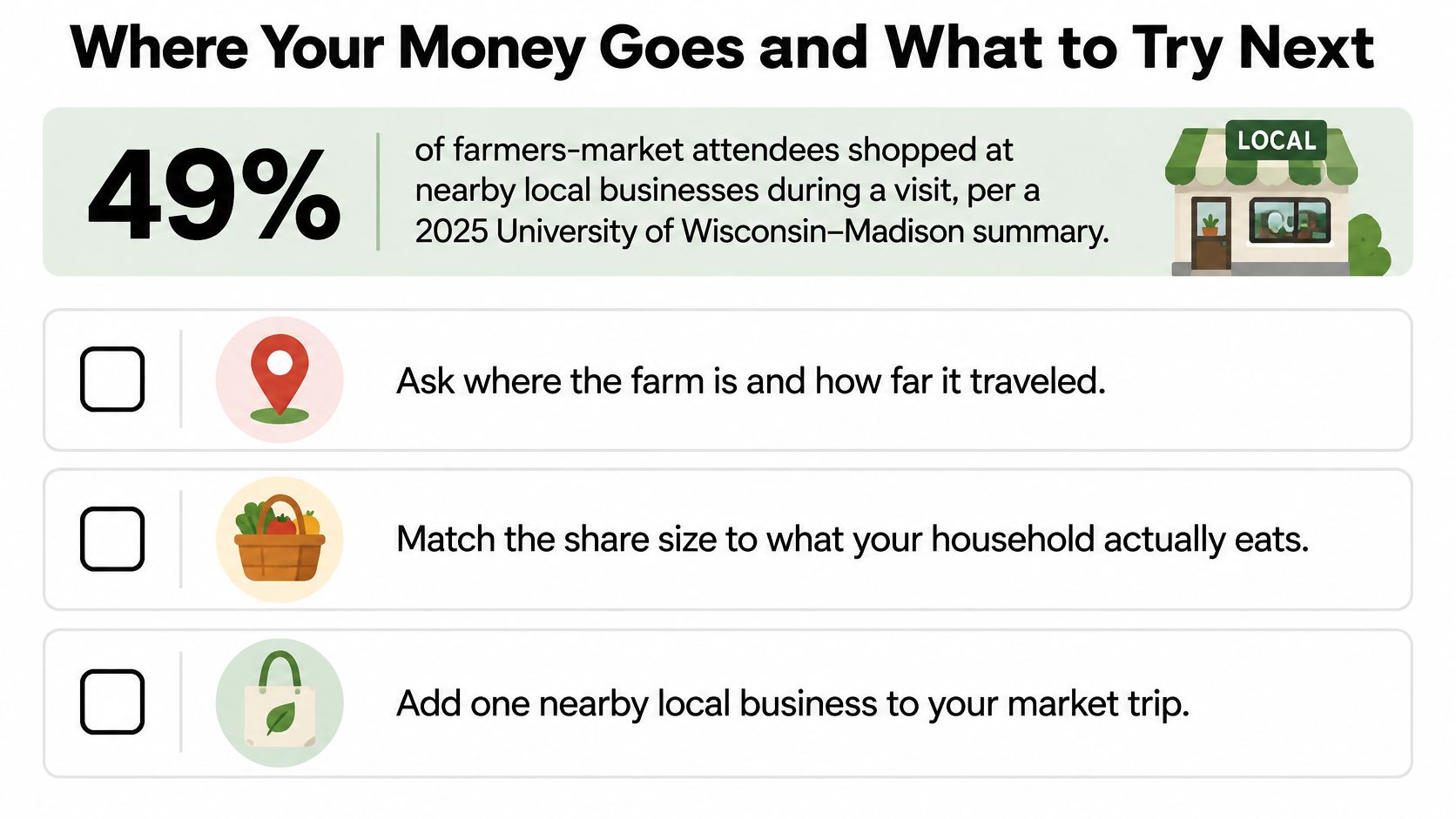
Two trips can cost the same and support very different things. A 2025 University of Wisconsin-Madison summary of farmers-market research found 49% of farmers-market attendees shopped at nearby local businesses during a market visit, and 42% ate at local restaurants on market days. Market money fans out across a neighborhood of independents.
A share concentrates it. The full amount lands with one farm before the season, paying for seed, labor, and acreage, with nobody between you and the grower. What you don't get is that same-day spillover into the bakery two doors down.
The channel is bigger than the parking lot suggests. USDA's 2022 Census of Agriculture work reported $17.5 billion in food sales through direct-marketing channels, and sales through farmers markets, on-farm stores or stands, and u-pick operations rose 33.2% after inflation to $14.2 billion between 2017 and 2022, per USDA's direct sales analysis. A single Saturday stall can look small next to a supermarket aisle. It belongs to the same channel.
The default I'd set
- Start at the market if you want flexibility, pay-as-you-go spending, and a wide mix of growers and makers in one stop. It's the lowest-risk way to learn what your household eats in a week.
- Add a share once you cook most dinners, can use a full box, and the pickup window fits your schedule. Test one season before you commit to two.
- Run a mix when the share covers staple produce and the market covers eggs, bread, honey, and the items you still want to choose yourself.
The same logic applies to the things you reorder anyway. Coffee, pantry goods, honey, and the rest of a weekly list can come from independent makers instead of a grocery shelf, and the dollar lands with one producer the way a share payment does. Loyaltie is a marketplace where you buy directly from independent makers and brands across the country, all in one cart. A jar of sunflower floral jelly works like a box of market tomatoes: a real person made it, and you know who.
Pick the one criterion from that first table that already bothers you, run it for four weeks, and keep whichever mix cuts your waste and missed pickups. Judge it by the cost of the meals you put on the table, not the sticker on the box or the bag. That's a better test than any price comparison you'll find online.
Loyaltie is a marketplace built for exactly this kind of shopping: you buy directly from independent makers and brands across the country, all in one cart, and every purchase through the marketplace is backed by Loyaltie. Whether this week calls for a market bag, a farm share, or a restock of the honey, coffee, and pantry goods you reach for daily, you can find the people who make them. Visit Loyaltie to browse independent brands and build a cart that fits how you really shop.