

You're probably at that awkward but exciting stage where your shop is working, customers are coming back, and the next question won't leave you alone: do you keep making every single thing yourself, or do you widen the shelf with products you'd be proud to stand next to?
That's where buying in bulk for resale starts to make sense. Not as a shortcut. Not as a race toward generic inventory. As a way to build a sharper shop with better everyday products from independent brands and local makers across the US. Coffee from a roaster you trust. Skincare from someone who obsesses over ingredients. Pet products from a maker who actually understands what they're putting into the package.
Done well, this kind of growth feels good. You're still curating with taste. You're still choosing quality. You're just no longer limited to what two hands can produce in a week.
Table of Contents
- Growing without flattening your taste
- Why this step feels bigger than it is
- What changes when you get this right
- Start with alignment, not availability
- Where to actually look
- What makes a good partner
- Talk terms early
- Learn your landed cost first
- A practical way to think about margin
- Compare your cost to a realistic selling price
- The fast decision filter
- What good numbers feel like
- Treat receiving like quality control
- Storage is part of the customer experience
- Compliance isn't the boring part
- Domestic sourcing helps, but it doesn't remove your job
- Price for the market you actually serve
- Write listings that sound like a person chose the product
- The first sale is proof of selection
The Next Step for Your Growing Shop
A lot of sellers hit the same ceiling.
You start with one great product line. It gets traction. Customers ask what else you carry. Someone buys your candle and asks if you also stock room spray. Someone grabs your handmade snack mix and asks if you've got coffee to go with it. A pet customer wants treats, then shampoo, then a travel tin for walks.
At first, it's flattering. Then it becomes a business question.
Growing without flattening your taste
The mistake is thinking growth means acting like a big-box retailer. It doesn't. For an independent seller, growth often looks more like becoming a thoughtful curator. You keep your standards. You just widen your assortment with products that feel native to your shop.
That's why sourcing from fellow independent US makers works so well. You can buy directly from the maker, skip the middleman, and add products that feel human instead of interchangeable. Customers notice that difference even if they can't always explain it. The textures are better. The ingredients are clearer. The packaging usually has more care in it.
You don't need to stop being a maker to become a better merchant.
A home fragrance seller can add a small run of bath soaks from a regional body care maker. A coffee shop can stock pantry goods from nearby producers. A wellness seller can pair their own blends with skincare or self-care items made by someone whose process they respect.
Why this step feels bigger than it is
New sellers often treat bulk buying like crossing into some formal wholesale world where every conversation is rigid and every order is huge. That isn't how many independent maker relationships work.
In practice, it often starts with a simple exchange: you love the product, you understand your customer, and you ask if the maker offers wholesale terms. Some do. Some don't. Some are open to a small first run because they also want thoughtful placement, not just volume.
If you're at that point now, it helps to read through practical seller resources before making your first few buying decisions. Loyaltie keeps a useful set of seller resources for growing your shop that can help you think through the operational side without losing your point of view.
What changes when you get this right
Your shop stops depending on a single hero product.
You give customers more reasons to come back. You also build a business that isn't so fragile when one product has a slow month, one ingredient gets delayed, or one production cycle runs long. That's the appeal. More resilience, better curation, and a shelf that feels more complete.
Finding Great Products From US Makers
The best resale inventory usually doesn't start with a spreadsheet. It starts with taste.
If you want your shop to feel cohesive, begin with products you'd be happy to buy yourself. For most independent sellers, that means looking for everyday categories people reorder naturally: coffee, skincare, pantry staples, wellness products, supplements, pet goods, home scent, and practical giftable items that fit into ordinary routines.

Start with alignment, not availability
A common beginner move is chasing whatever looks easy to source. That usually leads to a scattered catalog.
A stronger approach is to ask:
What does my customer already trust me for
If people buy from you for clean ingredients, don't suddenly add loud novelty items that weaken that signal.What problem does this product solve in everyday life
The strongest independent brands often make ordinary routines feel better. Better coffee in the morning. Better toner after washing your face. Better treats for a dog with a picky stomach.Would this still make sense on my shelf six months from now
You want products with staying power, not impulse inventory that looked good for a week.
Where to actually look
Independent US makers are easier to find than most sellers think. Start with local markets, regional gift shows, neighborhood retailers you admire, ingredient-focused product directories, and marketplaces built around direct-from-maker discovery.
If you want a broader sourcing map beyond your own local network, this guide to sourcing resale inventory is helpful because it shows different sourcing paths and the trade-offs behind each one.
You can also study live product pages to see how strong makers present themselves online. For example, wholesale coffee beans from Little Cup Coffee shows the kind of product that fits well in resale: familiar category, clear use case, and direct-from-maker context.
What makes a good partner
This part matters as much as the product itself.
You're not just choosing an item. You're choosing the person or team behind it. Independent brands can be fantastic partners when expectations are clear and the fit is real. You want someone who communicates well, ships consistently, and understands how their product behaves once it leaves their hands.
Look for these signals:
| What to check | Why it matters |
|---|---|
| Product consistency | Your second order needs to resemble your first |
| Packaging quality | Good product can still arrive looking rough |
| Ingredient or material clarity | Especially important in food, wellness, beauty, and pet categories |
| Responsiveness | Slow replies now often become bigger problems later |
| Wholesale openness | You want a maker who understands resale needs |
Practical rule: If a maker is hard to get basic answers from before the first order, don't expect the process to become smoother after payment.
Talk terms early
When sourcing bulk inventory for resale from independent US makers, negotiate minimum order quantities explicitly, because smaller manufacturers often accept lower MOQs than large factories to enable customization and market entry. Negotiating unit pricing to include bulk discounts is also standard when discussing terms with these suppliers, according to this manufacturer sourcing overview.
That matters because many new sellers assume the posted minimum is fixed. Often it isn't. A maker may accept a smaller opening order, a mixed-product case, or a test run if the conversation is thoughtful and the fit is good.
Ask directly. Be specific. Don't treat negotiation like combat. With independent brands, it usually works better as a practical conversation about what makes sense for both sides.
Smart Sampling and Negotiating Terms
The first bulk order shouldn't feel like a leap. It should feel like the result of a short, disciplined process.
That's especially true when you're buying from makers whose products you admire. Liking a product is not the same thing as being ready to resell it. Your job is to verify that the product holds up in transit, arrives as described, and still makes business sense after real-world handling.

A simple validation rhythm
One reliable framework for buying in bulk for resale uses a 5-week product validation process: identify 3 candidate SKUs in Week 1, calculate full landed costs in Week 2, disqualify any supplier refusing to provide audit reports or references in Week 3, order 3–5 units as paid samples in Week 4, and negotiate terms in Week 5, based on Alibaba's product validation guide.
Even if you're sourcing from US makers rather than overseas factories, the logic still holds. Slow yourself down just enough to test what needs testing.
I'd break the sampling step into three checks:
Use check
Does the product perform the way your customer expects?Handling check
Does the packaging survive shipping, shelves, and customer pickup?Listing check
Do you have enough clear product information to describe it accurately and confidently?
Sample like a seller, not just a fan
If you're evaluating fragrance, body care, or pantry items, don't just open the sample and decide whether you like it. Handle it the way a customer will. Put it in a mailer. Leave it in a warm room. Re-read the label. Notice whether the cap loosens, the pump sticks, or the ingredients copy raises questions.
A product such as Stillness botanical Perfume Mini 5ml | Tap & Echo by Loyaltie gives you a good example of what to look for in maker detail. The available product snapshot notes that the base begins with lavender extract made by infusing organic lavender buds in alcohol for 6 weeks, and that this base makes up half the volume. That kind of process detail is useful because it helps you judge whether the maker understands and communicates their formulation clearly.
If you can't explain what makes a product good in plain language, you're not ready to stock it.
Terms that protect both sides
Negotiation gets easier when you stop framing it as getting the lowest possible price.
What you want is workable terms. A manageable opening order. Clear reorder timing. Reasonable lead times. Packaging standards. Replacement expectations if units arrive damaged. Written confirmation of what's included and how it ships.
A strong first message to a maker usually includes:
Your store context
Briefly explain what you sell and who buys from you.The products you want to test
Be precise about variants, sizes, or scents.Your planned first order shape
Ask whether they offer mixed cases, smaller opening orders, or introductory wholesale runs.Operational questions
Ask how they pack products, what reorder timing usually looks like, and whether labels are retail-ready.
Short, respectful, and clear beats overly polished every time.
Calculating Your True Costs and Profit
Most resale mistakes happen before the order is placed.
A seller sees a good unit price, imagines a markup, and calls it profitable. Then the shipment arrives, platform fees show up, packaging supplies add up, and the margin that looked healthy on paper starts to disappear. That's why the number that matters most is landed cost per unit, not supplier price.
Learn your landed cost first
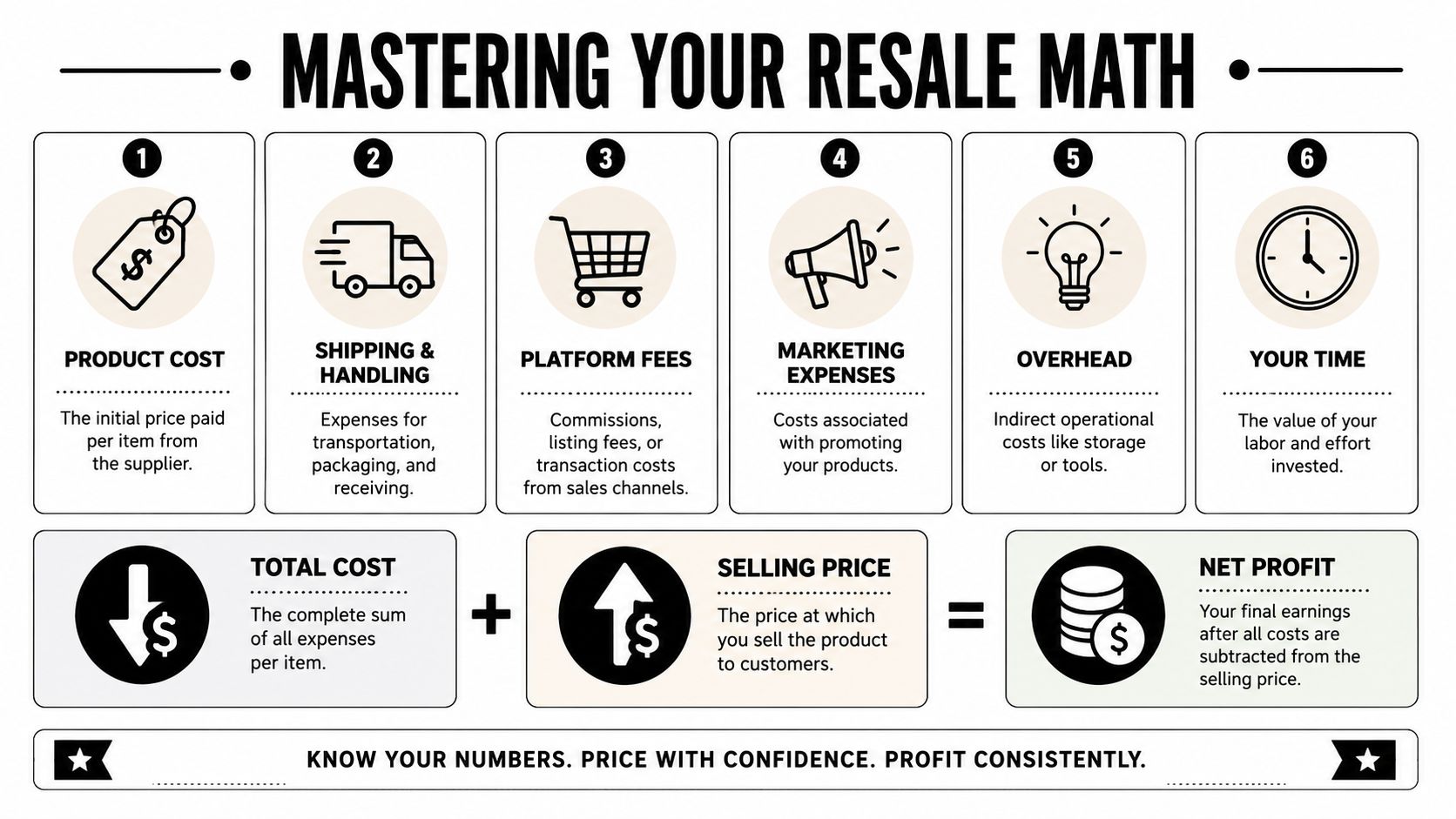
For bulk resale, reported profit margins typically fall between 40% and 75%, and reaching that range depends on calculating the full landed cost per unit and moving inventory within 30 to 60 days, according to Qogita's bulk buying analysis.
Landed cost per unit is simple in principle. Add up everything required to get the item ready for sale, then divide by the number of sellable units.
That usually includes:
Product cost
What you paid the maker per itemShipping and receiving
Freight, local delivery, packing material, and any receiving costsSales channel fees
Some platforms charge meaningful fees that must be in the math from day oneOperational overhead
Storage, software, labeling tools, and the quiet costs that don't belong to one item but still hit the businessYour labor
If an item takes time to inspect, relabel, pack, or explain to customers, that work has value
A practical way to think about margin
You don't need a fancy system at the start. You need disciplined arithmetic.
Use a worksheet or spreadsheet with one row per product. Don't estimate loosely. Enter the actual invoice amounts, actual shipping charge, actual packaging cost, and expected sales channel fee. Then compare that total to the realistic selling price.
Sellers get themselves into trouble by pricing against hope. If the product only works at a dream retail price, it doesn't work.
Healthy resale businesses survive on honest math, not optimistic math.
Compare your cost to a realistic selling price
The selling price should come from the market you're entering. If similar products are already listed elsewhere, study how buyers behave there. If they're sold in boutiques, compare your shelf position rigorously. If they're online, ask whether your photos and trust signals are strong enough to support the same price.
A useful companion read here is this e-commerce inventory optimization guide, especially if you're starting to carry enough stock that storage and movement decisions affect profit.
The fast decision filter
When I'm mentoring a newer seller, I tell them to use a short decision table before every purchase:
| Question | If yes | If no |
|---|---|---|
| Can I explain why this product belongs in my shop? | Keep evaluating | Pass |
| Do I know the full landed cost per unit? | Keep evaluating | Stop and calculate |
| Is the likely selling price realistic for my customer? | Keep evaluating | Rework or pass |
| Can I move this inventory quickly enough to keep cash free? | Buy small first | Don't over-order |
That last point matters more than people think. Slow inventory doesn't just sit there. It ties up money you could have used for faster products, packaging, reorders, or better merchandising.
What good numbers feel like
Good numbers feel calm.
You know your cost. You know your likely selling price. You know how fast it needs to move. You know what happens if sales are slower than expected. Once those answers are clear, buying in bulk for resale becomes much less emotional. You're no longer guessing whether a product is “worth trying.” You know whether the business can support it.
From Delivery to Your Doorstep
A clean purchase order is only the middle of the job. The actual test starts when the boxes arrive.
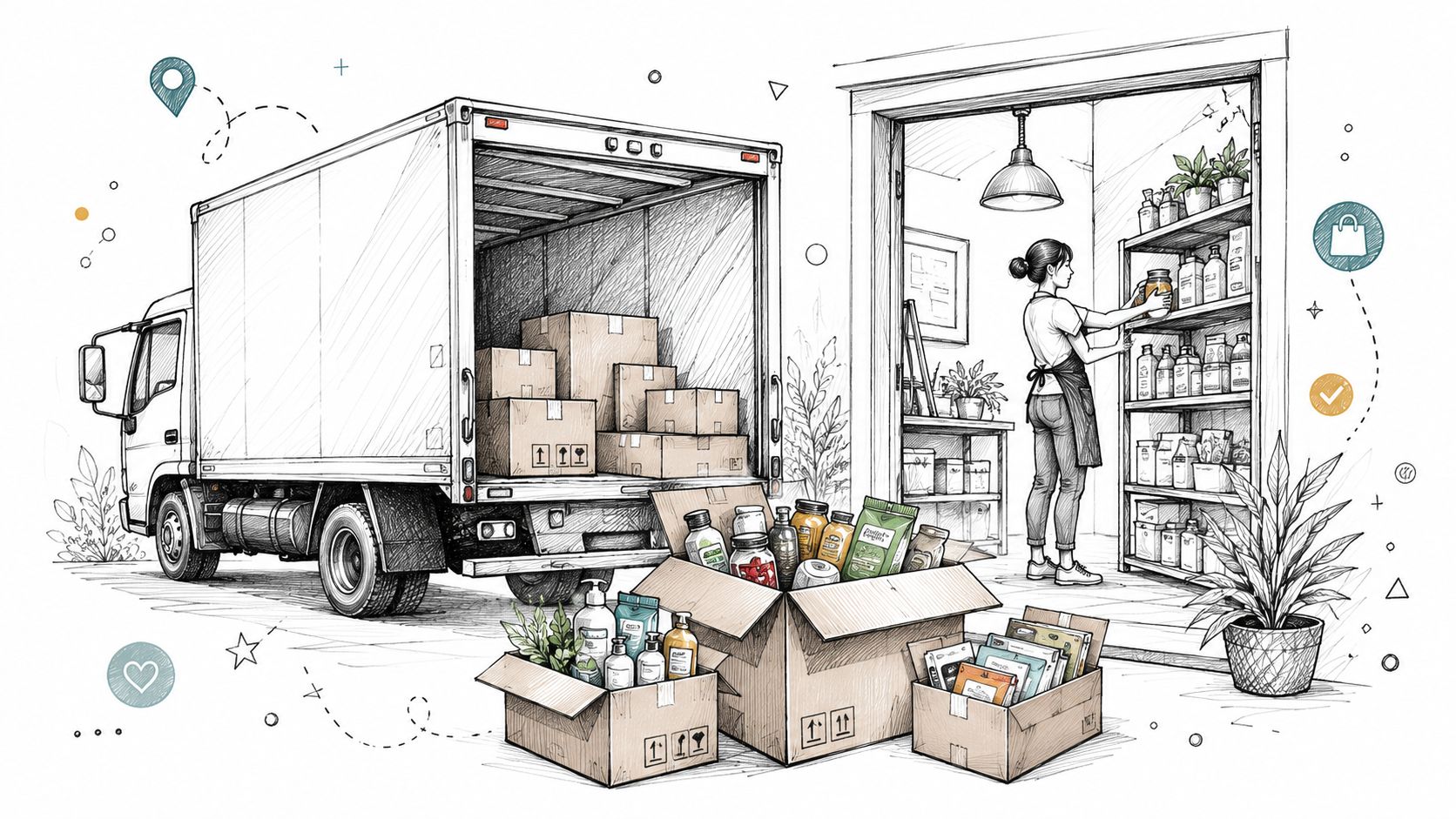
The process of managing inventory reveals whether many sellers are building a hobby or a real resale operation. Receiving, inspecting, storing, and preparing products for sale isn't glamorous, but it's the work that protects your reputation. Customers don't care whether a dented box came from the maker, the carrier, or your storage setup. They only know what landed in their hands.
Treat receiving like quality control
The fastest way to create avoidable headaches is to stack incoming boxes in a corner and assume everything's fine.
Open shipments promptly. Count units. Check labels. Inspect seals. Look for leaks, cracks, crushed corners, or any variation from the approved sample. If you're buying food, wellness, beauty, or pet products, this step matters even more because packaging details and batch consistency affect trust right away.
A basic receiving routine should include:
Count every unit
Don't trust the packing slip blindlyInspect packaging condition
Damage caught early is easier to document and resolveSeparate sellable from questionable stock
Never let uncertain units drift into regular inventoryRecord lot or batch details when relevant
Especially useful in ingestible or topical categories
Storage is part of the customer experience
Storage sounds back-office, but it shapes the final product.
If items are sensitive to heat, humidity, breakage, or scent transfer, your setup matters. So does your packaging supply quality. If you need sturdier shipping materials for customer orders, a supplier with a broad range of cardboard carton box options can be useful as you test what sizes and strengths fit your products best.
For heavier pantry items, glass skincare, and boxed sets, don't wait until your first damaged shipment to take packaging seriously. Build the standard early.
A product can be excellent at the maker's studio and still become a disappointment in your hands if you store or ship it poorly.
Compliance isn't the boring part
For food, wellness, and beauty, compliance is where many promising resale ideas fall apart. Sellers often account for unit cost and freight but forget the cost of proving a product is ready to sell in a compliant way.
For niche categories like wellness, food, and beauty, hidden compliance costs for third-party testing and regulatory filings can consume 15% to 25% of the initial bulk budget, based on Alibaba's analysis of bulk reselling costs.
That's a big enough share of the budget that you can't treat it as an afterthought.
If you're stocking ingestibles, topical products, or products with regulated labeling requirements, ask the maker detailed questions before you buy. What testing do they already have? What claims are on the label? Are the units retail-ready as-is, or do you need to add anything for your sales channel? If the answers are vague, pause.
Domestic sourcing helps, but it doesn't remove your job
Working with US makers simplifies a lot. Lead times are often easier to discuss. Communication is closer. Reorders can be more flexible. It can also give you better access to direct shipping for test orders. Saveur's feature on independent food producers noted that some brands, including Saxelby Cheese, offered direct online discounts such as a 10% code for orders, and highlighted makers like Dandelion, Raaka, and Fruition as shipping directly to consumers through their own infrastructure in this roundup of small food producers.
That kind of direct infrastructure is useful when you're validating a product and trying to understand how the maker handles fulfillment.
If you sell food gifts, for instance, a product like English almond toffee bulk case from Dudley's Toffee fits the kind of category where receiving condition, storage environment, and packaging protection all matter before the customer ever tastes it.
Pricing, Listing, and Making Your First Sale
When it's finally time to sell, a lot of new resellers undo their own work by pricing too high, writing vague listings, or leaning too heavily on the maker's suggested retail price.
That's risky. Financial failure often happens when resellers use MSRP instead of checking actual sold comps, and average sold prices on platforms like eBay are typically 15% to 20% lower than MSRP. A common filter is to keep a minimum 30% ROI threshold per unit, as outlined in this resale pricing guide.

Price for the market you actually serve
That doesn't mean racing to the bottom. It means respecting the difference between a maker's ideal shelf price and the price buyers reliably pay.
Your listing price has to balance four things:
- Your true cost
- Observed market value
- The quality of your presentation
- The kind of customer you've built trust with
If your photos are weak, your copy is vague, and your store has little social proof, you may not be able to command the same price as a polished retailer. That's normal. Tighten the listing rather than forcing the number.
Write listings that sound like a person chose the product
Resale listings work best when they answer the buyer's quiet questions.
What is it? Who is it for? What does it feel like to use? Why did you choose this version instead of the many forgettable ones online? If the product is from an independent brand, say enough about the maker's process to make the listing feel grounded, but don't bury the shopper in filler.
For marketplaces, keep the structure clean:
| Listing element | What it should do |
|---|---|
| Title | State the product clearly without stuffing keywords |
| First paragraph | Explain the benefit in plain language |
| Product details | Cover materials, ingredients, size, or use case |
| Why it belongs here | Connect it to your shop's taste and standards |
A marketplace where people discover and buy directly from the best independent brands in the US can be a practical fit for this kind of inventory. Loyaltie is one example if you want a channel built around direct-from-maker shopping rather than generic mass listings.
A quick visual example helps here:
The first sale is proof of selection
Your first sale tells you more than your first order ever could.
It shows whether your pricing, product choice, and listing all aligned well enough for someone to trust you. If it sells quickly, don't instantly scale. Check whether the margin still holds after packing time, platform fees, and customer service. If it stalls, revisit the listing and the price before blaming the product.
Buying in bulk for resale gets satisfying right here. Not when the invoice is paid. When the product lands with the right customer, at the right price, and you can see the next reorder clearly.
If you want a place to discover and buy directly from independent brands across the US, Loyaltie is a marketplace where shoppers can find real makers without the middleman, and sellers can present products in a context that fits quality-driven everyday goods.