
You are staring at a shelf or a checkout screen, trying to decide if the coffee, face cream, or dog food from a maker nearby is really better than the big brand you usually grab. It might be. It might not. The good news is you don't have to guess based on a nice label or a feel good story. You can buy local items the same way you'd judge any upgrade, by checking what's inside, what it costs per use, and how easy it is to get again.
Table of Contents
How to Buy Local Items in Six Steps
Your usual coffee runs out on a Thursday. You could grab a bag from the big brand shelf, or you could try the roaster down the road whose beans were roasted this week. That one small decision is the easiest place to start, because you'll know within a few mornings if the switch was worth it.
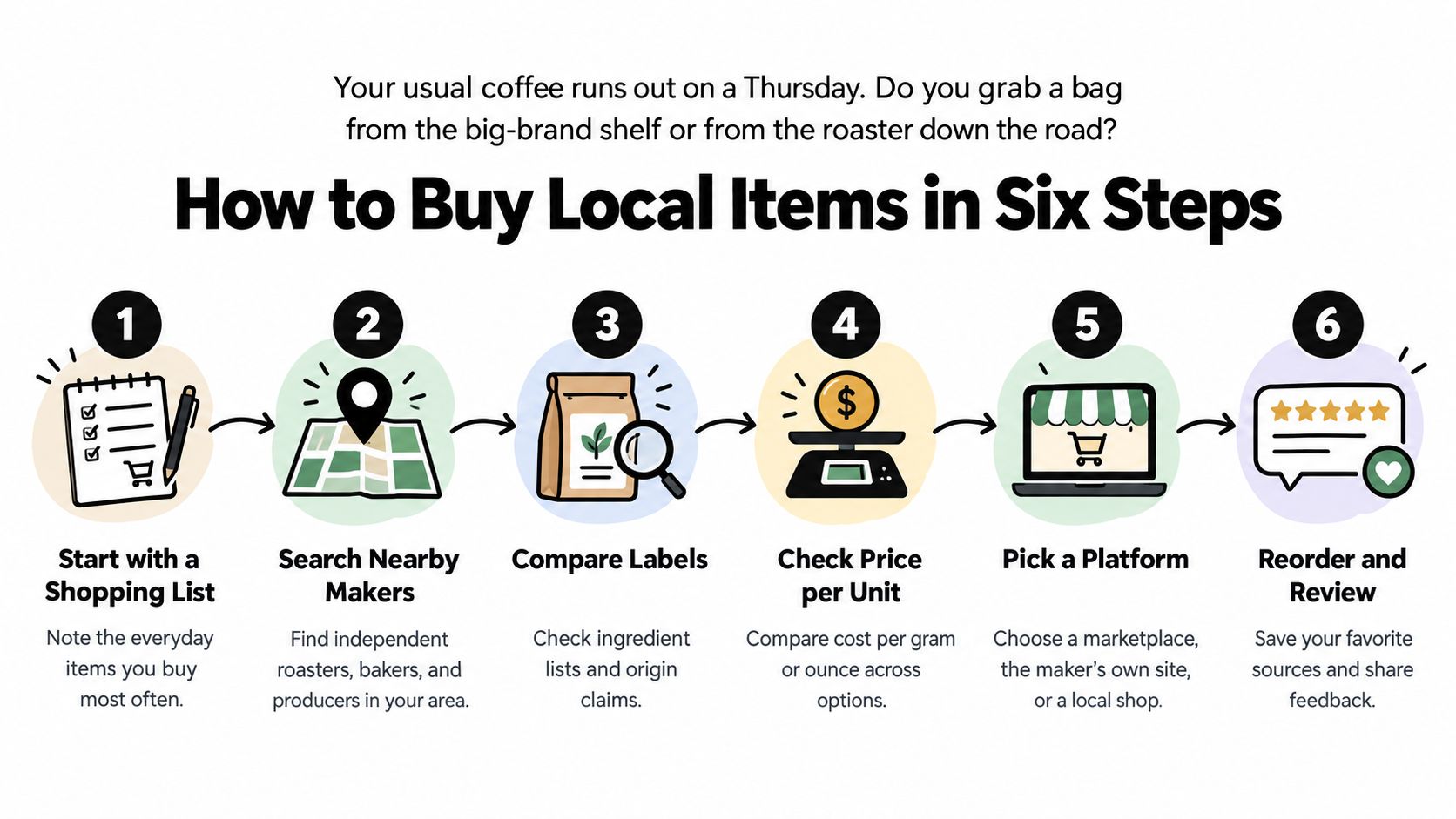
The Six Steps That Keep It Simple
Pick one everyday item you rebuy. Choose something you use up every few weeks, like coffee, granola, skincare, supplements, or dog food. A repeat purchase gives you a fair test, since you'll notice quality, freshness, and how long it lasts.
Find two or three local makers. Don't commit to the first name you see. A short shortlist lets you compare ingredients, price per ounce, and delivery terms side by side.
Check the label before the cart. Look at the ingredient list, the producer name, and the location. If a maker won't tell you what's inside or who made it, that's your answer.
Pick where to buy. A marketplace helps you compare several independent brands at once. A maker's own site works well for reorders, and a market stall lets you taste or smell before you pay.
Confirm shipping, returns, and payment. Check the final total, the ship date, and what happens if something arrives damaged. Surprises at checkout are where a lot of local purchases fall apart.
Set up a reorder after it earns one. Don't lock yourself in on day one. If the first bag, jar, or bottle is genuinely better, put it on a regular delivery rhythm so you don't run out and default back to the old brand.
Local on the label doesn't automatically mean better in the jar. These steps are how you prove it on your own shelf.
If you want ideas beyond shopping, there are practical ways to support local businesses that fit normal routines too. For now, one test purchase this week is enough. Start with the item you complain about most, and let the product make the case.
Where to Find Local Makers Online and In Person
Direct-to-consumer buying is already a normal route to market for US farms. USDA 2020 Local Food Marketing Practices Survey data found that 77% of farms with direct sales sold to consumers, and those consumer sales totaled $2.9 billion. Nearly three in five of those dollars, $1.7 billion, moved through on-farm stores and farmers markets.
The practical question is which channel gives you the most useful quality signals before you pay.
Where to Look First
| Channel | Best for | How to search | Watch out for |
|---|---|---|---|
| Local marketplace (Loyaltie) | Comparing several independent brands in one place | Browse by category and read each maker profile | Confirm each seller's delivery window on the listing |
| Farmers markets | Produce, honey, eggs, baked goods | Check market association sites and USDA local food directories for schedules | Seasonal hours and some stalls cash only |
| Craft fairs and maker markets | Skincare, candles, pet treats, gifts | Local event calendars and city arts council listings | Some vendors resell goods made elsewhere, so ask |
| Maker social accounts and map searches | Finding makers close to home | Search product plus city and check location tags | Follower counts do not prove a real address |
| On-farm stores and roadside stands | Eggs, meat, cider, direct from farm staples | State department of agriculture farm listings | Limited hours and seasonal stock |
| Local shops with maker shelves | Quick pickups and gifts | Ask staff who makes each item | Consignment products may come from anywhere |
A marketplace listing makes comparison easier for fresh items too. A microgreens variety box with weekly delivery shows what's included and the delivery rhythm before you order, which beats driving to a stall that already sold out.
Three Search Moves That Work
- Product plus city in a map app. Search coffee roaster, soap maker, or pet food plus your town, then check whether the maker tags a real location.
- Regional directories. Look at food and farm directories run by state agriculture departments and the USDA for producers near you.
- Ask the shop staff. Ask who makes an item on a maker shelf. The answer often reveals whether it's made in-house or only resold there.
Each channel gives you different evidence. Markets let you taste and smell before money changes hands. A maker's own listing puts the producer name and reorder terms in writing. Treat a verifiable address, a named maker, and a clear ship window as the baseline. Pay the local premium when you can confirm those three things. When a seller cannot name the maker or will not commit to a delivery window, the local tag is decoration, and you are better off buying on price.
Reading Labels to Spot Better Local Products
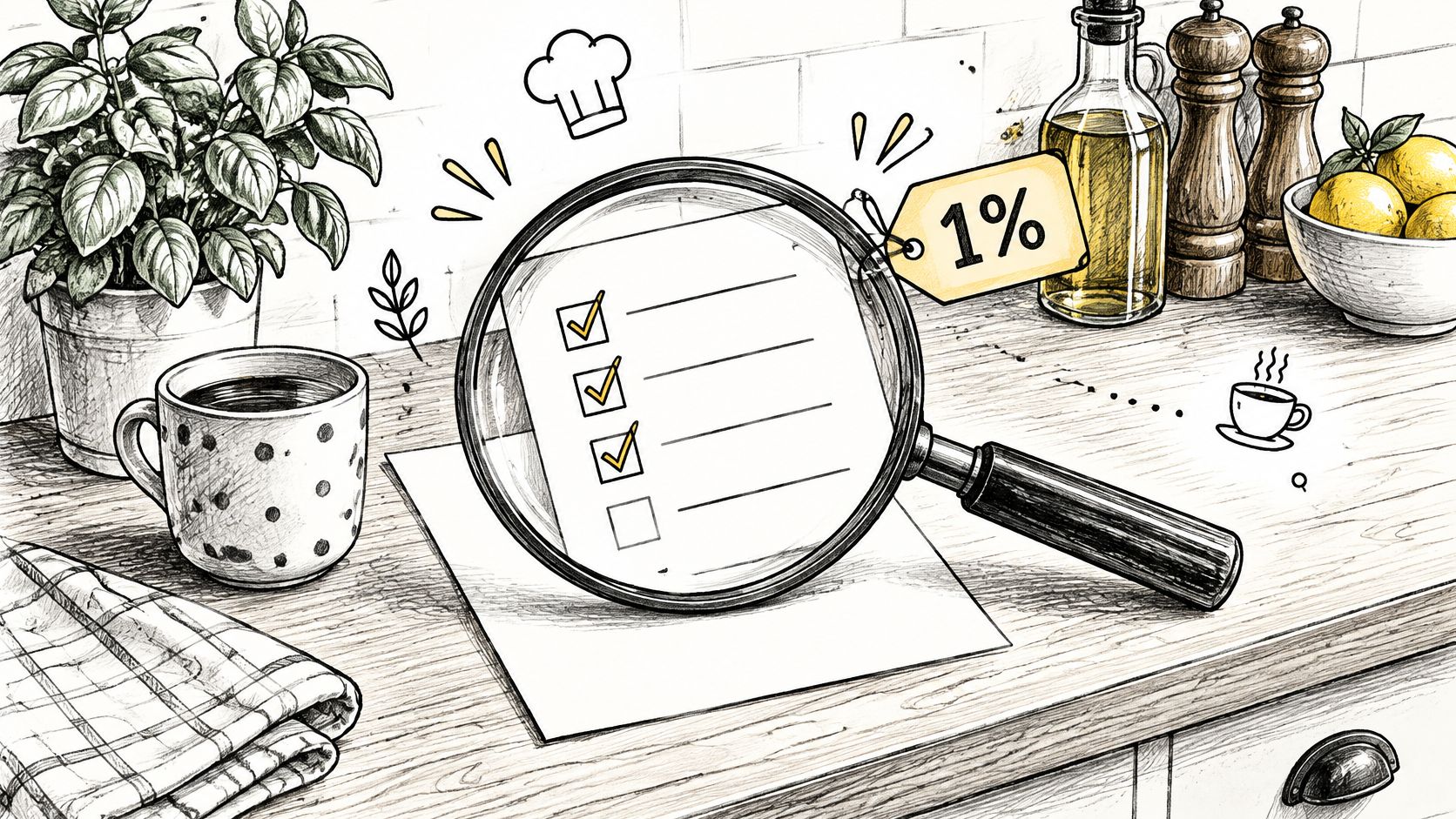
Start with skincare, because the rule is concrete. FDA cosmetic labeling guidance on ingredients listed in descending order of predominance says retail cosmetics must list ingredients that way, and ingredients present at 1% or less may be listed in any order after the higher concentration ingredients. That means the first few names tell you most of what matters in a face cream, cleanser, balm, or serum.
Here's a quick visual for what to scan first on a label before you pay.
Retail cosmetic labels must also state the product identity, net quantity, and the name and place of business of the manufacturer, packer, or distributor. The rules don't guarantee one formula beats another. They do make a fair comparison possible, so you can favor makers who clearly disclose what's inside and who stands behind it.
What to Check by Category
| Product | What to check on the label | Red flag |
|---|---|---|
| Skincare | Ingredients in descending order, net quantity and maker name | No full ingredient list or only vague natural claims |
| Supplements | Supplement Facts panel with amount per serving and servings per container | Proprietary blend with no amounts and no named manufacturer |
| Pet food | Ingredients listed most to least by weight and a named business with place of business | No ingredient list or no contact details |
| Coffee | Roast date, origin country or farm, net weight | No roast date and origin listed only as blend |
| Granola and packaged food | Full ingredient list, net weight and producer name with location | Homemade claim with no producer address |
For supplements, check the Supplement Facts panel for serving size, servings per container, and the amount of each ingredient per serving. A proprietary blend can hide individual amounts, which makes cost per serving hard to judge. For pet food, ingredients listed from most to least by weight show you what makes up the bulk of the bag.
This short video walks through how to read those details in practice.
Three Terms People Mix Up
Local production means it's made nearby. Local ownership means the business is owned nearby. Reseller activity means someone bought goods in and relabeled or resold them. A maker can own the business locally and still source base ingredients from elsewhere, so ask where key ingredients come from if that matters to you.
Ask before you buy: Where is it made, who packs it, and what sits in the first three ingredients?
A maker who answers those three questions clearly has already passed a useful trust test. A vague answer isn't proof of a bad product, but it's a good reason to try a different brand first.
When Local Costs More and When to Skip It
Say you're holding a jar of market honey priced at twice the supermarket bottle. The right question is whether the extra money buys something you can check: freshness, a named producer, or a product that lasts longer.
Buyers weigh this everywhere. PwC's 2025 survey of 21,075 consumers across 28 countries found 44% were willing to pay more for locally produced food, while 56% would choose a cheaper product made outside their country when forced to choose.
Pay more when the label is clear, the producer name and location are listed, and freshness is the point. Fresh roasted coffee, honey, and eggs qualify, because you can taste or see the difference within days.
Skip the premium when the label is vague, the seller resells goods made elsewhere, or you can't detect a difference after a fair try. And compare cost per serving, not sticker price. A smaller supplement bottle with clear amounts per serving can cost less per day than a bigger bottle hiding behind a proprietary blend.
Run the granola test before paying up: if a 300g local jar costs more per serving but you'll finish it in two weeks at peak freshness, buy it. If it will sit in your cupboard for months, the supermarket box wins.
Picking the Right Platform for Each Purchase
Say you found a honey you like at a weekend market and want it shipped every month. The right checkout for that reorder is a different one from the checkout for comparing five candle makers you have never bought from. Platform choice is really a risk question: how well you know the maker, and how much protection you want behind the payment.
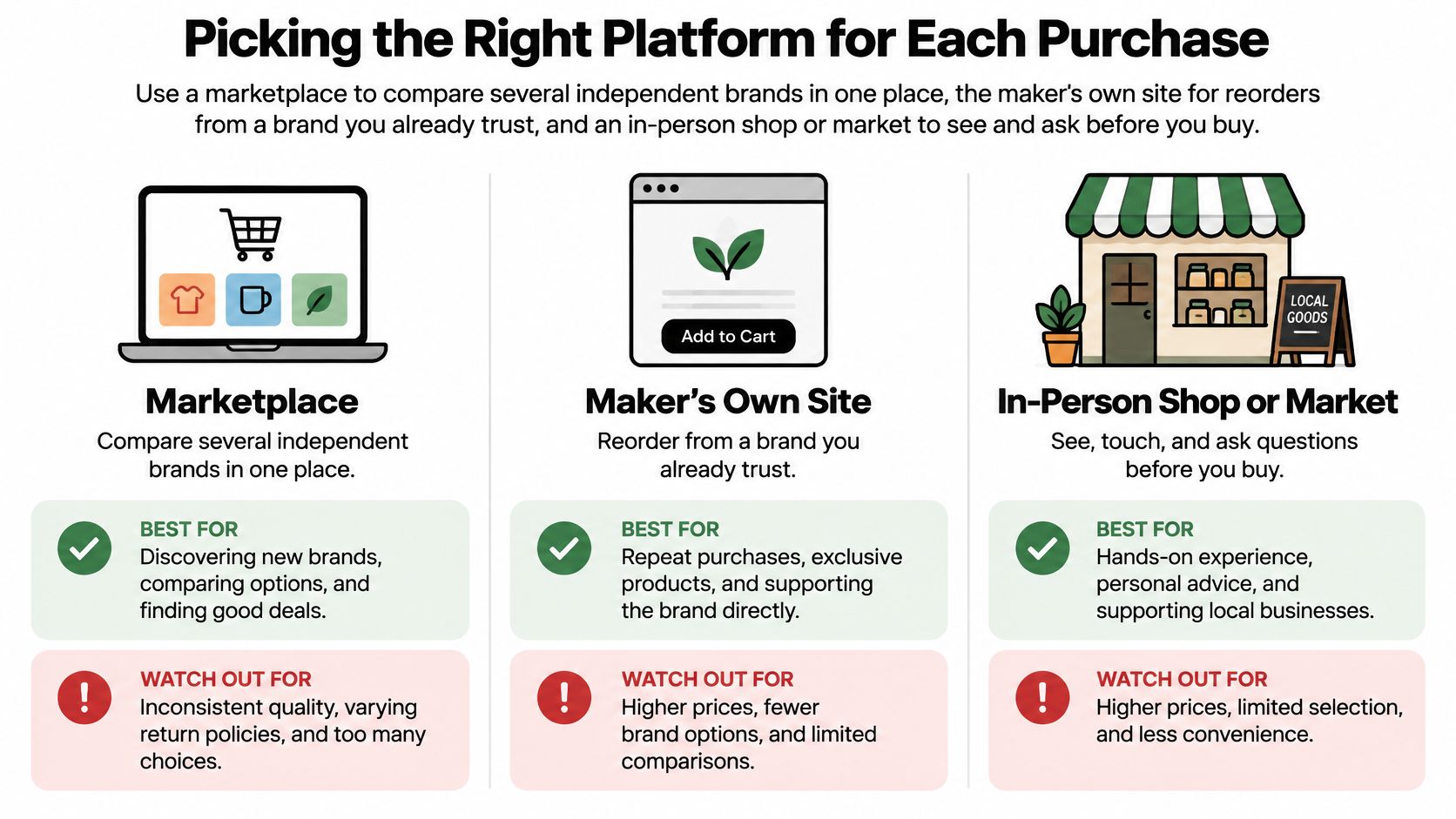
Match the Platform to the Purchase Situation
| Purchase situation | Order protection to look for | Shipping and returns | Where it fits |
|---|---|---|---|
| Comparing several makers at once | Order backing spelled out before checkout | Set per seller, confirm on each listing | Online marketplace |
| Reordering a product you already trust | A stated refund policy on the site | Set by the maker | Maker's own website |
| Tasting or inspecting before you pay | You handle the product before money moves | Usually none once you take it home | Farmers market or maker fair |
| One-off buy from a maker you have vetted | A payment method with buyer protection | Agree on terms in writing first | Social shop or direct message |
For the first row, Loyaltie's online shop collects independent makers in one place so you can compare categories side by side. Judge any marketplace on what you can verify: how the sign-in and checkout flow works, whether the Help Center answers buyer questions before you order, and whether order backing is stated plainly. Those details tell you more than any tagline.
Be honest about the limits. Shipping and return terms are set per seller on most marketplaces, so check each listing rather than assuming one policy covers every brand. And once you know you love a product, the maker's own site is often the better call, because it cuts a step out of every reorder.
Marketplace for discovery, maker site for loyalty, market stall for trying something new.
Match the channel to the risk. A first order from an unfamiliar maker deserves platform backing and written policies. A third reorder from a maker you trust just needs a working cart.
What Shipping, Returns and Payment Should Look Like
In PwC's Voice of the Consumer 2025, 41% of Americans said they would shop at small businesses more often if it were more convenient, and 36% would shop online more often if small businesses offered free shipping. Slow delivery, vague returns and surprise checkout costs are product flaws you can test before paying.
A fair jar price can turn into a bad buy once delivery, return postage and a made-to-order wait are added. Run the checkout screen like a label read: total cost, dispatch date, refund route.
Confirm This Before You Pay
- Ship-by date. Check whether the item is in stock or made to order, and when it leaves the maker.
- Final shipping cost. Judge the total at checkout. A fair product price can stop looking fair after delivery is added.
- Return window. Read whether opened skincare, supplements, or food can be returned at all, and who pays for return shipping.
- Payment timing. Confirm which payment methods are accepted and whether you're charged at order or at dispatch.
- Damage plan. Ask what happens if a jar arrives cracked, a bag is torn, or an order is short.
- Combined delivery. Find out whether several makers can be combined into one delivery, or whether each ships separately.
Pay the local premium when those answers sit on the listing. Skip it when the policy page is blank, the ship date stays fuzzy, or delivery charges appear only at the last step.
Buyer protection matters most in a social shop or direct message, where the platform may not stand behind the order. Keep the promised ship date, price and refund route in the message thread before you send money.
Good makers answer these questions up front because clear terms are part of the craft.
Set Up Your First Reorder Before You Forget
A good first purchase only saves you effort if you reorder on time. Relying on memory usually means you notice an empty coffee bag or supplement bottle on the morning you need it, then grab whatever's fastest.
Typical Reorder Windows by Product Category
| Category | Typical reorder window | Why it fits |
|---|---|---|
| Coffee | Every 2 to 4 weeks | Fresh roast flavor fades over weeks |
| Granola and snacks | Every 2 to 4 weeks | Depends on household size and portion |
| Hot honey and pantry sauces | Every 1 to 3 months | Small bottles last a long time |
| Pet food | Every 3 to 6 weeks | Bag and pouch sizes vary a lot |
| Supplements | Every 1 to 2 months | Matches the servings per container on the label |
| Skincare | Every 2 to 4 months | Depends on jar size and how often you use it |
Set the Rhythm in Five Steps
- Note the package size and the date you opened it.
- Divide the contents by how fast you use them to estimate days left.
- Set a reminder about five days before you run out, which covers ordering and shipping time.
- Reorder from the same maker through the same channel so the terms stay familiar.
- Keep a second maker in each category as a backup for when stock runs out.
For coffee, a rotating micro-batch coffee you can buy on a plan shows how regular delivery can match a fresh roast cycle. For pantry staples, the Chunky Nut Granola, Oats & Date Syrup, Pistachio + Macadamia, Great Taste Award, 300g Jar | HOMEMADE GRANOLA by Loyaltie is described as chunky clusters of oats, nuts and seeds, lightly sweetened with date syrup and toasted in coconut oil, which makes it an easy item to test for a repeat breakfast order.
Place your first reorder this week if a product has already earned it. If not, set the reminder today while the open date is still fresh in your mind.
Ready to buy local items without the guesswork? Visit Loyaltie to discover independent brands across coffee, food, skincare, wellness, and pet products, check the maker and label details on each listing, and buy directly with every order backed by Loyaltie.