
You've found a jar that sounds just right: raw, local, wildflower, maybe even harvested near home. The photos are lovely, the description reads well, and you're one tap from checkout. Before you buy local honey online, take a moment to check what the listing proves. A few clear details can tell you far more than a string of reassuring adjectives.
Independent makers can offer distinctive flavor, a named place of origin, and a direct connection to the person who keeps the bees. But “local” is the start of the check, not the end. Look for the producer, harvest details, label information, and a clear answer about what's in the jar.
Table of Contents
- What a Trustworthy Honey Listing Shows
- How to Decode a Honey Label in Six Steps
- Certifications Worth Checking and What They Miss
- Picking the Right Honey for Your Use
- How to Vet a Maker Before You Buy
- Crystallization, Shipping Damage and Returns
- Confirm Your First Local Honey Order
What a Trustworthy Honey Listing Shows
A listing says raw, local, wildflower honey, and the jar looks perfect in the photo. Before you add it to your cart, check whether you can identify who produced it, where it came from, and what the seller can demonstrate about its claims.
The FDA's honey labeling guidance offers a useful authenticity screen: single-ingredient honey can be labeled “honey,” the producer should be identifiable, floral claims should have support, and added sweeteners shouldn't be hidden. A short ingredient panel isn't automatically suspicious, because a product made from one ingredient doesn't need a separate ingredient statement. Vague naming or an unexplained sweetener is a better reason to pause.
| Check | What a solid listing shows | Red flag |
|---|---|---|
| Producer identity | Named beekeeper, apiary location, state, and a working contact | Only a logo, a stock photo, or “family farm” with no name |
| Harvest details | Harvest month and year, plus a batch or lot number | No date, or a “current season” claim with nothing behind it |
| Floral claim | Evidence the named plant is the chief floral source | “Clover” or “orange blossom” with no support |
| Sweetener disclosure | Ingredient information matches the product, and blends are labeled as blends | Syrup implied in the description but missing from the label |
| Label photos | Clear views of the front, back, and ingredient panel | Only a styled hero photo of the jar |

Crystallization, color, and the word “raw” aren't laboratory proof of authenticity. Honey can vary naturally in appearance and texture, so use those features to decide whether you like the product, not to verify what's in it.
A seller who doesn't show a harvest date isn't automatically dishonest, but you can't verify details you can't see. If two or more checks come up empty, I'd choose another maker. For a real listing example, compare the product description with the available details on Raw Wildflower Honey with goldenrod and aster notes.
How to Decode a Honey Label in Six Steps
Read the label in order, and answer a simple yes-or-no question at each step. That keeps familiar words like “raw” from doing more work than they should.
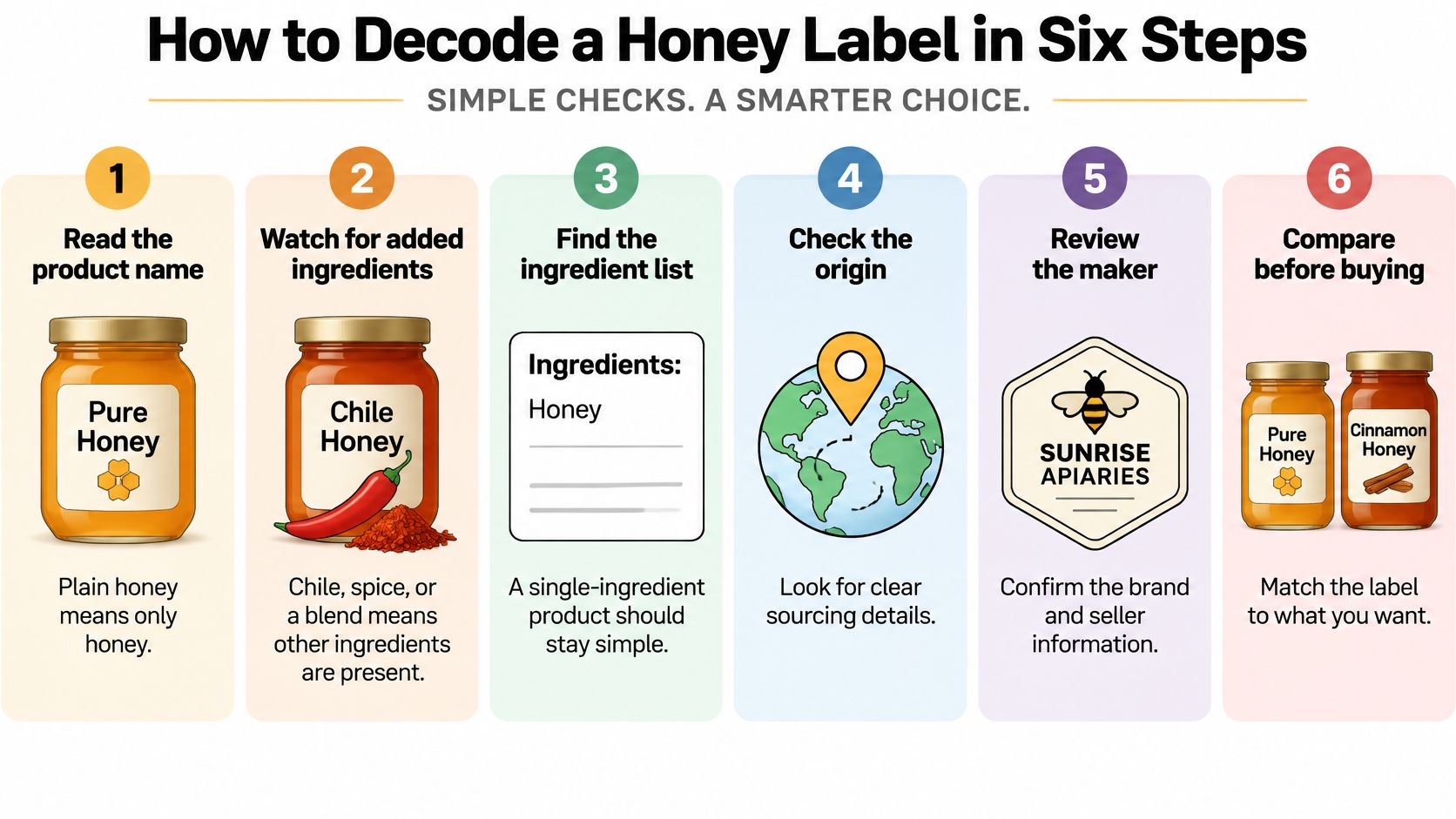
Read the product name. A product named “honey” should contain only honey. If the name includes chile, spice, or another flavor, look for the blend's added ingredients. Can you tell from the name whether it's plain honey or a flavored product?
Watch for added ingredients. Words such as “infused” or “spiced” suggest there may be something besides honey in the jar. The label should make that clear rather than leaving you to infer it from a photograph. Does the product description match the product name?
Find the ingredient list. A single-ingredient honey product doesn't need a separate ingredient statement, so the absence of a list alone isn't a red flag. If the description says the honey contains something extra, check that the label names it. Can you account for every ingredient the seller describes?
Compare the ingredient list with the nutrition panel. The FDA's guidance on added sugars in honey says single-ingredient honey containers don't have to state grams of added sugars per serving, but they must show the percent Daily Value. That percentage doesn't mean another sweetener was added; products with multiple ingredients have different requirements and must show both grams and percent Daily Value. Does the panel make sense alongside the ingredients?
Check the origin. Some packaged honey products that carry a USDA grade mark or similar USDA statement must show country of origin. If that rule applies, the origin should be printed legibly and permanently near the relevant USDA mark, preceded by wording such as “Product of.” Is the origin clear, or can the seller tell you where it was produced?
Weigh the claim words, then compare. “Raw,” “unfiltered,” “local,” and “crystallized” don't establish a jar's geographic origin or purity by themselves. Save a photo of the label and listing so you can compare them with the jar that arrives. Do the visible details support the claims you care about?
Nutrition labels aren't the only labels worth learning to read. If you're comparing other products for clear sourcing and ingredients, this guide can help you find pesticide-free tea in Australia.
Certifications Worth Checking and What They Miss
A seal can answer a specific question, but it can't tell you everything about a jar. Treat certification as one layer of information, alongside a named producer, a traceable batch, and evidence for any floral claim. The strongest way to read any logo is as a starting point: find the record behind it.
| Certification or proof | What it verifies | What it does not tell you |
|---|---|---|
| USDA Organic seal | Production met organic standards and was verified by a named certifier | Floral source of a specific jar, or whether the harvest was local |
| USDA grade mark | Grade reflects appearance and defects under a voluntary standard | Origin, floral source, or whether sweeteners were added |
| Third-party lab report | Test results for added sweeteners on a named batch | Results for batches that were never tested |
| State beekeeper registration | The beekeeper is registered under that state's rules | Purity, floral source, or quality; registration requirements vary by state |
Every row leaves a gap, so the follow-up question is always the same: does the paperwork reach the jar in front of you? For an organic seal, ask for the certificate number and look it up in the certifier's public directory. For a lab report, ask the seller to show how the report's lot number matches the batch code printed on the product. For a state registration, check the rule that applies where the beekeeper operates, since requirements differ by state.
Practical rule: When a listing names a certification, ask the maker for the certificate number or the certifier's name, then check it against the certifier's own records before you pay.
That gap between logo and record is where local claims tend to fall apart. A jar can carry a genuine organic seal and still have been blended, packed, and shipped from far away, so keep chasing provenance until the batch itself checks out.
Picking the Right Honey for Your Use
Start with what you'll do with the honey, then choose the flavor and evidence that suit that use. A mild wildflower or clover honey works well as an everyday sweetener in tea, on toast, or stirred into yogurt. A blend can be a perfectly sensible choice for that job, provided the listing identifies it as a blend and names what else went in.
A distinctive monofloral jar asks for more than a plant name on the label. Ask the maker what supports it: a forage map showing what grows near the hives, or a pollen-analysis note for that harvest, is the kind of evidence a serious producer can point to. For a gift, a named beekeeper plus a harvest month and year makes the jar more specific than a generic "local honey" label.
| Use | What to buy | What to check |
|---|---|---|
| Everyday sweetener in tea, toast, or yogurt | Mild wildflower or clover from a verified maker | Blend label if anything else is added |
| Distinctive monofloral flavor | Named plant with floral-source support | A forage map or pollen-analysis note for that harvest |
| Gift | Named beekeeper with harvest month and year | Batch number on the jar |
| Wellness-oriented purchase | Producer identity and a lab report for the batch | Processing details behind the "raw" claim |
| Any child under 12 months | Do not give honey | Botulism risk regardless of origin |
Treat "raw" as a processing description and nothing more. Choose it when lighter handling matters to you, and judge provenance and purity from the maker and batch details instead. The FDA's FY2025 honey sampling update covered domestically produced and imported honey alike, which is why an origin claim on its own carries limited weight.
For a specific everyday option, Raw Wildflower Honey from Shenandoah Valley, Virginia is described as a full-bodied wildflower honey in a squeeze bottle. Read the listing's batch, ingredient, and origin details against the checks you care about; the flavor description isn't a substitute for that information. For a gift, compare the jar details with a honey sampler gift box of mini jars.
How to Vet a Maker Before You Buy
“Local” doesn't automatically mean verified. In the FDA's FY2025 sampling, 2 of 54 domestic samples were violative, the same 4% rate as 2 of 48 imported samples, according to the FDA's sampling results. Those targeted samples aren't a measure of every jar on the market, but they make the practical point: a nearby address is not a substitute for clear provenance.
Use this order of checks before paying:
Search by place and variety. Try “wildflower honey” plus your state, rather than searching only “local honey.” A specific search is more likely to surface makers who name a real region.
Open the maker profile. Look for a beekeeper's name, an apiary location, and a way to get in touch. If the page gives only a brand name, ask who produces the honey and where the hives are located.

Read reviews for consistency. Focus on comments about whether flavor and color matched the product description. Reviews can help you judge whether the listing reflects what buyers receive, but they don't independently verify ingredients or origin.
Send three direct questions. Ask, “Which year was this harvested?”, “What's the chief floral source?”, and “Is anything blended in?” Clear answers give you useful details to compare with the listing. If the seller avoids the questions, consider another jar.
Check shipping and damage terms. Find out when the order is expected to ship and what the seller asks you to do if a jar breaks or leaks. Save the listing details before checkout, so you can refer to the seller's stated terms.
Compare price per ounce. Jar size can make two listings look more alike than they are. The USDA put the average U.S. producer price at $2.69 per pound in 2024, up from $2.55 per pound in 2023; that's what producers received, not a retail price, so use it only as background when comparing offers. The USDA honey report gives the producer-price figures.
A marketplace can make the comparison easier by bringing independent producers' listings and maker details together. Loyaltie is a marketplace where people discover and buy directly from independent brands in the U.S.; you can browse Goldfire Honey as one maker listing to assess for the same kinds of details.
Crystallization, Shipping Damage and Returns
A grainy or solid jar often causes the first post-delivery worry. Crystallization is a natural change, and plenty of genuine raw honey sets firm within months of harvest. It reflects the honey's sugar balance, which tells you nothing about whether the jar is pure. If you want it liquid again, gentle warmth reverses it without harming flavor. For a closer explanation of why honey sets, Topanga Quality Honey explains crystallization.
| Situation | What it usually means | What to do |
|---|---|---|
| Honey turns grainy or solid | Natural crystallization | Warm the jar gently in a bowl of warm water; skip the microwave, which can overheat honey and change its flavor |
| Bottle leaks or cracks on arrival | Packaging failed in transit | Photograph the box, bottle, and label before opening, then contact the seller within the listed window |
| Softened or darkened honey after a warm shipment | Heat exposure during transit or storage | Report it with photos and request a replacement |
| Cloudy honey with a fermented smell or foam | Moisture uptake and fermentation | Don't eat it; report with photos and your batch number |
| Wrong variety arrives | Fulfillment mismatch | Compare the batch number on the jar with the listing and request a correction |
For a damaged delivery, expect the seller to want a report within a few days of arrival, backed by photos of the packaging, the jar, and the label. The batch number and your order confirmation tie the complaint to a specific shipment, so keep both until the claim is resolved. A broken jar is usually a straightforward replacement. Heat-softened honey is a harder call, and cloudiness alone settles nothing either way. A seller who states a clear reporting window and asks for photos is easier to work with than one silent on returns, which is why those terms belong in your pre-purchase check rather than a discovery after something goes wrong.
Confirm Your First Local Honey Order
Pick one jar and treat the first order as a test of the maker. Compare the visible label with the product description before you pay, and check any certification you care about rather than relying on a seal alone. The label words that carry weight are the ones you can verify: a lot code, a harvest date, a named apiary or region. Words like "local" and "pure" earn their place only when the maker can say where the hives sat.
Confirm when the order should ship and what the seller's damage or return terms say, especially if the jar will travel through warm weather. Check the ship-from address while you are at it. A jar described as local that mails from far away is a fair question to raise before you pay.
When the box arrives, match the jar's label and batch number against what the listing showed. If the batch number differs, ask the seller which lot the listing describes before you reorder, since the harvest date and floral source you chose may belong to a different run of honey. If the details line up, taste the jar the way you plan to use it, stirred into tea, spread on toast, or set next to cheese, and see whether the flavor does what the description promised.
Sign in or create your Loyaltie account to place your order. If the jar earns a regular spot in your kitchen, reorder from the same maker while the batch and flavor details are still fresh in your mind.
Loyaltie is a marketplace where you can discover and buy directly from independent brands across the U.S. Start with one local honey listing, check its maker and batch details, and visit Loyaltie to find a jar that fits your kitchen.