You're standing in the grocery aisle with a jar in each hand. One is the brand you've bought for years. The other says local, and you can't tell if that means better tomatoes, a longer drive, or just a higher price. That's the central question when you buy local food. You want coffee, sauces, skincare, and pantry staples that taste like a person made them on purpose, not a donation dressed up as a purchase. Local can be the better product. It can also cost more, or fail a green test if you drive across town for one bunch of carrots. The useful move is to match a channel to your week, check which products are worth it, and read the label before you pay.
Table of Contents
- Where to Buy Local Food and Which Channel Fits
- What Buying Local Food Really Gets You
- When Local Food Costs More and When It Doesn't
- How to Check Quality on Any Local Label
- How to Order Local Food Online Step by Step
- How Repeat Buying Keeps Local Producers Growing
- Start Buying Local Food This Week
Where to Buy Local Food and Which Channel Fits
Start with the six ways you can buy, then pick the one that fits the week you already have.
| Channel | Best for | How you buy | Main catch |
|---|---|---|---|
| Farmers markets | Seasonal produce, eggs and bread | In person, usually on set days | Limited hours and seasons |
| Farm stands and on-farm stores | Weekly staples and fresh produce | At the farm, in store | Only practical when a farm is close to home |
| Community-supported agriculture (CSA) | Regular weekly boxes | Buy a share up front, pick up weekly | You take what the season provides |
| Food co-ops | Mixed local staples | In store or online | Membership rules differ by store |
| Food hubs | Products gathered from several farms | Mostly wholesale to retailers and institutions | Some hubs sell to the public, others do not |
| Online local marketplaces (such as Loyaltie) | Many independent makers in one cart | Online checkout with delivery or pickup | Check each maker's delivery area and stock |
Most shoppers only need two or three of these. A farmers market is the right stop for peak strawberries, eggs, and a loaf you'll eat this weekend. It fails as a Tuesday-night plan, because the stall is closed. A farm stand works for weekly staples if the drive is already on your route. A CSA is a regular box you pay for up front. You get what the farm harvested, which is great in July and awkward when you hate kohlrabi.
Food co-ops sit closer to a normal shop. You can grab milk, bread, and a local sauce in one stop, after you accept that store's membership rules. Food hubs mostly gather product for retailers and institutions, so treat a hub as a source only if it sells to households.
Match the channel to your week
The USDA's 2020 Local Food Marketing Practices Survey found that more than 147,000 farms produced and sold food locally and generated $9.0 billion in 2020, and 78% marketed products within 100 miles of the farm. That scale is real, and it is scattered across markets, stands, co-ops, hubs, and direct orders. You can browse independent makers in one shop and put several of them in a single cart, including makers who aren't on your Saturday route.
Practical rule: If the channel doesn't match the day you already shop, you won't come back for a second order.
Make one first purchase this week. A single jar, bag, or bunch tells you more than a month of browsing.
What Buying Local Food Really Gets You
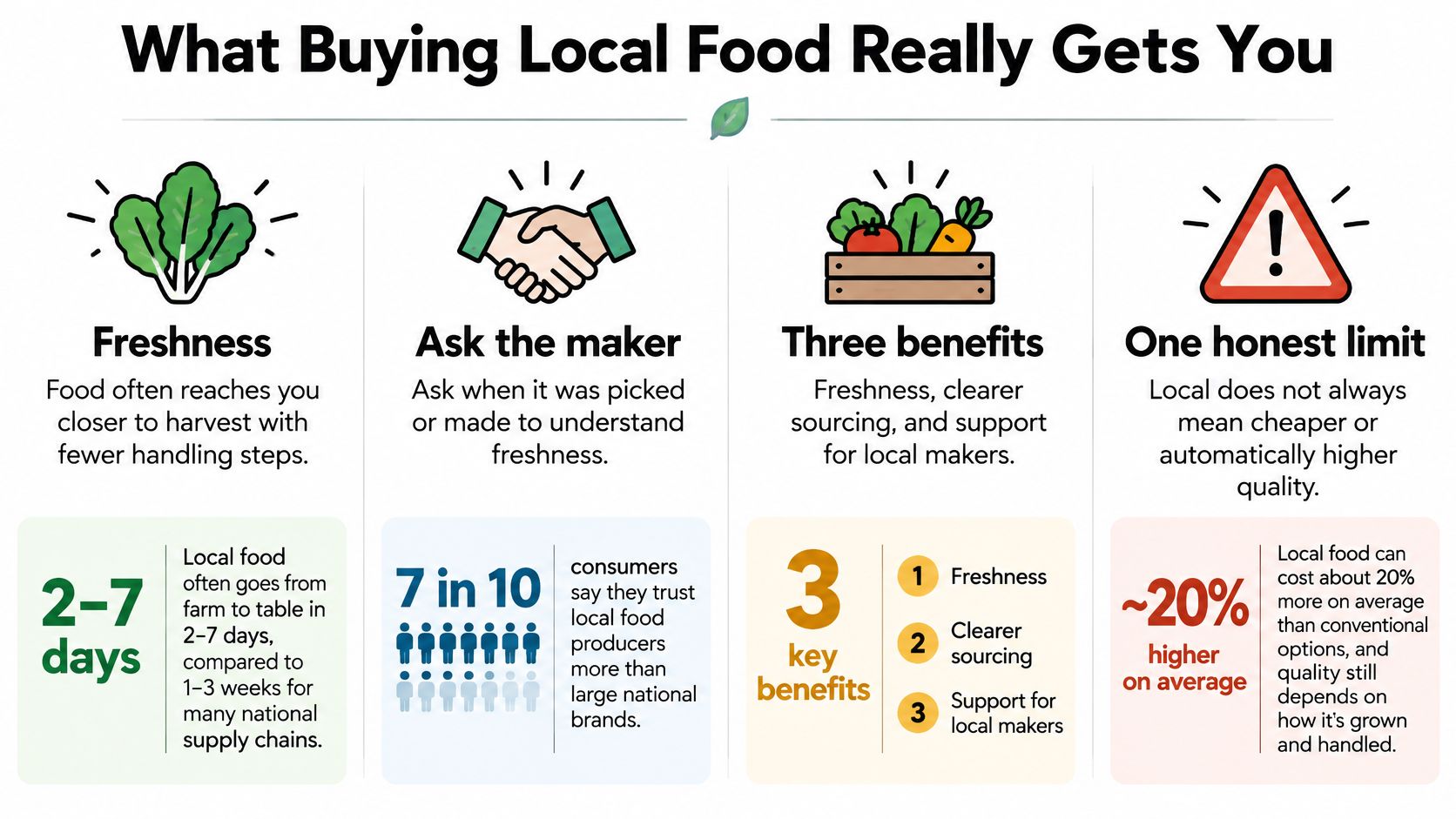
Three things are worth paying attention to, and one limit keeps the story honest.
Freshness is the first. Food often reaches you closer to harvest, with fewer warehouses between the field and your fridge. Ask the maker when it was picked or made, and expect a clear date. If they can't answer, the "just harvested" feeling is a guess.
Clearer sourcing is the second. You can ask the person who grew or roasted the product how it was produced. That's hard to do in a supermarket aisle. The same habit shows up in coffee. Direct sourcing explained by Cartograph Coffee is a useful read if you want to see how a roaster names the farm instead of hiding it behind a brand story.
Money that stays nearby is the third, and the numbers are specific. USDA research on Iowa farmers' markets reports that each dollar spent generated an additional $0.58 in indirect and induced sales, a total local effect of about $1.58 per dollar of direct spending. We exist to move everyday spending toward the people who make things and to keep more of that money in the communities that earn it. That's a result of buying a product you'll finish, not a reason to overpay for one you won't.
The green claim needs a second look
Buying local does not automatically cut emissions. A U.K. life-cycle comparison found that driving more than 6.7 km round trip to a farm shop for organic vegetables could produce more carbon than a large vegetable-box system that included cold storage, packing, regional transport, and home delivery. Production methods and your own trip matter as much as miles on a truck. Bundle the errand, or choose delivery when the drive is the bigger footprint.
A short drive can wipe out the climate benefit of a short supply chain.
Pick the one benefit you care about most, freshness, a real answer from the maker, or money that stays nearby, and let that guide the next order.
When Local Food Costs More and When It Doesn't
Price is the practical limit, not a values quiz. A 2025 Western North Carolina study found that 35% of existing local-food shoppers said price prevented them from buying more, rising to 57% among typical shoppers. The same brief notes a separate 2025 survey of 21,075 consumers across 28 markets in which 44% were willing to pay more for locally produced food, while 56% would choose cheaper food produced outside their country. Sort the cart by category before you decide the whole idea is expensive.
| Category | Local vs. retail price | Why | Buying move |
|---|---|---|---|
| Seasonal fruits and vegetables | Often comparable | Peak-season supply | Buy when in season |
| Carrots and potatoes | Often more expensive | Lower-margin staples priced against bulk retail | Buy in larger sizes |
| Locally raised meat | Often more expensive | Smaller production runs | Compare price per pound across makers |
| Packaged goods such as coffee or skincare | Runs higher or lower by batch | Small-batch production and packaging | Compare price per unit |
| Pantry staples on regular delivery | Can match or beat a one-time price | Repeat orders | Regular delivery saves 5% per delivery |
An audit behind that North Carolina brief found many seasonal fruits and vegetables at prices comparable to nearby retailers, while carrots, potatoes, and locally raised meat often cost more. Coffee, skincare, and other packaged goods swing with batch size and the jar, so the sticker on a 4-ounce tin is a bad comparison to a pound bag.
Three moves that actually change the total
Buy in season. Supply is high, and fruit and vegetables are the category most likely to land near a grocery price.
Check the unit, not the package. A larger bag of carrots, or a price-per-pound look at two meat makers, beats hoping the smaller pack is a deal.
Use regular delivery on staples you already finish. Regular delivery saves 5% on every delivery. Passion Pickles Ghost Pepper Homestyle Chips cost $13.00 as a one-time purchase or $12.35 per delivery when you buy on a plan. Compare those two numbers on anything you reorder monthly.
Write down what you spend for one month. You'll see which local swaps fit the budget and which ones are a sometimes jar, not a weekly habit.
Price per unit beats the sticker every time.
How to Check Quality on Any Local Label
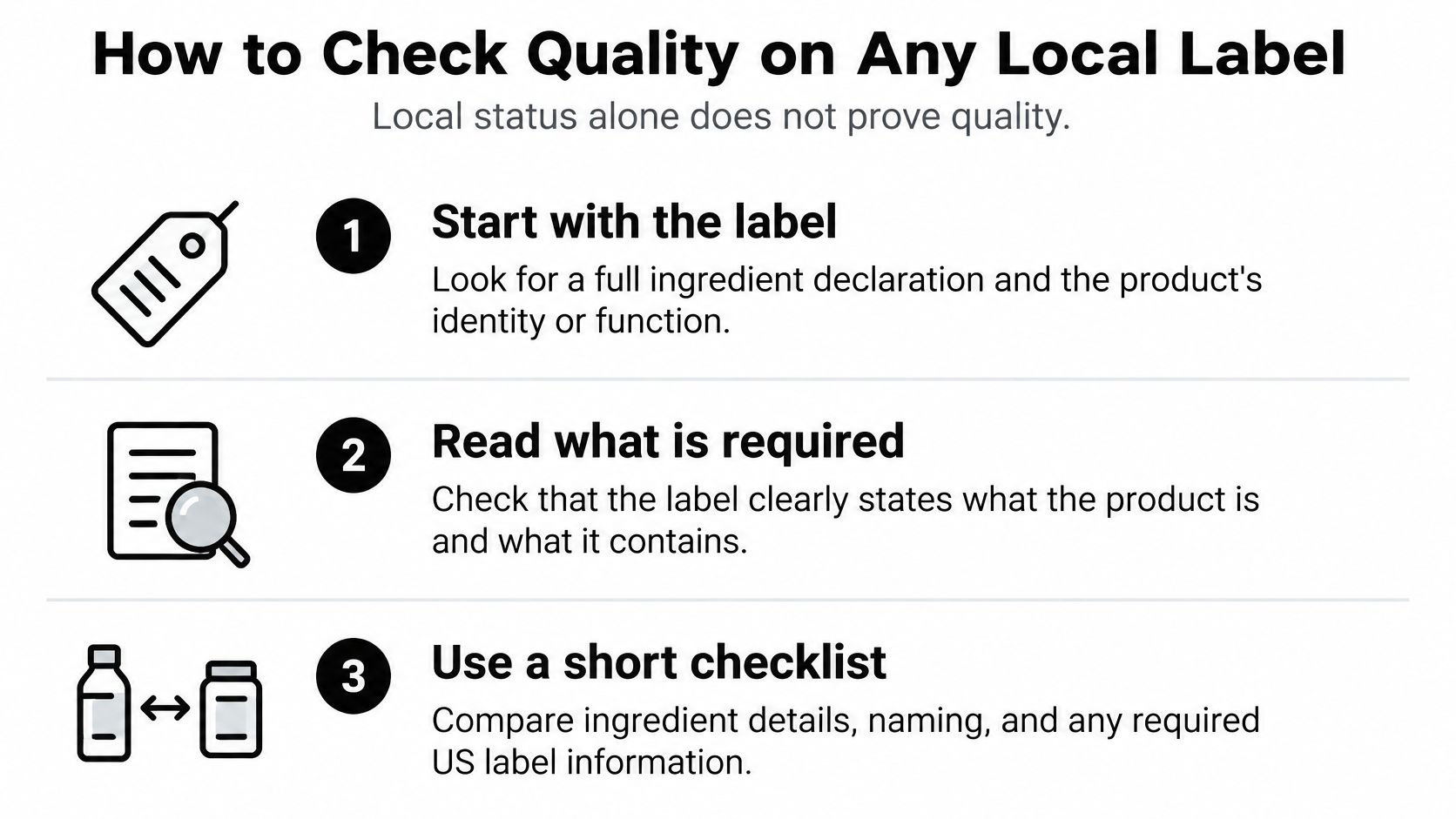
Local status alone does not prove quality. Use three questions before you add anything to the cart. Can you read every ingredient? Can you name who made it? Can you confirm what local means on this package?
Read the cosmetics label first
For face cream, soap, serum, or body products sold at retail in the United States, FDA cosmetics labeling rules require an ingredient declaration conspicuous enough to read at purchase, a statement of the product's nature or use, the net quantity, and the name and place of business of the manufacturer, packer, or distributor. If that business isn't the manufacturer, the package should say "Manufactured for" or "Distributed by." The same rules cover cosmetics made in the US and imported ones.
The FDA does not conduct premarket approval of cosmetic labeling. The company responsible for the product has to get the label right, and you still have to read it. A polished story is not a substitute.
Ask what local means
"Local" can mean grown nearby, made nearby, or only sold by a nearby shop. Ask the maker which one it is, and ask about ingredients, production steps, and the batch. A good maker welcomes that. Every product on our marketplace comes from a person or a small team who put their name on it, so you have someone to ask.
Say you're comparing a local face cream and a jar of pickles. On the cream, you want the full ingredient list, the net amount, and a business you can name. On the pickles, you want the ingredients, a pack date or batch note, and a straight answer on whether the peppers were grown nearby or the recipe was made nearby. If either label hides the maker, put it back.
If you can't name who made it, you can't ask a follow-up when something tastes off.
How to Order Local Food Online Step by Step
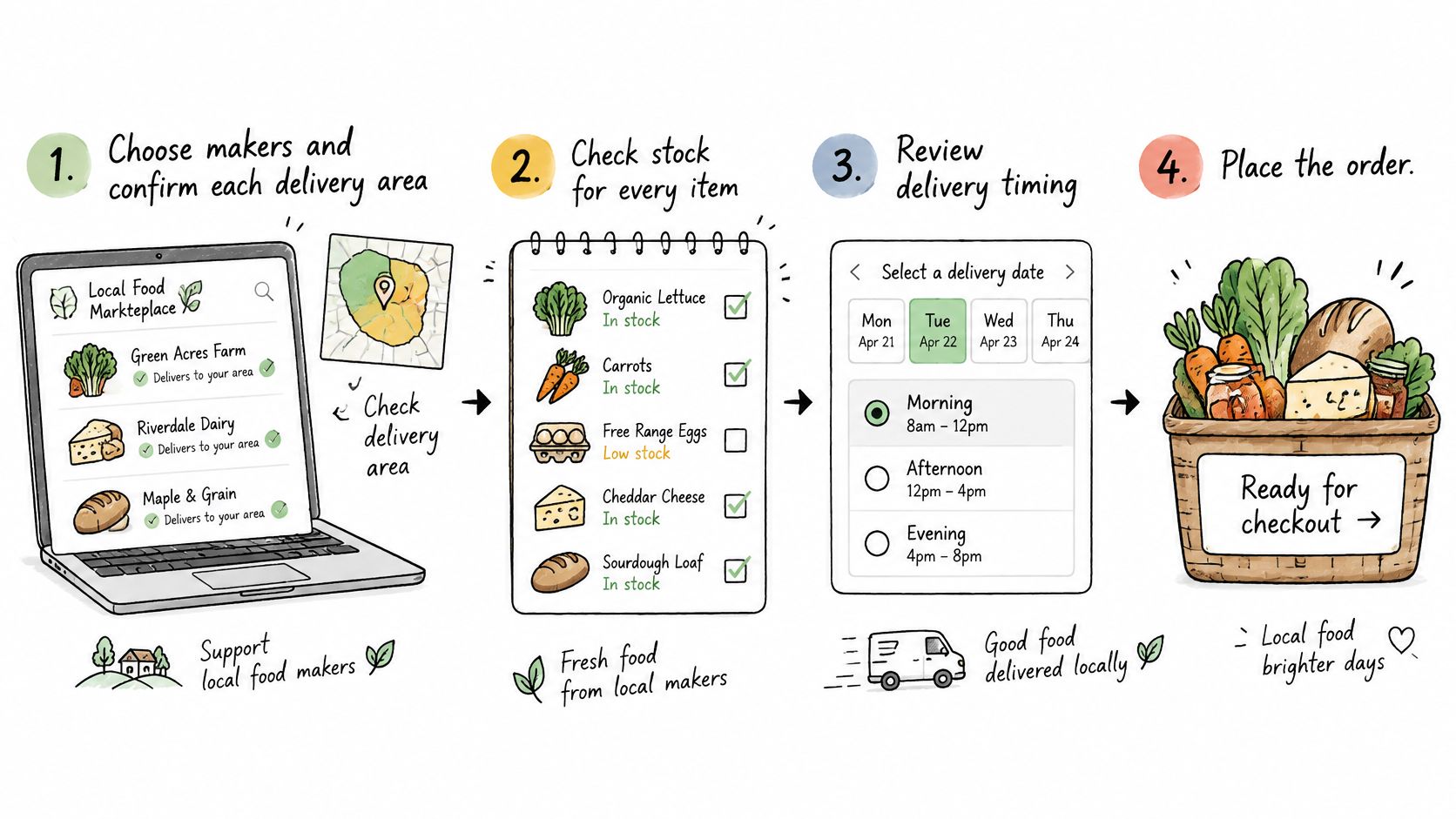
A good local order is a short checklist, and each step you skip tends to cost money rather than time. This is the pass I make before paying.
- Choose makers and confirm each delivery area. Shoppers can purchase directly from independent makers and brands across the country, all in one cart. The common slip is adding a maker who doesn't ship to your ZIP. A fresh option to test the habit is a microgreens variety box, once you've confirmed it reaches you.
- Check stock on every item. Availability changes, and some makers only ship certain days. If one jar is out, don't assume the rest of the cart still ships on the date you wanted.
- Combine items in one cart. One checkout from several makers means fewer separate delivery trips than ordering each site on its own. The slip is treating every maker as a separate errand and paying shipping five times.
- Compare delivery and pickup, including free-shipping thresholds. Finally All Natural offers free U.S. shipping on orders over $45. That threshold is a real decision: add a second jar you'll use, or pay the shipping and stop pretending the total was lower. If you're near the maker, pickup can still beat a box that arrives tomorrow.
- Note made-to-order timing. Cin Chili & Company and Finally All Natural make products to order and ship them directly from the company. That can take longer than grabbing a jar off a store shelf. Don't plan tonight's dinner around a sauce that hasn't been packed yet.
- Read the return policy before you pay. Cookie mixes cannot be returned because they are food products, for food-safety and quality reasons, so be sure of the flavor before ordering. For anything else in the cart, ask the maker directly instead of assuming.
- Set regular delivery for monthly staples. Repeat plans come with member discounts and loyalty rewards, and a standing slot saves you the reorder hunt each month. A chunky option for that slot is Speculaas Chocolate Granola, oats and dark chocolate in spiced clusters you can snack on or sprinkle. At checkout, confirm the ship date shown, not just the day you placed the order, so you know which week the box leaves the maker.
Before you hit pay
Confirm the delivery area, the ship date, and the return rule in one pass. That's the difference between a reorder you'll make next month and a carton you resent.
How Repeat Buying Keeps Local Producers Growing
A one-time purchase tells a maker that someone was curious. A reorder tells them how much to make and when to make it. In 2024, FRESHFARM's annual report says its markets and farm stands generated $29.8 million in sales for 244 local farmers and food producers. That kind of demand comes from people who show up again, not from a single Saturday splurge.
For the maker, a regular order is a production plan. They buy ingredients, book a packing day, and skip the guesswork of a freezer full of product nobody claimed. You get the same product next month instead of hunting for a replacement when a favorite disappears.
Four habits that keep a good maker going
Reorder what you already like. A new jar every week feels fun and leaves the maker with no signal about what to produce next.
Tell them what you use and why. "We finish the mild sauce on rice, not the hot one" is more useful than a star rating with no note.
Pass the name to one friend who'd enjoy it. A Sonoma Valley wine club is a clear example of the same idea outside the grocery aisle. People keep buying from a maker they already trust, season after season.
Buy a seasonal surplus and store it. When a producer has extra, freezing or jarring it is how you eat that harvest in January.
We measure impact in three ways: a fairer economy, stronger local communities, and better consumerism. None of that happens because you felt guilty at checkout. It happens because you liked the product enough to buy it again. Makers who want that direct relationship can reach buyers from their own shop. A steady order is the simplest way to still find your favorite maker next season.
Start Buying Local Food This Week
Saturday morning, you're in the grocery aisle holding a bag of coffee with no maker's name you can picture. The swap is smaller than a pantry overhaul: pick one channel, one maker, one everyday product, and give it a week.
- Pick one channel that fits this week. A market visit if you're free on market day, a CSA if you want a box on a set schedule, or an online cart if you shop after the kids are in bed.
- Pick one maker whose label you can read and whose product you'd reorder. Makers in the marketplace include Roost Roastery in Matthews, NC and Dudley's Toffee in Beech Grove, IN. Either is a clean first choice because a person, not a faceless line, is behind the bag.
- Swap one everyday product. Coffee, a sauce, or pet food is enough. A practical coffee test is Costa Rica Single Origin Coffee from Pops Coffee Company, air-roasted, with a naturally sweet aroma, in whole bean or ground.
After that one order, compare three things: taste, the label, and price per unit. If two of the three beat what you buy now, reorder. If they don't, you spent the price of one bag to learn that, and you move on.
Give one maker's version a fair test, then let a second order decide. Loyaltie is where you discover and buy directly from independent makers across the US, from coffee and snacks to skincare and pet products, in one cart. If you want local food you can check, compare, and reorder without guessing who made it, start with a single product on Loyaltie. Pick one maker this week and see whether their version belongs in your regular order.