
You've filled a beautiful body oil, chosen a bottle that looks right on the shelf, and shipped the first orders. Then a customer writes to say the label is lifting, the pump dribbled into the box, or the dropper dispenses far more oil than expected. None of those problems necessarily starts with the formula. They start with treating the bottle as decoration instead of part of the product.
For independent makers, body oil bottles have to protect the formula, control the experience, survive handling, and make repeat use easy. This guide focuses on the decisions that matter after the product photography is finished, from glass and plastic compatibility to dosage, label adhesion, leak testing, refills, and launch preparation.
Table of Contents
Why Your Bottle Choice Matters as Much as Your Formula
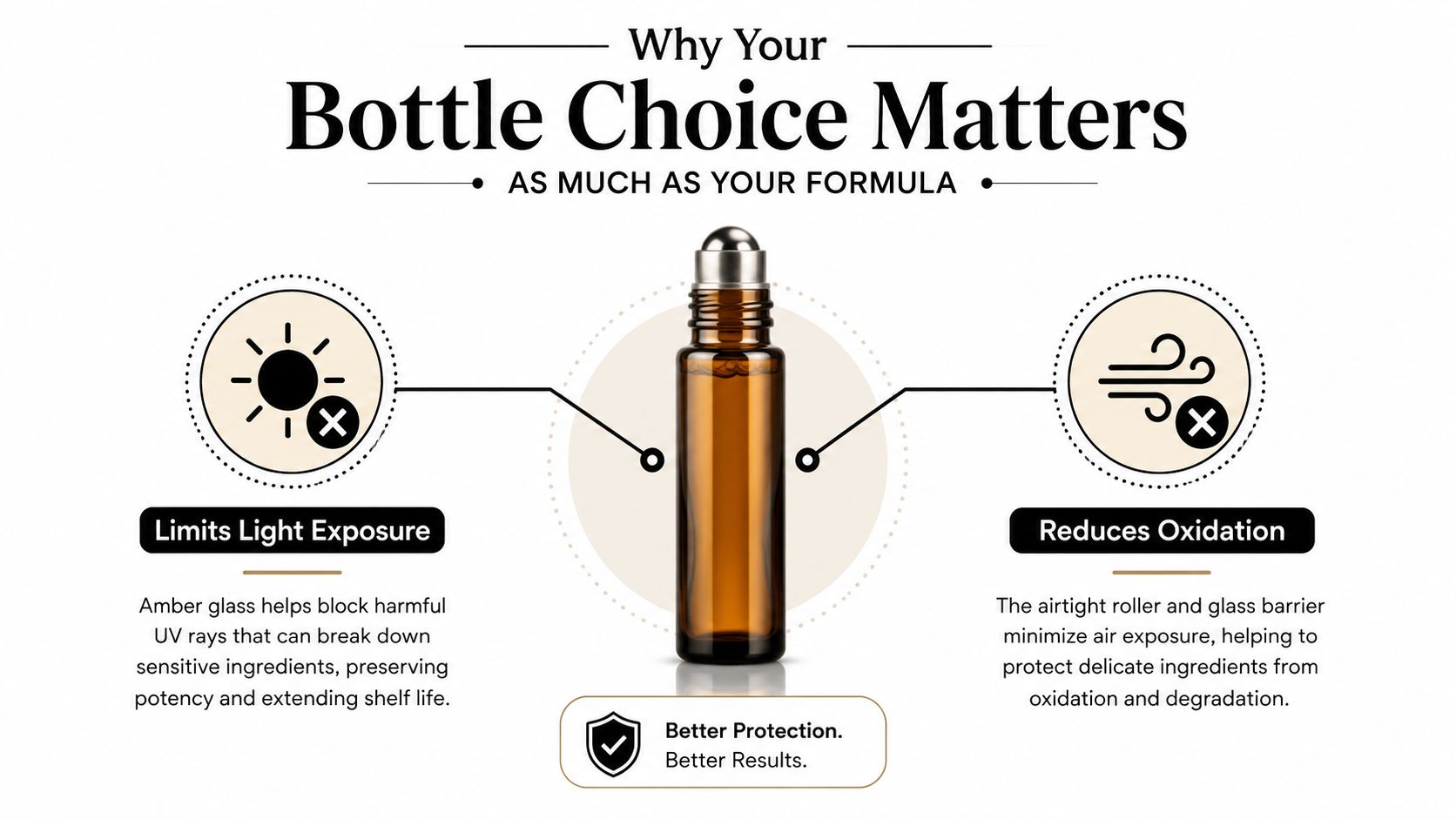
A body oil bottle is a working component of the formula. It controls how much air and light reach the product, how cleanly the customer dispenses it, and how much handling the label and closure can tolerate. The broader cosmetic and perfumery glass bottle packaging market was projected at USD 2.59 billion in 2025, USD 2.73 billion in 2026, and USD 3.42 billion by 2031, with an implied 4.61% CAGR from 2026 to 2031 according to Mordor Intelligence's cosmetic and perfumery glass bottle packaging market data. Body oils fit naturally into that ingredient-focused, skincare and fragrance-adjacent packaging category, where protection and shelf presence both influence the purchase.
A 30 ml amber glass bottle with a stainless roller can help limit light exposure and make a concentrated facial or body treatment feel controlled. A clear PET bottle may be easier to ship, but a maker still needs to confirm that the specific oil blend behaves well in that material over time. Material compatibility isn't a styling detail. Carrier oils, essential oils, citrus components, and resins can interact differently with plastics, liners, adhesives, and closures.
Four decisions to make before ordering
Choose for formula contact. Test the bottle, liner, dip tube, bulb, and dispenser with the finished oil, not a generic carrier oil. Essential oils and strongly aromatic ingredients deserve particular attention because a formula can soften, swell, stain, or change the feel of a component.
Set the dose deliberately. A dropper, roller, treatment pump, reducer, and mist sprayer each create a different ritual. Decide whether the customer needs a few controlled drops, a measured pump, or a broad application over the body.
Design for shipping. A closure that works upright on a workbench can fail after vibration, inversion, temperature changes, and repeated handling. The neck finish and dispenser mechanism are usually more important to leakage than the bottle silhouette.
Plan for oily surfaces. A label can look perfect at filling and begin peeling once customers handle the bottle with moisturized hands. One practical packaging guide identifies microscopic oil residue and incompatible adhesive as common causes of label failure on oil bottles. Packfolio's guide to packaging beauty products with oils is useful because it treats label durability as an operational issue rather than an aesthetic afterthought.
I once saw a jojoba blend stain a white cap badly enough that the product looked careless after normal use. Switching to a black urea closure solved the visual problem and made residue less obvious. The formula hadn't changed. The system around it had.
Practical rule: Test the bottle as if it were another ingredient. If it changes dosage, scent, appearance, cleanliness, or customer confidence, it belongs in your formulation review.
Matching Bottle Materials to Your Body Oil
The right material depends on the oil, the format, the selling price, and the route to the customer. Glass, PET, HDPE, and aluminum can all work, but they solve different problems.
Glass has the strongest association with skincare and fragrance, especially in amber, cobalt, or frosted finishes. Amber and cobalt can reduce light exposure, while frosted glass gives a softer visual effect without making the bottle completely opaque. The trade-off is weight and breakage during fulfillment. A glass bottle also needs protective shipping materials, and a heavy package can make direct shipping more expensive than a lightweight plastic format.
PET is shatter-resistant and easy to handle, which makes it practical for massage oils, larger body formats, and products that travel through the mail frequently. It isn't automatically compatible with every blend, though. High-citrus or resinous formulas should be tested in the actual bottle over time rather than assumed safe because the container feels sturdy.
HDPE is a useful choice for thicker oils and balm-oil hybrids. It tolerates practical handling well, but the surface and feel can read more utilitarian. Aluminum offers a distinctive travel-friendly appearance and good light blocking, but the inside resin liner becomes part of the compatibility system, especially for acidic blends.
Match the material to the use case
| Material | Pros | Cons | Best For |
|---|---|---|---|
| Glass | Strong shelf appeal, good light protection in amber or cobalt, broad compatibility potential | Heavy, breakable, higher shipping risk | Amber glass for facial oils above $25, when the formula and channel justify the added protection |
| PET | Lightweight, shatter-resistant, practical for shipping | Requires testing with citrus, resinous, and strongly aromatic blends | Massage oils under $20 and larger everyday formats |
| HDPE | Handles thicker formulas and balm-oil textures well | More utilitarian appearance, compatibility still needs testing | Thick body oils, balm-oil hybrids, and practical refill systems |
| Aluminum | Blocks light, travels well, distinctive appearance | Needs a suitable resin liner, can dent, closure compatibility matters | Travel sets and light-sensitive oils |
Fill temperature matters too. A hot-pour process at 45°C can suit PET and HDPE, but thin glass may experience more stress during filling and cooling. If your process uses heat, fill samples in the exact bottle you plan to sell and check the bottle, shoulder, neck, liner, and label after cooling.
Recycling codes can help you communicate material choices, but they don't tell you whether a bottle is refill-compatible. A refill system also needs a closure that can be removed and reseated reliably, a neck that survives repeated handling, and a cleaning process that won't leave oil residue behind. For a useful look at amber glass considerations, consult Skin Perfection's amber glass bottle guide.
For a real-world glass body oil example, see this organic body oil in a 4 oz glass bottle. The important lesson isn't that glass always wins. It's that the bottle should match the formula's sensitivity, the customer's use pattern, and the shipping experience you can consistently deliver.
Closures, Dispensers, and Getting Dosage Right
A bottle can suit the formula and still frustrate customers if the closure delivers an erratic dose. Start with how the oil is applied, then select the dispenser. Facial oils often benefit from a few controlled drops. Body oils spread across legs and shoulders are usually easier to use with a treatment pump. Lightweight dry oils may suit a mist sprayer, provided the formula's viscosity and particulate content match the mechanism.
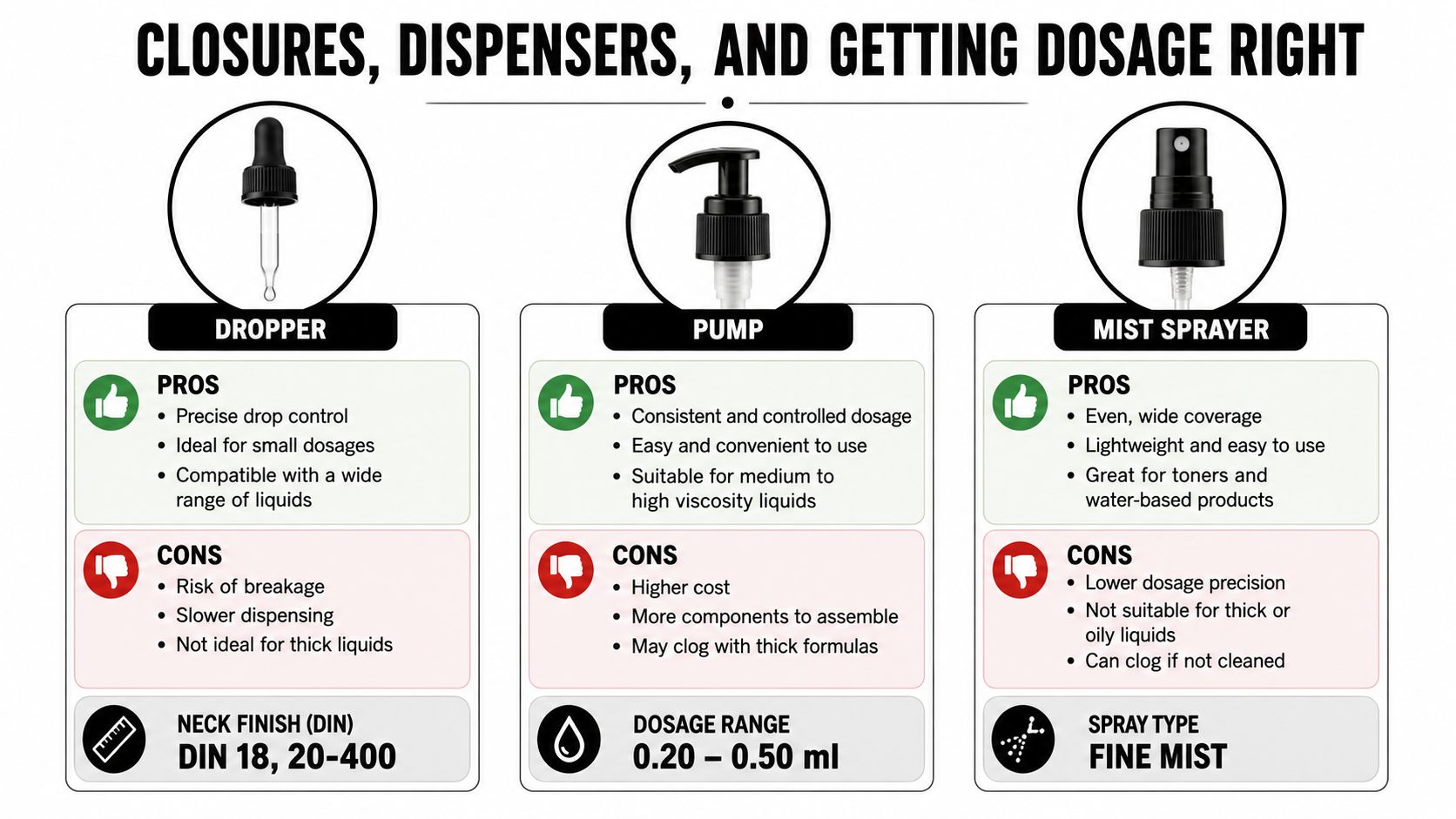
Dropper assemblies commonly use neck finishes such as DIN 18 or 20-400. These codes are not interchangeable. A dropper made for one finish may sit loosely, bind during assembly, or fail to seal on another. In use, that mismatch appears as leakage, a crooked cap, or a pipette that does not draw properly. A hair oil in a dropper bottle, such as this lightweight botanical hair oil serum, shows how this format supports measured application.
Treatment pumps often deliver approximately 0.20 to 0.50 ml per stroke, depending on the pump and formula. Use that range as a testing starting point, not as a guaranteed output. Viscosity, dip-tube length, fill level, priming, and pump orientation all change the delivered amount. Fill and test the actual oil in the intended bottle, since a component that works with a thin blend may struggle with a heavier one.
Choose the mechanism by customer behavior
Droppers: They provide a familiar, measured ritual for concentrated oils. The glass pipette can break, and the bulb becomes messy if the user touches skin with it.
Treatment pumps: They suit body application and allow one-handed use. Oil can collect around the actuator, and a short dip tube may pull air instead of product.
Mist sprayers: They distribute a lightweight dry oil quickly over larger areas. Thick blends may clog the orifice or spray unevenly, so test the finished formula after storage.
Reducers and disc caps: A reducer in a Boston round controls the pour without pump complexity. Disc caps suit bath oils and straightforward formats. Press-down reducers are useful on larger bottles when the user needs a controlled stream.
Wide-mouth jars: They suit oil-balm hybrids, but each opening increases air exposure and finger contact. Choose one when the texture requires it, not because the jar feels substantial.
A facial oil commonly uses around 3 to 5 drops, while a body oil may require 4 to 8 pumps, depending on coverage area and spread. Test those directions with internal testers or real users before printing them. Roll-ons offer another route for targeted application. The Acne Spot Treatment Roll-On, Tamanu & Jojoba Oils + Tea Tree, Redness-Calming Blemish Repair, Sensitive Skin | Orion Wellness by Loyaltie uses a roll-on format for a blemish oil containing tamanu and jojoba oils, with tea tree.
Closure terminology also helps when comparing component options. You can browse crimp seal and flip off cap through Herbilabs Labware. These closures do not replace a standard cosmetic pump, but their construction makes the neck, liner, and seal relationship easier to assess. For refill-friendly packaging, select parts that can be removed, cleaned, and reseated without damaging the neck or compromising the seal.
Choose 30 ml for concentrated, travel-oriented products or controlled facial use. Choose 100 ml when customers need broader coverage and the pump or reducer can dispense without repeated priming. Let the closure mechanics and application pattern determine the bottle volume.
Labeling Bottles That Actually Stay Stuck
Oil residue is a label adhesive's quiet enemy. A bottle can leave your bench clean and still carry fingerprints, mold release residue, or a thin film that prevents proper bonding. Standard paper labels often struggle in humid bathrooms and steamy showers, particularly when customers handle the bottle with oily hands.
Start with preparation. Wipe every bottle with isopropyl alcohol and a lint-free cloth, then allow the surface to dry fully. Don't apply labels immediately after filling if oil has migrated onto the shoulder or neck. Clean the bottle again, especially around the area where the label edge will land.
Build the label around the bottle material
For glass, water-resistant BOPP or vinyl with acrylic adhesive usually holds up better than untreated paper in damp environments. PET and HDPE need more attention because their surfaces can have lower surface energy. Use a corona-treated or otherwise pre-treated bottle, or select flexible PE or PP labels rated for that plastic.
Apply labels between 60°F and 75°F, using firm hand pressure and a squeegee to push out air pockets. Let them cure for 24 hours before boxing. That waiting period matters because a label that feels attached immediately may still have weak edge adhesion.
A thin topcoat can help protect printed information from oil handling. A clear box-tape strip over vulnerable corners is less elegant, but it can be practical during early production runs. A tamper-evident neck seal or shrink band also helps prevent a damaged label edge from becoming the first visible sign of rough shipping.
Test the finished package, not the empty bottle
Fill and label samples with the actual body oil. Soak them in warm water for one hour, then inspect the edges, corners, seams, and printed areas. Rub the bottle with oily fingers, place it in a travel pouch, and wipe it clean. The point isn't to create a laboratory simulation. It's to recreate the ordinary abuse a customer gives the package.
A label that only survives a clean-finger inspection hasn't passed the real test.
Keep a record of the label stock, adhesive, bottle supplier, cleaning method, application temperature, and cure time. If a shipment later develops peeling, you'll know whether the issue came from surface preparation, material variation, storage, or the adhesive itself.
Filling, Leak Testing, and Quality Checks
A Saturday filling session can look simple from the outside. A maker sets up a clean stainless bench, fills 200 four-ounce bottles, presses on the closures, applies labels, and boxes the order. In practice, consistency starts before the first bottle. The filler needs calibration, the oil needs a stable viscosity, and every closure needs to seat with the same care.
For thicker oils, a small vacuum chamber can help remove air pockets before filling. Warming the oil to roughly 25°C can make viscosity more consistent, but the formula should be handled within its validated process conditions. Dispense by weight rather than relying only on volume when you need repeatable fills, and record the target fill weight for the batch.
Cap each bottle with consistent torque. Too little pressure can allow leakage during transit. Too much can damage the liner or leave customers struggling to open the package. For droppers, check that the pipette reaches the oil without pulling air and that the bulb seats fully.
A practical small-batch audit
After filling, inspect every unit for clarity, fill height, label alignment, cap security, and visible residue. A simple 10% leak audit can catch problems early. Tilt selected bottles upside down over absorbent paper for 15 minutes, then look for wicking past the closure threads. This won't replace a full validation program, but it gives a maker a fast screen before the order leaves the studio.
For stronger validation, test the complete system, bottle, closure, pump, or dropper, with the actual oil. An inversion test at 95% fill can hold the package upside down for 72 hours at ambient temperature and again at 40°C, with zero leakage as the acceptance criterion. Neck and closure interfaces, along with dispenser mechanisms, deserve close attention. Testing only with water can miss failures caused by viscosity, swelling, or formula-specific interactions.
| Test Method | Duration | What It Catches | Best For |
|---|---|---|---|
| Inversion leak test | 72 hours at ambient temperature and again at 40°C | Wicking, closure leaks, neck-interface failures | Validation of the complete filled package |
| Tilt audit | 15 minutes | Fast signs of loose caps or thread wicking | Small-batch pre-shipment screening |
| Pressure decay | About 30-second dwell, typically 5 to 20 psi | Non-destructive pressure loss and seal weakness | High-volume screening |
| Vacuum simulation | Set by the test protocol | Failures that appear under reduced pressure or transport conditions | Comparing component combinations |
The cosmetic packaging compatibility testing guidance describes pressure-decay testing at about 5 to 20 psi with a dwell period around 30 seconds, and gives 0.5 psi as an example of a defined pressure-drop threshold. Use your own validated threshold rather than copying a number without understanding the equipment and package.
Document batch numbers, fill weight, expiration dates, component combinations, and inspection results. A refillable cleaner bottle with a choice of spray pump or twist closure, such as this refillable cleaner bottle option, also illustrates a broader packaging lesson. A reusable container is only useful when the closure remains reliable through repeated use.
Sourcing, Compliance, and Going to Market
A bottle supplier isn't approved because the sample looks good. Approve the complete package after filling it with your actual formula, applying the final label, closing it with production torque, and putting it through the handling your customers will create.
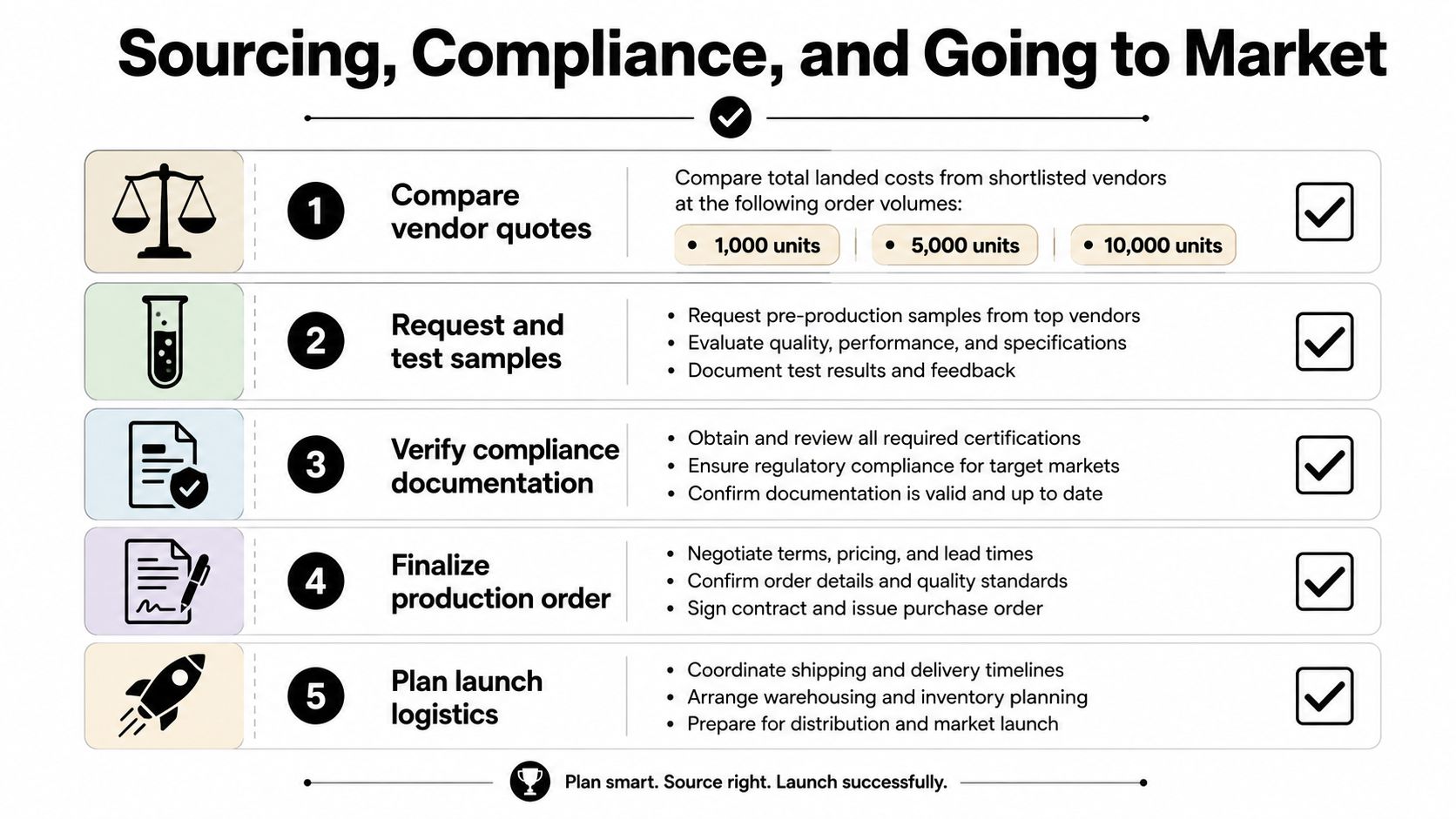
Start vendor comparisons with minimum order quantities, lead times, and unit costs at 1,000, 5,000, and 10,000 units. Ask for samples from the same material and closure family as the production quote. A sample from one component lot doesn't prove that another lot, liner, actuator, or dip tube will behave identically.
Domestic glass suppliers in the US typically ship in two to four weeks with higher unit costs, while overseas importers may lower the price by 30% to 60% but add eight to twelve weeks plus customs paperwork. These are sourcing benchmarks from the packaging guide in the brief, not guarantees for every supplier. Build your launch date around the longest realistic path, especially if the bottle requires a custom finish or printed decoration.
Use a launch checklist that protects the product
Compare the complete quote: Include bottles, closures, liners, pumps, labels, freight, breakage allowance, customs work, and storage.
Test supplier samples: Fill samples with the finished oil, then check appearance, scent, leakage, label adhesion, dispensing, and cap comfort.
Request compliance documents: Confirm that packaging intended for cosmetic contact has appropriate supplier documentation, including FDA 21 CFR or EU ECOCERT-related documentation where applicable. Recycled glass deserves particular attention because heavy-metal leaching claims need supporting documentation from the supplier.
Prepare the product file: If you sell cosmetics in the United States, register your brand with the FDA, prepare Safety Data Sheets, and follow FDA cosmetic labeling rules, including INCI ingredients, net weight, and company contact information.
Choose sustainability with performance in mind: Refillable glass with an aluminum cap may suit a return-and-refill model, while PCR PET with a mono-material design can ship lighter and cost less per unit. Neither choice removes the need to test leakage, dosage, label durability, and product protection.
The packaging industry is moving toward recyclable materials, PCR plastics, bio-based materials, mono-material structures, refill systems, and connected packaging such as QR codes, according to current skincare bottle design coverage from A Packaging Group. Airless formats are also being developed for liquid, oil, and lotion formulas, with attention to refillability and controlled dispensing. The useful question isn't which trend sounds most responsible. It's which system performs well enough that customers can reuse, refill, recycle, or finish the product without leaks and waste.
Buying directly from independent brands fits this same quality-focused approach. A 2025 consumer survey on local brands found that 56% of respondents believed local brands offer higher quality, and 50% preferred buying from local brands according to The Battle of the Brands. PDG Insights reported that almost half of US consumers go out of their way to buy local products, while definitions of local vary, with 28% using an immediate city or town and 20% using a 50-mile radius in the same research (PDG Insights on consumers and local brands). Retail Brew's summary of a 2024 LendingTree survey found that more than 9 in 10 Americans shop local at least once a month, 90% said local shopping has a positive community impact, and 50% would pay more to support local businesses (Retail Brew's local shopping survey summary). USDA data also recorded USD 17.5 billion in food sold through direct marketing channels from the 2022 Census of Agriculture, showing that direct-from-maker purchasing is an established market (USDA direct marketing data).
Loyaltie is a marketplace where people discover and buy directly from independent brands in the US, including makers selling skincare, wellness, food, coffee, supplements, and pet products. Visit Loyaltie to find body oils and other everyday products from real makers, with the convenience of online ordering and no middleman between you and the brand.