
You finish the last of your favorite locally roasted coffee on a Monday morning, or squeeze the final drop from the skincare serum that finally works for your routine. You forgot to reorder, so you grab a generic replacement on the way to work. It solves the immediate problem, but it doesn't deliver the same flavor, ingredients, or trust.
Automatic replenishment prevents that substitution. It turns a product you already prefer into a predictable reorder, while leaving you in control of timing, quantity, and spending. For independent brands, that creates a direct relationship built around products people use, not surprise boxes or forced purchases.
Table of Contents
- Why Shoppers Are Choosing Regular Delivery from Independent Brands
- How Automatic Replenishment Actually Works
- Better planning starts with buyer behavior
- What to measure without pretending certainty
- Phase one, place the choice where the decision happens
- Phase two, protect the economics
- Phase three, make fulfillment boring
- Phase four, communicate before the system acts
- Phase five, measure the behavior
- Rigid schedules create avoidable cancellations
- Unclear charges damage confidence
- Stock-outs turn convenience into frustration
- Too many messages feel like pressure
Why Shoppers Are Choosing Regular Delivery from Independent Brands
Regular delivery protects access to products shoppers have already chosen. A locally roasted coffee, an independent maker's face oil, or a supplement with familiar ingredients can become part of a weekly routine. The value is practical: customers avoid an unwanted substitute while keeping control over what arrives and when.
Buying directly from an independent brand also provides useful context. Shoppers can see where a product comes from, how it is made, and who stands behind it. That information matters when quality, ingredients, and the maker's standards carry more weight than a familiar package on a supermarket shelf.
Direct buying is already a common habit in the US. A DTC market summary reports that nearly six in ten Americans had purchased from a direct-to-consumer brand in the previous year. It also reports that 65% intended to buy from one in 2022, while 81% expected to make at least one DTC purchase within five years. The practical takeaway for independent brands is clear: shoppers will buy from makers online when product information, delivery terms, and customer controls are easy to understand.
The useful promise: your preferred product arrives before the empty shelf becomes a problem, and you can change the plan when your life changes.
Control separates a well-run replenishment program from a generic auto-ship offer. Customers should be able to choose a suitable cadence, review what they will receive, skip an order, or stop delivery without contacting support. Independent brands can also explain sourcing, production, and product changes in ways a large retail program rarely does.
That transparency supports trust, but convenience still has to earn its place. The product must be something customers use repeatedly, and the delivery interval must reflect real household consumption. A plan that sends coffee too often creates excess inventory. One that arrives too late defeats the purpose.
A coffee customer may begin with a one-time bag, then select a regular coffee delivery option after the flavor becomes part of the morning routine. The product earns the repeat order first. The delivery plan removes the need to remember it, giving the maker more predictable revenue without taking decision-making away from the buyer.
How Automatic Replenishment Actually Works
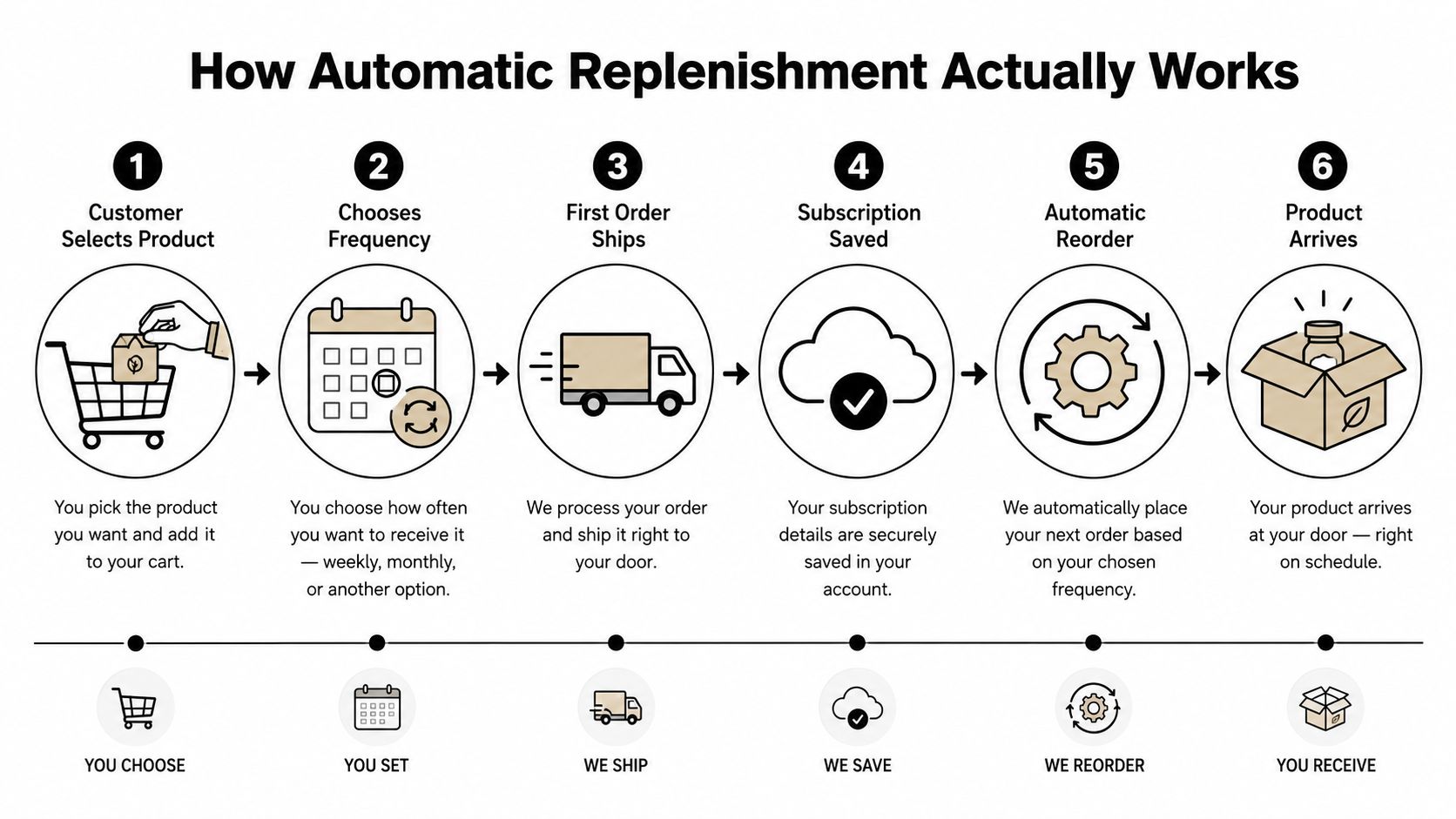
The basic model is simple. You select a product, choose how often you want it, save a payment method, and allow the system to create future orders according to that schedule. A 30-day plan works much like a utility bill. You authorize the recurring payment once, then the service handles the next order and fulfillment until you change or stop it.
A reliable program has four connected parts:
- The trigger: The chosen date or reorder rule tells the system when to begin.
- The billing cycle: The customer receives notice before the saved payment method is charged.
- The fulfillment handoff: The order moves to the maker, warehouse, or delivery partner.
- The customer updates: A confirmation, shipment notice, and tracking message keep the buyer informed.
Consider a ceramic mug maker who also sells refillable hand soap. The mug is a one-time anchor purchase. The soap is the natural replenishment product because the customer uses it up and already knows they like it. The system shouldn't send a different soap blend as a surprise. It should repeat the chosen item at a cadence that fits the household.
That distinction separates replenishment from curated boxes. A curated box emphasizes discovery and variety. Automatic replenishment emphasizes restocking a known product. Coffee, vitamins, pet food, skincare, cleaning refills, and household supplies tend to fit because the buyer can estimate use and wants consistency.
The customer portal is where the experience succeeds or fails. Buyers should be able to skip the next shipment, pause the plan, change quantity, swap a scent, update an address, or cancel without contacting support. If you're mapping the operational side of recurring orders, resources on consignment store automation can also help clarify how repetitive product movement and handoffs should be organized.
The best programs automate the routine while keeping the decision visible. Customers shouldn't wonder what will ship, when they'll be charged, or how to stop it.
Benefits for Local Makers and Independent Brands
For an independent maker, recurring orders turn repeat demand into a planning signal. You can see which products customers reorder, estimate upcoming requirements, and schedule purchasing or production with less guesswork. That matters for coffee, wellness goods, skincare, food, supplements, and pet products, where materials and labor often need to be arranged before orders arrive.
Predictable revenue helps, but it does not guarantee growth. A customer can pause or cancel at any time. The practical value is a visible purchasing pattern that the maker can monitor, adjust, and support with better service.
Better planning starts with buyer behavior
A candle maker with 500 customers paying $28 per month has a hypothetical baseline of $14,000 in monthly revenue, before new customer acquisition and assuming every customer remains active. This is not a forecast. It shows how active replenishment plans can support production and purchasing decisions when regular demand is visible.
That visibility improves inventory planning as well. If 300 units are scheduled for next month's shipments, the brand can plan wax, bottles, labels, ingredients, packing time, and staffing around an actual order commitment. Perishable and seasonal products benefit especially because production can follow known demand instead of optimistic estimates.
Automatic ordering also has a documented role in retail inventory management. A retail replenishment study reported a 3.72% stock-out rate for manually ordered SKUs, compared with 1.38% for automatically ordered SKUs, while the dataset average was 2.53%. It also reported availability gains of up to 60% overall, including 40% for fast-selling products, 48% for promoted products, and 59% for products in high-density stores. Those findings come from a retail inventory setting, not a small maker's direct-to-consumer operation. The transferable lesson is narrower and useful: timely demand signals can reduce the need for reactive purchasing.
What to measure without pretending certainty
Avoid promising a churn reduction benchmark unless your own customer cohorts support it. Replenishment can remain durable because it removes a repeat checkout, but poor timing, excess inventory, unclear billing, or weak cancellation controls can still drive customers away. The right measures include active plans, skips, pauses, cancellations, reorder timing, fulfillment accuracy, and the share of subscribers who remain active over time.
| Metric | One-Time Purchase | With Replenishment | Improvement |
|---|---|---|---|
| Revenue visibility | Order arrives unpredictably | Future orders create a planning signal | More predictable planning |
| Production planning | Based on estimates and recent sales | Based on active delivery commitments | Less guesswork |
| Customer relationship | Brand must win each reorder | Product enters a repeat routine | More opportunities to retain |
| Inventory decisions | Reactive purchasing | Forecast-informed purchasing | Better alignment between supply and demand |
For practical direct-to-consumer brand tips, assess the customer experience alongside the revenue model. Give shoppers control over timing and quantity, explain charges before they occur, and use recurring demand to reduce waste and protect availability. A program built around transparency is more likely to earn repeat trust than one treated as a billing shortcut.
Types of Replenishment Models for Everyday Products
The right model follows the way customers use the product. Coffee drinkers may know they need a new bag on a regular rhythm. Skincare use varies more. Pantry inventory can depend on household size, while a refill concentrate may be used only after a bottle is empty.
Fixed-interval delivery
This is the easiest place for most independent brands to start. The customer chooses a product and a cadence, such as coffee every 14 days or a candle each month. The brand gets a clear production calendar, and the customer gets a familiar item without another checkout.
Fixed intervals work best when consumption is steady and delivery lead times are dependable. They create the strongest predictability but can produce cancellations when customers accumulate product. A pause and skip control reduces that pressure.
A monthly candle plan, such as this soy candle regular delivery product, illustrates the model's basic logic. The buyer knows what category of product will arrive and can decide whether the cadence matches their routine.
Usage-based triggers
Usage-based replenishment responds to estimated consumption rather than a calendar. A smart dispenser might detect usage, or a customer might report how quickly they use skincare, supplements, or pet products. This can reduce excess deliveries, but it requires better data, device support, or a dependable self-reporting experience.
Threshold-based restocks
Threshold models trigger when inventory drops below a chosen level. They suit pantry staples, household refills, or products managed through an inventory app. They can feel highly relevant to the buyer, but they require accurate stock information and more complicated event handling. Guidance on smart inventory tracking for ecommerce is useful when a brand is evaluating that infrastructure.
The Bathroom Cleaner Concentrate Refill, Scented Blend, Soap Scum & Hard Water Cleaning, Makes 16 oz Spray, 8 oz | Cielo Puro by Loyaltie is the kind of refill product that can fit a fixed plan or a threshold reminder. It pours into a reusable 16 oz glass bottle, then gets topped with water for everyday soap scum and grime.

| Model | Best For | Data Required | Predictability | Cancellation Risk |
|---|---|---|---|---|
| Fixed interval | Coffee, candles, vitamins, routine skincare | Order history and delivery cadence | High | Moderate if cadence is too rigid |
| Usage based | Dispensers, variable skincare use, pet products | Usage signals or customer input | Medium | Lower when estimates are accurate |
| Threshold based | Pantry goods and household refills | Inventory level and trigger logic | Medium | Higher if stock data is unreliable |
Most makers should prove a simple fixed-interval plan before adding smarter triggers. Complexity won't repair weak product-market fit, unclear value, or poor communication.
Building Your Replenishment Program Step by Step
Start with one product customers already reorder. A hero SKU with clear use frequency gives you a cleaner test than launching a plan across an entire catalog.
Phase one, place the choice where the decision happens
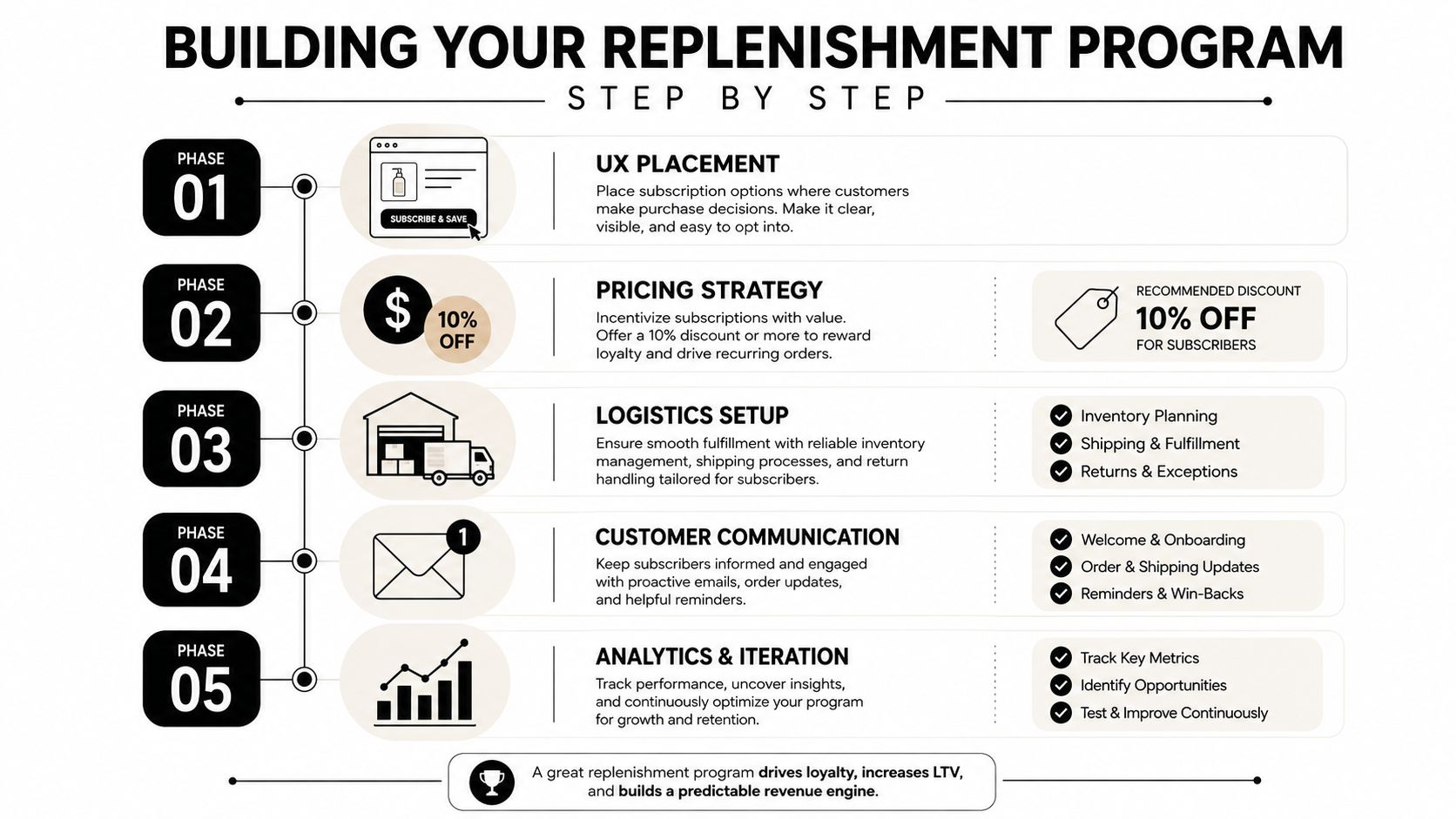
Put the regular delivery option beside the one-time purchase choice on the product page. Explain the practical benefit first, such as avoiding a last-minute replacement, then show any price difference if you offer one. Let shoppers choose a cadence that reflects real use instead of hiding the schedule in account settings.
A coffee maker might place “buy once” beside “receive regularly,” then offer cadence choices based on how often customers finish a bag. The wording should describe what arrives and when, not rely on vague promises about savings.
Phase two, protect the economics
Discounts can help, but convenience may be the stronger value for products customers already prefer. Model shipping, packaging, payment fees, picking time, and product margin before setting an incentive. Free shipping thresholds can increase order size, but they can also make a recurring order unprofitable if the buyer receives only one low-priced item.
Loyalty tiers can reward consistency without giving every customer the same reduction. Keep the terms visible after the first order so the customer doesn't feel trapped by a discount cliff.
Phase three, make fulfillment boring
Batch orders by ship date, reserve inventory for active plans, and define what happens when one item is unavailable. If a customer orders multiple products, decide whether the system holds the full order or sends a partial shipment. A proactive substitution or a clear delay usually protects trust better than silence.
Phase four, communicate before the system acts
Send a pre-charge notice, then a fulfillment confirmation and tracking message. If the customer skips a shipment, confirm the new date. A win-back message can invite a return, but it shouldn't pressure someone who deliberately paused.
Phase five, measure the behavior
Track attach rate, churn by cohort, lifetime value lift, and days between orders. Compare customers who chose regular delivery with similar one-time buyers, and watch where people pause or cancel. Use Loyaltie's seller resources when you need practical guidance for presenting and managing products online.
A useful first test doesn't need enterprise tooling. It needs a clear product, an honest cadence, reliable inventory, and a customer account experience that makes changes easy.
Common Pitfalls and How to Avoid Them
The biggest mistake is assuming automation should remove customer choice. It doesn't. Ipsos found that 70% of consumers described replenishment as convenient and 57% said it required little to no work, but 32% worried about extra fees, 19% worried about the price, and 17% worried about storing too many products (Ipsos consumer research). Those concerns point to design problems, not a lack of interest.
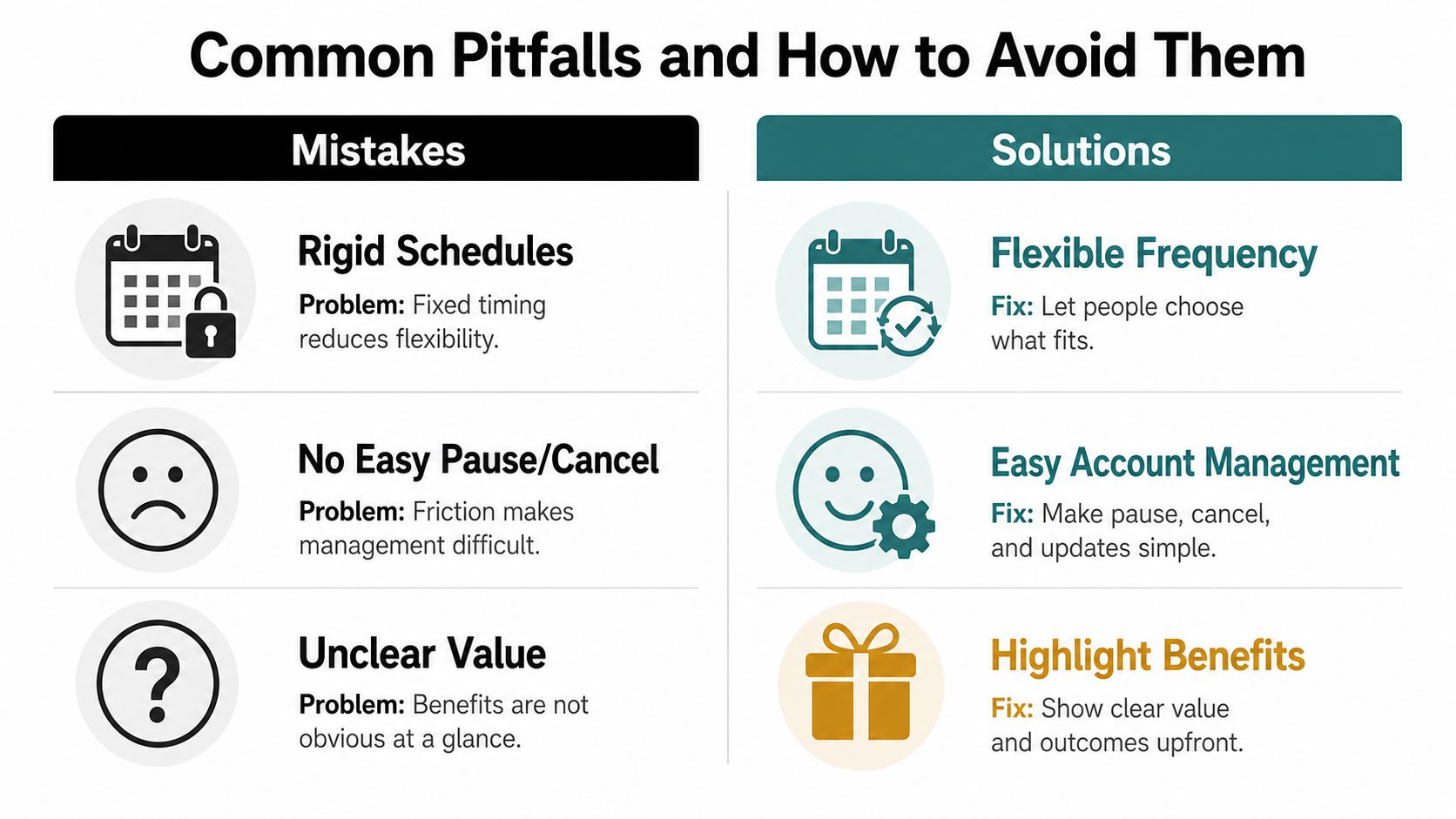
Rigid schedules create avoidable cancellations
A customer who receives product too quickly needs a snooze button, not a lecture. Offer skip, pause, quantity changes, frequency changes, and product swaps directly in the account area. If cancellation is the only visible escape, buyers may leave permanently when a temporary pause would have preserved the relationship.
Unclear charges damage confidence
Show the upcoming product, quantity, shipping cost, charge date, and delivery date before billing. Don't rely on a first-order incentive that disappears without a clear explanation. A running savings tally can reinforce value, but only if the calculation is accurate and easy to understand.
Stock-outs turn convenience into frustration
Reserve inventory for active plans and create an exception path before launch. If the chosen item won't be ready, contact the buyer with options such as a later shipment, an approved substitute, or a refund. A back-in-stock email after the promised delivery date makes the customer do the recovery work.
Too many messages feel like pressure
Notifications should answer a useful question: what is shipping, when will it arrive, and what can the customer change? Remove repetitive reminders and make preferences adjustable.
Churn often reflects a broken experience. Fix the schedule, visibility, inventory, and controls before spending more on win-back campaigns.
Making Replenishment Work for Your Brand
Automatic replenishment works best as one part of a direct-to-consumer relationship. A strong first purchase introduces the product clearly. Helpful onboarding explains how to use it. Product launches give existing buyers a reason to return, while loyalty incentives recognize people who keep choosing the brand.
Treat regular-delivery customers as a distinct group. They've already shown a preference for your product, so their communication can include early access, relevant recommendations, and honest reminders about upcoming orders. Don't send them the same generic campaign as someone who has never purchased.
Start with one hero SKU and observe actual behavior over 90 days. Look at how often customers skip, how quickly they reorder, which cadence produces complaints, and whether the product arrives in good condition. Expand only after the evidence supports the next category.
A durable program earns permission repeatedly. The customer should always know what is coming, why it is coming, and how to change it.
For shoppers, the payoff is better access to products made by people whose standards you can understand. For makers, the payoff is a more dependable connection between production and real household demand. Transparency and control make that connection last.
Discover independent brands across coffee, wellness, skincare, food, supplements, and pet products through Loyaltie, a marketplace where people discover and buy directly from the best independent brands in the US. Find products you already want to use regularly, then choose makers that offer a clearer, more personal buying experience without the middleman.