
You've got a coffee bag, a skincare jar, or a supplement bottle open in another browser tab. The maker's story sounds lovely, but you're still looking for the detail that makes buying feel sensible: what's in it, who made it, and whether the product will match the promise.
If you sell everyday products, that hesitation is your real writing problem. Authentic storytelling helps people discover a quality upgrade from an independent brand, but only when you give them something they can check. Your late nights might explain your commitment. They don't explain why someone should put your product in their cart.
Table of Contents
- Who you are and why you made this
- What you actually do differently
- What you won't do
- When a customer noticed
The Story That Felt Real but Sold Nothing
Suppose you spend a weekend writing about your grandfather's recipe, your cramped kitchen, and the evenings you spent getting the texture right. You publish the page, share it, and hear nothing. This is an illustrative scenario, not a sales case study, but it captures a useful distinction: you've explained why the product matters to you without explaining what makes it worth buying.
A shopper comparing your food with a familiar grocery-store option still has practical questions. What ingredients do you use? What does it taste like? How should they store it, and what happens if it arrives damaged?
Your origin story can stay. It just shouldn't do the job of the product description.
Turn memories into buying information
Start by separating the personal detail from the product decision it led to. A family recipe might explain your choice of ingredients; a frustrating shopping experience might explain why you made an unscented skincare formula.
- Keep the motivation: Explain the problem you wanted to solve, without making the reader follow your entire life story.
- Name the decision: Show what you changed in the recipe, material, packaging, or production method.
- Attach the evidence: Put the ingredient list, process photo, or relevant document next to the claim.
- Explain the trade-off: Tell shoppers what your choice means for taste, storage, use, or availability.
A personal story explains your intention. Product evidence gives the shopper a reason to act on it.
In a 2025 study of university students on storytelling, authenticity, and trust, 78% rated real-life stories as the most trustworthy storytelling format, followed by testimonials at 69%. That's a defined student sample, not a universal buying forecast.
The practical lesson isn't to write a more emotional memoir. It's to connect a real experience to a product decision the buyer can understand.
Why Authenticity Is a Trust Signal, Not a Feeling
A photograph of flour-covered hands can establish atmosphere. It can't establish where the flour came from. A founder talking candidly about burnout might be sincere, but that doesn't verify the ingredients in their wellness product.
Authenticity is a claim you make observable. Emotion can make the story engaging; verification lets someone decide whether to believe it.
Clutch's brand authenticity survey identifies transparency, unfiltered reviews, a distinct voice, visible human involvement, and consistent messaging as trust signals. It also identifies declining product quality, generic or robotic messaging, and a mismatch between values and actions as important trust failures.
Give shoppers a way to check
Audit the page as someone who has never met you.
- Named maker: Identify the person responsible and their role, rather than relying on a logo.
- Visible process: Show the actual work, not an unrelated stock photograph.
- Specific inputs: Name ingredients or materials clearly and distinguish what you know from what your supplier claims.
- Traceable production: Use dated production information or batch identifiers when relevant.
- Real customer voices: Preserve the customer's meaning and disclose any incentive.
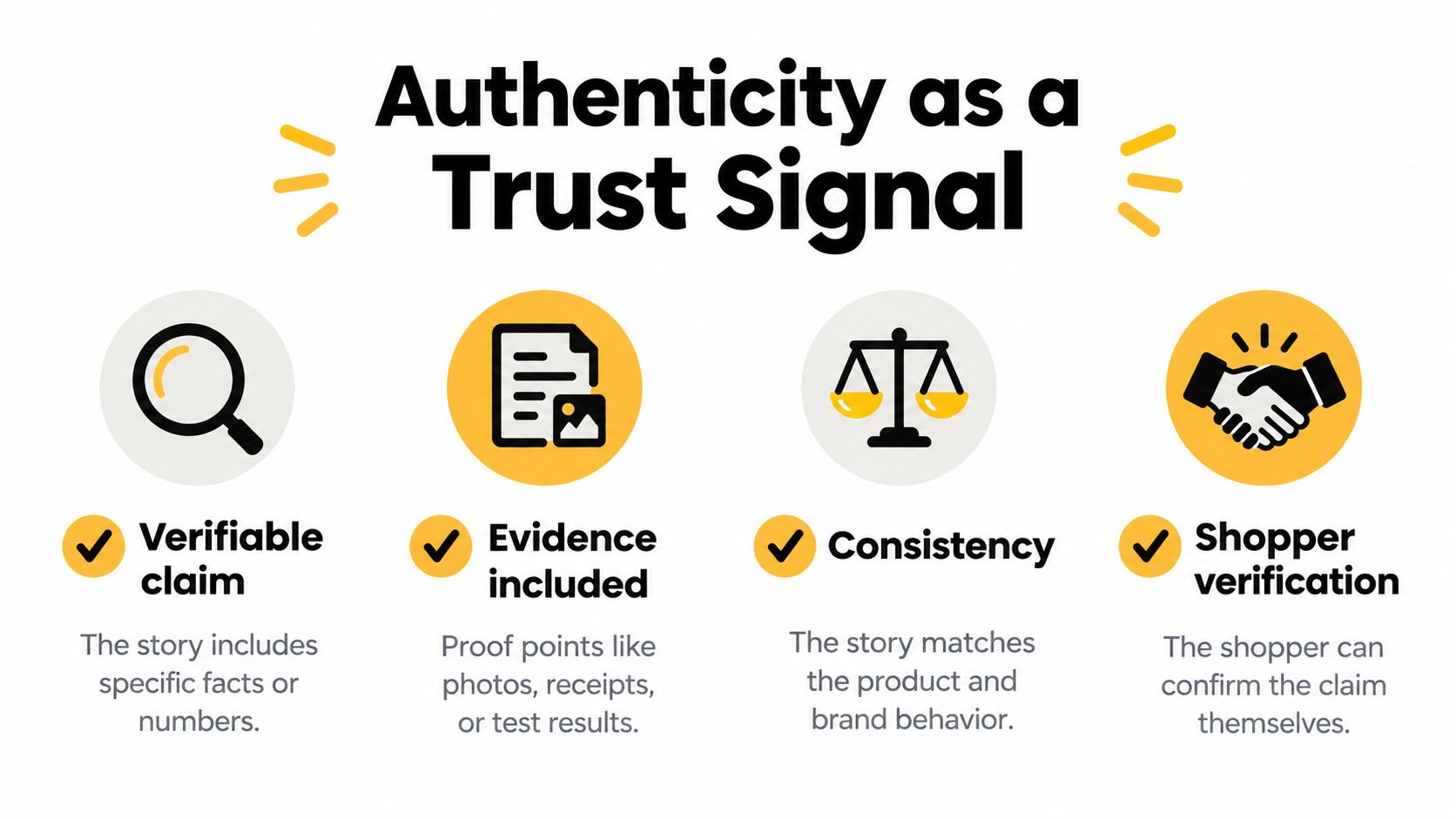
- Consistent follow-through: Make sure shipping, product quality, and responses match the promises on the page.
Use this visual checklist to separate a believable narrative from an unsupported claim.
Heritage needs a present-day connection
For a separate resource on expressing a brand's history, explore Pandemonium Millinery on brand heritage. When reviewing your own heritage story, ask which current product decision it explains.
Keep the scope of each claim honest. A sourcing receipt can support where a material was purchased; it doesn't automatically establish performance, safety, or environmental impact. You don't need to publish confidential supplier pricing to be transparent, either.
Share enough relevant evidence to answer the buying question. More disclosure isn't always better disclosure.
A Four-Part Story Framework You Can Fill In Today
Start with decisions, not personality adjectives. Words like passionate and dedicated are easy to write and difficult for a shopper to evaluate.
Use these prompts as a draft, then replace every bracket with information you can stand behind. Leave out any sentence whose evidence you don't have.
Who you are and why you made this
Your experience belongs here when it explains the product.
- Prompt: “I'm [name], a [role] based in [place]. I made [product] because [specific problem].”
- Prompt: “My experience with [relevant work or need] led me to choose [product decision].”
Avoid turning credentials into promises they don't support. Experience developing food recipes, for example, isn't evidence for a supplement's health benefit.
What you actually do differently
Describe the work rather than assuming independent production automatically means better quality.
- Prompt: “During production, we [specific action], which affects [observable product characteristic].”
- Prompt: “You can see how we handle [process] in [available evidence].”
A shopper should understand the quality upgrade through a useful formulation choice, a clearly explained roast, or a material selected for a particular purpose.

What you won't do
A meaningful boundary has a consequence. Don't invent a villainous factory practice to make your own process sound better.
- Prompt: “We don't [specific practice], because [reason relevant to the buyer].”
- Prompt: “That choice means [honest limitation], so this product may not suit [use or preference].”
When a customer noticed
Use an actual experience, with permission, rather than writing the testimonial you wish you had.
- Prompt: “[Customer's approved attribution] described [documented experience] after using [product].”
- Prompt: “The feedback concerned [specific characteristic], not an outcome we can guarantee.”
Keep the working draft beside your ingredient list and production notes. The seller resources library is another place to explore while preparing your storefront content, but the substance must come from your own records.
Before and After on a Real Product Page
Consider a fictional skincare product page. Keep the product, price, and audience unchanged; only revise the description. The placeholders below mark evidence the maker must supply, not facts about an existing formula.
Before
Made with love and inspired by nature, our carefully crafted serum brings the goodness of the earth to your daily ritual. We pour our hearts into every bottle so you can feel confident in your skin.
There's warmth, but almost nothing to compare. The shopper still doesn't know what the serum contains, who formulated it, or what the maker means by carefully crafted.
Revised product-page draft
Formulated by [verified name and role], this serum contains [active ingredient] at [verified percentage from formulation records]. Find the batch identifier on your bottle and review [the relevant supplier certificate of analysis] alongside the complete ingredient list. Designed for [substantiated intended use], it may not suit [documented limitation]. “[Exact customer wording, used with permission]”, [customer's approved first name and state].
Vague claims vs verifiable details
| Vague claim | Verifiable replacement |
|---|---|
| Made with love | Identify the formulator and explain a production decision. |
| Nature's best ingredients | Publish the complete ingredient list and relevant sourcing information. |
| Carefully crafted | Describe a real production check and its purpose. |
| Powerful active ingredients | State the documented concentration without implying that concentration alone proves effectiveness. |
| Customers love it | Use genuine, approved feedback about a specific experience. |
| Quality you can trust | Provide relevant records and explain what they establish. |
Know what each receipt proves
A supplier's certificate of analysis concerns the material described in that document. Don't present it as proof that your finished skincare product delivers a particular result. Make the relationship between the document, ingredient, and claim clear.
For supplements, label information offers a more concrete starting point than a moving founder story. FDA guidance on dietary supplement labels requires product identification, the responsible business and location, a Supplement Facts panel, other ingredients, and net quantity.
Keep a sentence about your motivation if it helps someone understand the formula. Cut anything that substitutes affection for information, and don't publish the revised draft until its placeholders have real evidence behind them.
Short Templates for Instagram, Email, and About Pages
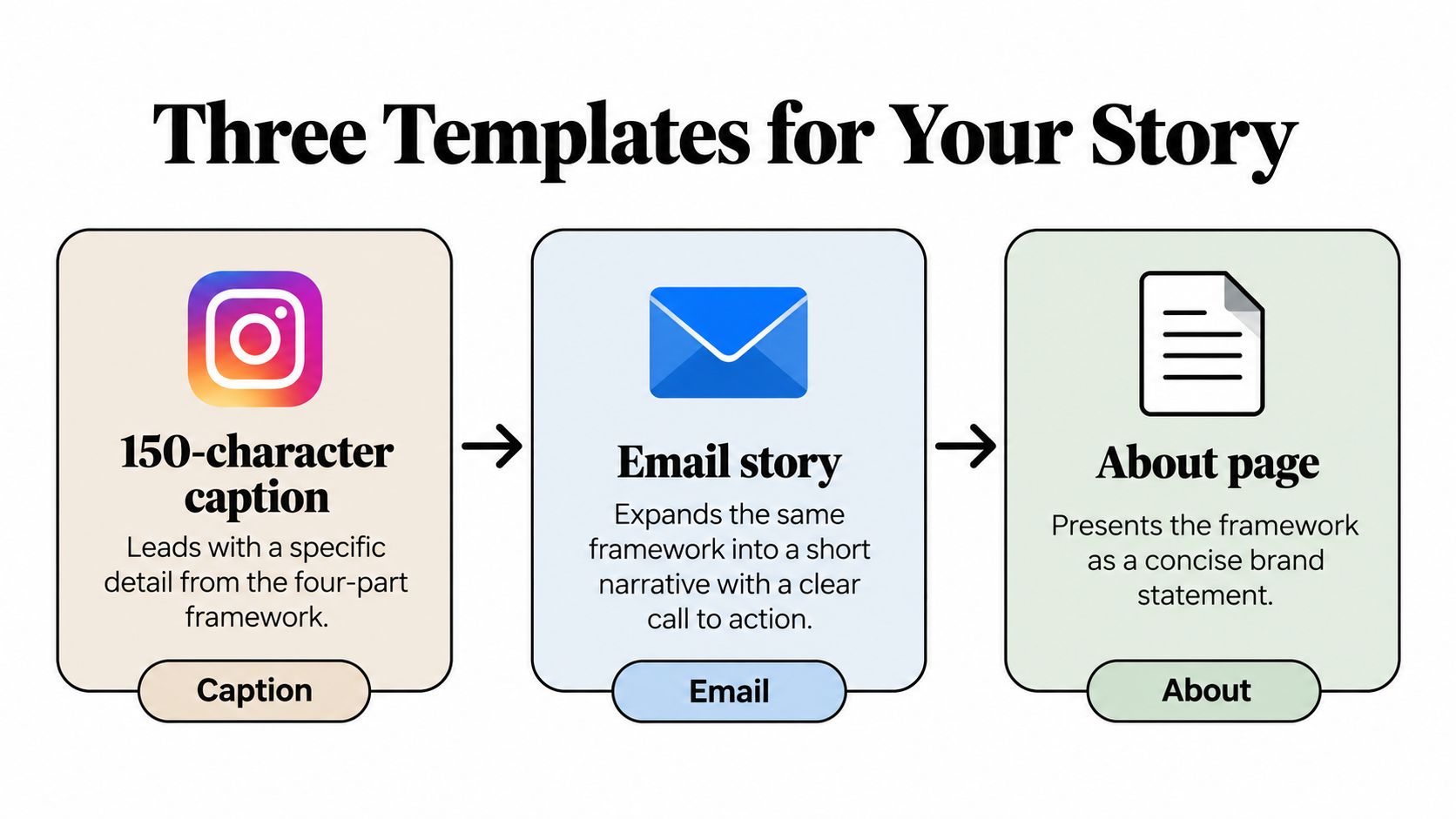
You don't need a new origin story for every channel. You need a different entry point into the same documented product decisions.
These are fill-in templates, not factual claims about existing brands. The food examples show how to adapt the structure without inventing results or customer experiences.
Instagram caption
Template for a 150-character limit
[Specific decision]. See [proof] before you choose [product].
Illustrative food example
Check the roast information before choosing your coffee. The details are on the product page.
Lead with something useful in the image or caption. A mood-setting photograph can accompany it, but shouldn't be the only information you offer.
Email opening
Template
You asked about [buying question]. We chose [documented decision] because [reason]. That means [benefit and limitation]. Check [evidence] before deciding whether [product] fits your routine.
Illustrative food example
Choosing coffee shouldn't require guessing what the bag will taste like. Use this email to explain your documented roast decision, describe the flavor honestly, and point readers to the matching product information. End with an invitation to compare, not a demand to believe.
Expand this into a short email only when you have something useful to add. Don't pad it with your founding story just to fill space.
About-page paragraph
Template
We're [maker names] in [location]. We make [category] for people who want [specific product benefit]. Our approach is [documented practice], with [honest boundary]. Explore [available evidence] and choose what fits your everyday routine.
For a food brand, replace the brackets with the actual people, place, preparation choices, and storage limitations. Keep the paragraph short enough that shoppers can reach the products without digging.
Browse about Leaping Lemur Media as an additional about-page reference, and seller background information for platform context. Adapt the emphasis to each channel instead of pasting identical copy everywhere.
Distributing Your Story Through Loyaltie
A marketplace listing needs to help someone discover the product and evaluate it. Treat Loyaltie's marketplace as one option alongside your own storefront and in-person selling. It's a marketplace where people discover and buy directly from the best independent brands in the US.
Use the marketplace view as context for how shoppers encounter products.
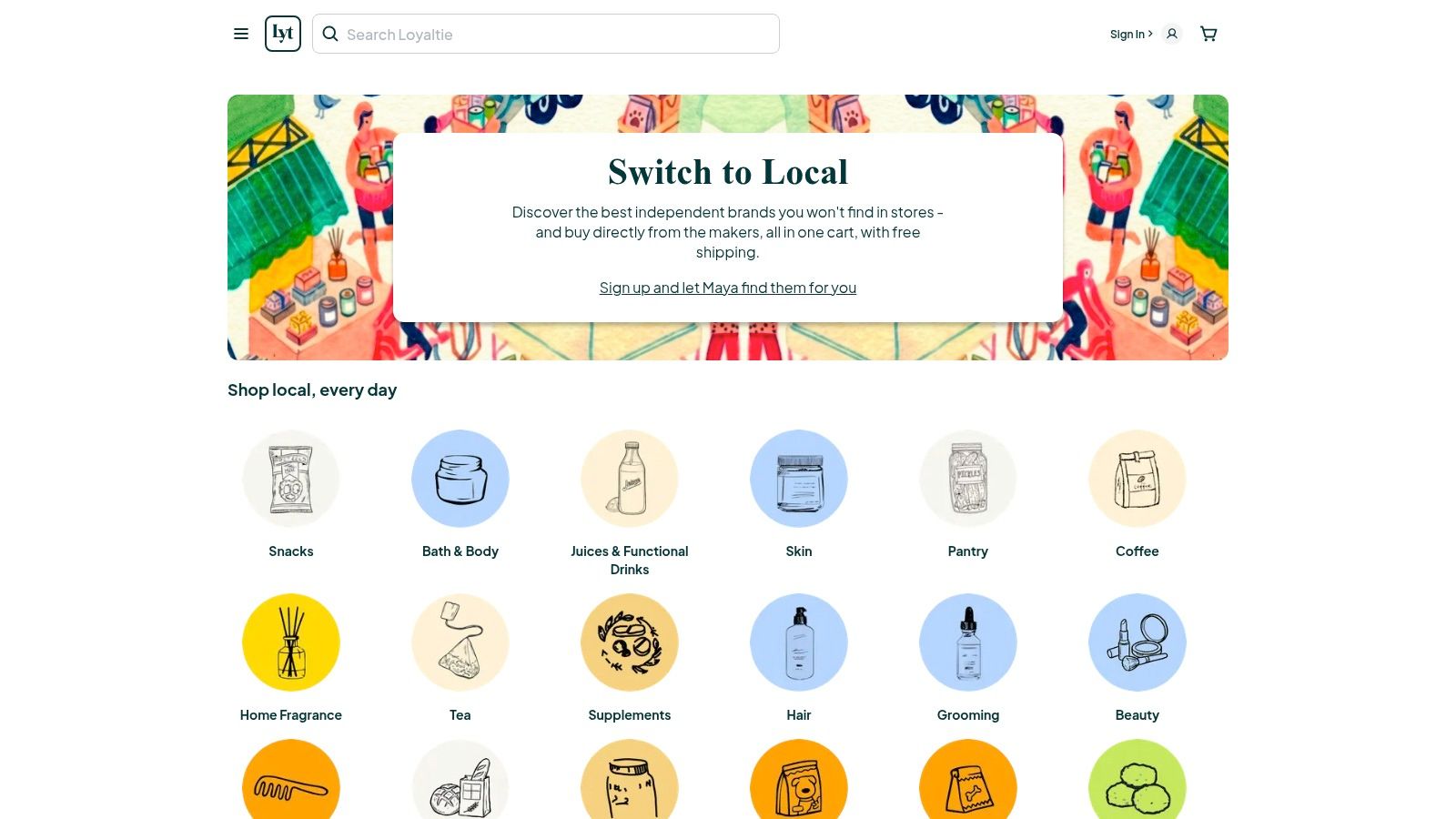
Consider an illustrative coffee maker preparing a listing. Instead of opening with a long biography, they put the coffee's identity and buying information first, then explain the maker's relevant decisions in the description. Their production photographs show the work discussed in the copy, rather than merely adding atmosphere.
Where the available listing fields allow, use the seller profile for the person and place, the product description for decisions and limitations, and images for visible evidence. These are publishing recommendations, not a claim about a particular seller's results or every available platform field.
Make the listing useful beyond the first order
Buying directly from producers is an established channel. USDA's local food sales report records $9 billion in US sales of locally produced edible food in 2020, including $2.9 billion in direct-to-consumer sales.
For a buyer considering a reorder or regular delivery, practical consistency matters. Keep product details current, explain changes, and respond to customer feedback with information rather than another promotional paragraph.
Use this video as additional context while exploring the marketplace.
Before publishing, check the information you can provide:
- Identity: Maker name, role, and accurate location.
- Product details: Ingredients or materials, intended use, and relevant care or storage instructions.
- Evidence: Clear photographs and appropriately scoped documentation.
- Expectations: Availability, fulfillment information, and known limitations.
- Continuity: A way to keep descriptions accurate when production changes.
A shopper should be able to understand what they're buying without arranging a conversation with you first.
Five Metrics That Tell You If the Story Is Working
You don't need an elaborate attribution system to evaluate a rewrite. A spreadsheet and the analytics available through your storefront, email service, and social accounts can help you spot useful patterns.
There's no defensible universal healthy range here, including for makers with under 10,000 followers. Use your own comparable history rather than borrowing a benchmark from a different category, audience, or buying cycle.
For additional measurement guidance, explore benchmarks and formulas for content growth from Narrareach. Treat benchmarks as context, not proof that your story succeeded or failed.
Reading and buying behavior
Product-page scroll depth tells you whether visitors reach the evidence. If they stop before the ingredient information, shorten the opening or move essential buying details upward. Deeper scrolling isn't automatically better, though: someone may scroll because they can't find an answer.
Add-to-cart rate lets you compare visits with cart additions. Compare a story-led version against your earlier version while keeping the product, price, availability, and traffic source as similar as practical. If cart activity drops, investigate clarity and buying friction before concluding that customers dislike your story.
A useful comparison log can be simple:
| Record | Why it matters |
|---|---|
| What changed | Helps separate a copy edit from a pricing or photography change. |
| Where visitors came from | Keeps different audiences from being treated as equivalent. |
| Availability and fulfillment changes | Identifies reasons shoppers may hesitate unrelated to the narrative. |
| Questions customers asked | Reveals missing information that analytics can't explain. |
Feedback and repeat behavior
Review velocity means how quickly new reviews arrive after a story-led launch. Read the content as well as counting reviews: comments about the actual product are more useful than praise for a beautiful founder photograph. Compare review activity with orders and your review-request timing so a change in outreach doesn't look like a change in trust.
Repeat purchase rate over a 90-day observation window can help you examine whether the experience matched the promise. That window is an operational choice, not a universal standard. Coffee, skincare, and a durable pet accessory have different replenishment needs, so also consider whether customers had a reasonable opportunity to reorder.
Email opt-outs and social unfollows show who chose to leave after story-led content. A sudden increase deserves investigation into relevance, frequency, and expectations, but it doesn't establish that readers found you dishonest. Read replies and customer questions before assigning a cause.
Measurement caution: A change in behavior is a reason to investigate, not permission to invent an explanation.
Your printable proof checklist
Use this before publishing a new product page, post, or email.
- Name the maker: Make responsibility visible.
- Name the place: Distinguish where you work from where ingredients or materials originate.
- Name a production difference: Describe something you do, without caricaturing factories.
- Name a boundary: Explain what you refuse to do and the buyer-facing consequence.
- Attach a checkable detail: Match the evidence to the precise claim.
- Ship a verifiable improvement each week: Choose a sustainable editing routine, not an imagined performance target.
When featuring customers or communities, add a permission check. Dynata's discussion of inclusive advertising distinguishes visible representation from perceived authenticity. Let contributors approve how their experiences appear, discuss compensation where appropriate, and don't turn someone's identity into decorative sales copy.
Keep the final warning close: weak product quality, robotic messaging, and promises you don't honor can undo a compelling story. Better writing should make the product easier to evaluate, not harder to question.
Loyaltie offers a marketplace for discovering independent US brands and buying directly from the maker. Visit Loyaltie to compare everyday products, look for clear maker and ingredient information, and choose an upgrade you can feel confident bringing into your routine.