
The most popular advice about artisan food products is also the least useful: look for a rustic label, a hand-drawn farm, and the words “small batch.” Those details can be charming, but they don't prove much. A vintage font won't tell you who made the food, where the ingredients came from, or whether the maker controls the process.
A better pantry upgrade starts with verification. Look for independent brands and local makers who explain their ingredients, methods, sourcing, and packaging clearly. You're not buying from them out of pity. You're looking for food, coffee, wellness products, skincare, supplements, and pet goods that offer a genuine quality upgrade over anonymous mass production.
Table of Contents
Looking Past the Rustic Label
A farmhouse illustration can sell a feeling before it sells a product. Large brands know this. They can borrow the visual language of a local kitchen, add phrases such as “traditional recipe” or “handcrafted,” and create the impression of personal care without giving you useful evidence.
That doesn't mean every polished package is suspicious, or every plain package is trustworthy. Design is decoration, not proof. The useful questions are much more direct: Who made this? Who owns the recipe? Where does production happen? Can the brand explain its ingredients without hiding behind broad language?
Consumers often say they understand what artisan products are, yet their definitions vary widely, which creates room for marketing to fill the gap. One study found that 88% of respondents said they understood artisan products, while their explanations remained broad and inconsistent (consumer research on artisan products). That should change how you shop. If the label gives you atmosphere but no process details, you haven't learned enough.
What quality looks like in practice
A real independent brand usually gives you something concrete to inspect:
- A readable ingredient list: You can identify the main ingredients instead of decoding vague flavor systems or catch-all additives.
- A clear maker story: The brand explains who makes the product and what expertise shapes it.
- A specific process: You learn whether the coffee is roasted by the brand, the soap is formulated in-house, or the sauce is produced under the maker's control.
- A traceable origin: The sourcing story names places, farms, growers, or suppliers where that information matters.
- Practical packaging: The container protects texture, freshness, and safety instead of serving only as a visual prop.
Shopping rule: If a brand wants you to pay for craftsmanship, it should show you where the craftsmanship happens.
This approach works across categories. For coffee, ask about roast date and roasting location. For skincare, look for full ingredient disclosure and responsible use guidance. For supplements, check whether the brand explains testing and formulation. For pet products, inspect the ingredient panel and manufacturing details. The point isn't to demand a romantic backstory. It's to find a maker with enough command of the product to explain it plainly.
The Real Scale of Independent Food Brands
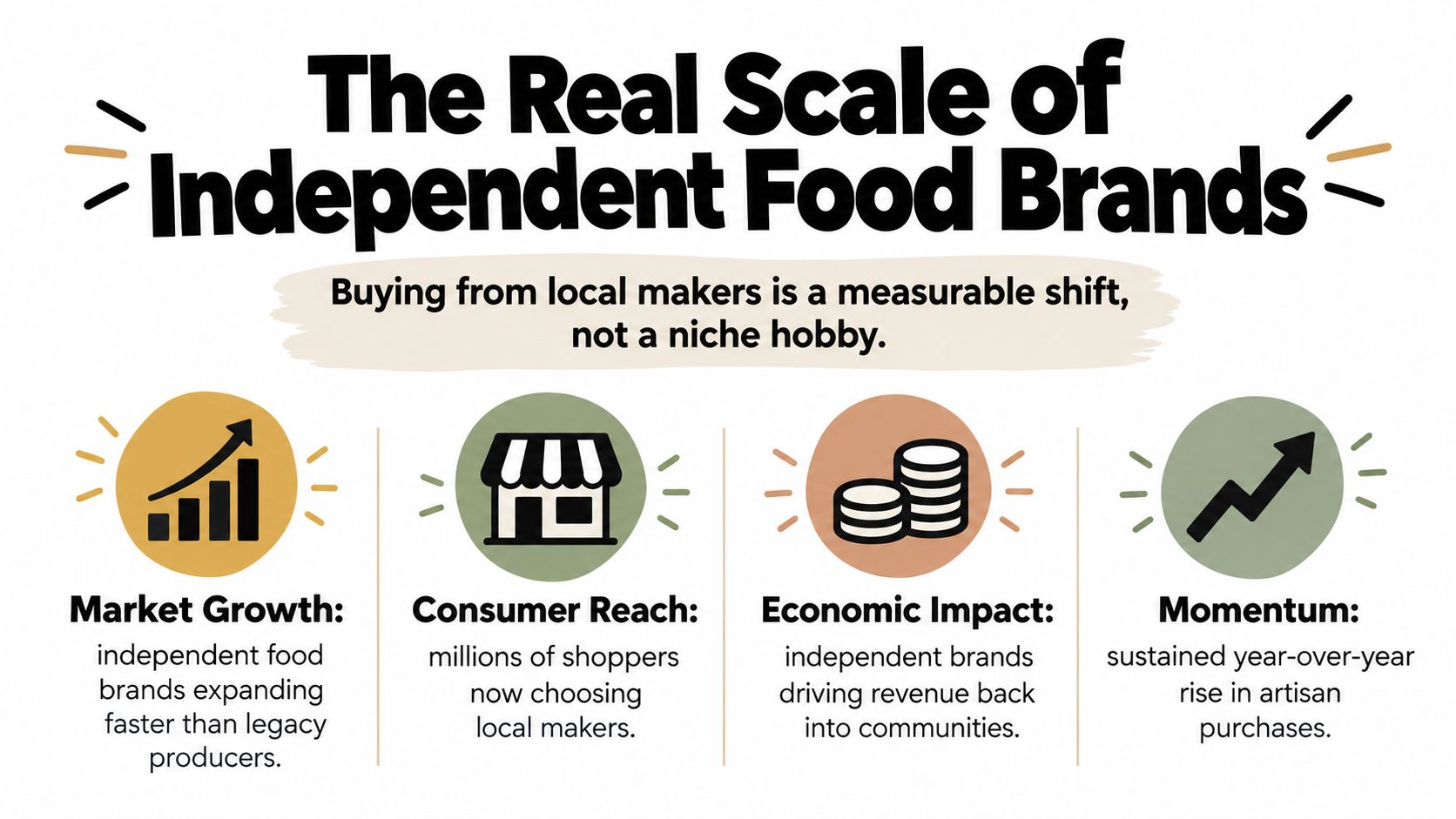
Buying from local makers can feel like a weekend activity, limited to farmers markets and specialty shops. The broader picture is different. Artisan food products have become a structured global category, spanning bakery and confectionery, dairy, meat and seafood, beverages, and pantry goods. One industry estimate values the global artisanal food market at $137.1 billion in 2026, with a projected rise to $233.8 billion by 2034, equivalent to a 6.9% CAGR over that forecast period (Strategic Market Research on the artisanal food market).
That scale matters because it changes the way you should think about independent brands. You're not choosing between a giant supermarket and a charming roadside stall. You're participating in a mature shift toward products that compete through quality, origin, authenticity, and direct relationships, rather than price alone.
From craft tradition to modern commerce
Historically, food made by hand was normal rather than niche. Before the Industrial Revolution, skilled craftspeople produced food through specialized traditions, with techniques passed between generations. The modern revival gained cultural force when the Slow Food movement was founded in Italy in 1986, after the opening of a fast-food restaurant near Rome's Spanish Steps (historical overview of the artisanal food market).
That history explains why independent food still carries such a strong emotional charge. A jar of sauce or loaf of bread can connect you to regional ingredients, inherited knowledge, and a person who has chosen to control more of the process. But heritage alone isn't enough. The modern shopper needs heritage plus evidence.
Consider Jalapeño Tomatillo Verde Hot Sauce, Lime & Cilantro, Medium Heat, Small-Batch Green Sauce, 5 oz | Maria's Sauce Co by Loyaltie. Its description gives you a useful sensory picture: bright, tangy verde flavor, a smooth medium kick, and fresh notes from lime and cilantro for tacos, eggs, and marinades. That kind of specificity helps you decide whether the product belongs in your cooking, rather than asking you to buy based on a vague promise of tradition.
How to Spot Genuine Quality and Craftsmanship
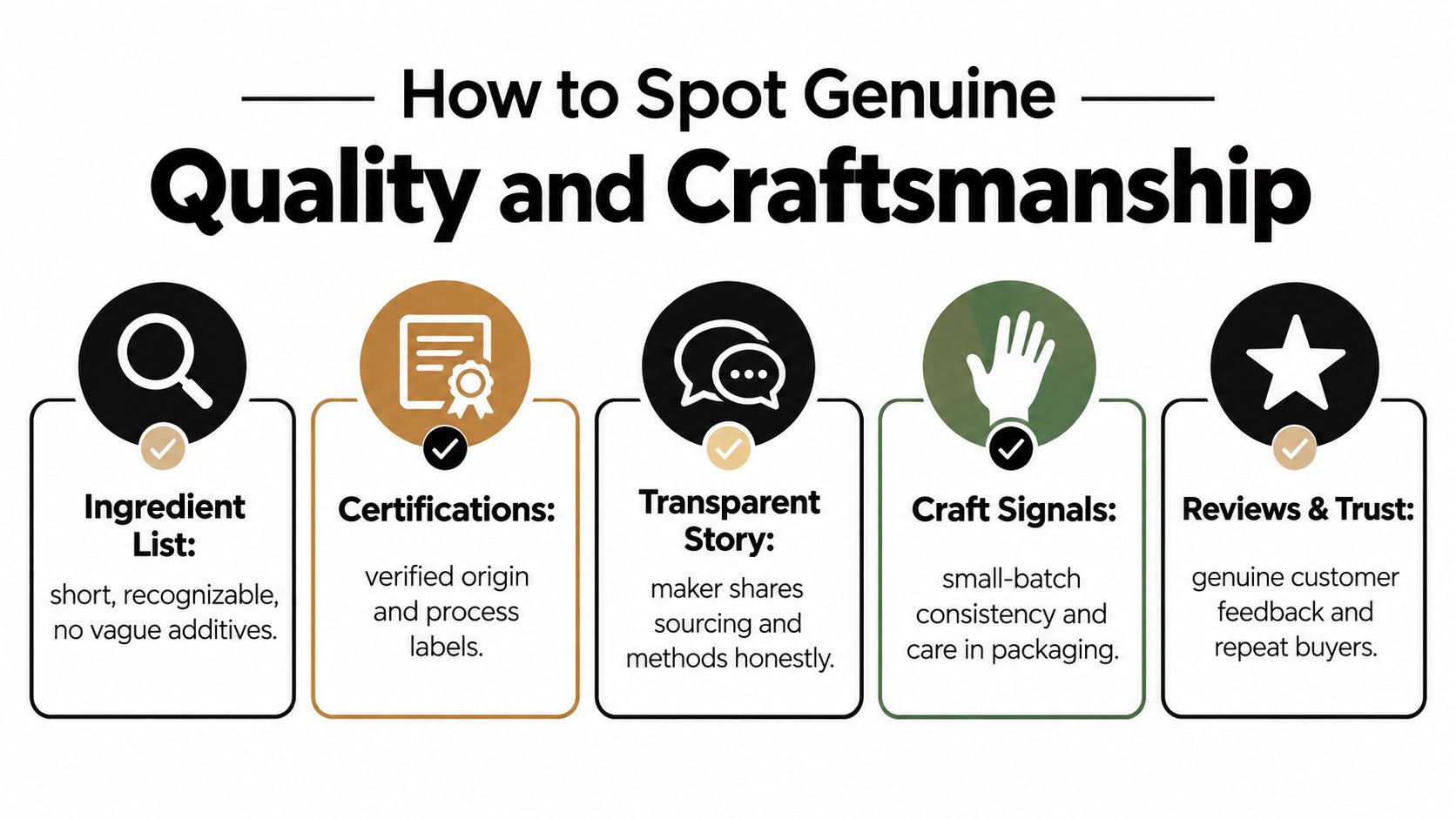
Start with the label, then move outward. A product earns trust when its details agree with one another. The ingredient list, maker story, production description, packaging, and customer experience should form one coherent picture.
A practical shopper's inspection
First, read the ingredient list before the front label. Short, recognizable ingredients aren't automatically superior, but unexplained language should make you pause. If a brand highlights local fruit, single-origin coffee, or botanical extracts, the ingredient panel should support that story.
Next, identify the maker's role. Does the brand roast, blend, bake, ferment, formulate, or package the product itself? A maker can work with a co-packer and still produce an excellent product, but honest brands explain that relationship. What you want to avoid is a generic formula dressed up with a local identity.
Then, look for process detail. “Made with care” says little. Details about fermentation, roasting, milling, curing, extraction, or storage tell you whether the maker understands the product's behavior. The more perishable or technically sensitive the product, the more important this becomes.
Check the packaging as evidence. A carefully selected container, seal, label, and storage instruction suggest that the brand has thought beyond appearance. Packaging should preserve the food and communicate how to handle it.
Finally, use reviews intelligently. Look for comments that describe flavor, texture, freshness, fit, or repeat purchases. A string of vague praise is less useful than a specific account of how someone used the product.
Where to find the real makers
Local markets remain excellent because you can ask questions face to face. Among consumers who buy locally made products, local markets are the most common purchasing platform at 65%, followed by online sales channels at 51.7% (State of the Handworker Economy report). Online discovery matters when you want to compare makers outside your immediate neighborhood, inspect product details, and reorder without waiting for a market day.
If baking is your preferred way to understand craftsmanship, a practical sourdough bread cookbook can help you learn how fermentation, flour, hydration, and timing affect the final loaf. Making bread yourself sharpens your eye as a buyer because you start noticing what a brand explains, and what it leaves out.
For specialized diets, inspect the same evidence rather than lowering your standards. A grain-free flour blend for rustic loaves or pizza is available through Forage Breads. Whether you buy it or not, the useful habit is consistent: read the ingredients, understand the intended use, and judge the product on information rather than packaging mood.
The Operational Reality for Local Makers
Independent makers don't get to treat authenticity and safety as competing values. In fact, the less automated the production line, the more deliberately the maker must control the points where variation can affect the finished food.
Artisanal production typically uses batches, manual intervention, and greater variation between batches than continuous automated manufacturing. Research from an artisanal organic salami plant found high inter-batch variability in physicochemical and microbiological parameters, and linked higher total bacterial counts on equipment surfaces with more bacterial pathogens in the final product (study of safety in an artisanal organic salami plant).
Control the critical points
A maker should standardize the steps that protect the product, even when the rest of the work remains hands-on. That means disciplined raw-material hygiene, careful sanitation in areas such as the stuffing room, and validated hurdles such as pH, water activity, salt, and moisture where those controls apply.
The aim isn't to make every batch soullessly identical. The aim is to ensure that natural variation doesn't become a safety failure. A maker who can explain critical control points, storage conditions, and corrective actions demonstrates more credibility than one who repeats “made by hand” without operational detail.
For makers: Keep the human decisions that shape flavor, but standardize the controls that protect the customer.
Packaging deserves the same attention. In research on artisanal bread, air-packed samples had an acceptable shelf life of only 6 days, while modified-atmosphere and bag-in-bag approaches extended acceptable quality to 20 days in some treatments and up to 41 days in the best-performing treatment (artisanal food shelf-life research). Those figures apply to the tested bread treatments, not to every food, but they show why packaging isn't just a branding decision.
Treat the pack as part of the product
First identify what ruins the food: microbes, moisture loss, oxidation, texture changes, or color. Then select materials and storage conditions that address that failure mode. Test using commercial packaging and equipment early, under realistic cold-chain conditions, so the results can support microbiological planning and HACCP work.
Makers expanding distribution may also need better purchasing, fulfillment, or packaging partners. A PlatformDTC supplier network can be a useful place to investigate those operational relationships, provided the maker verifies specifications and keeps control of quality decisions. For a perishable product such as Pressed with Purpose's cold-pressed juice, storage, handling, and delivery conditions are part of the customer promise, not back-office details.
Solving the Availability and Pricing Friction
The two most stubborn obstacles to buying from independent food brands are price and availability. A 2019 study identified both as the biggest barriers to purchasing artisanal food (study on barriers to artisanal food purchasing). Better taste won't create a habit if you can't find the product, understand the delivery options, or buy it again without unnecessary effort.
Direct-to-consumer commerce helps because it removes layers between maker and buyer. The U.S. DTC market reached $213 billion in 2024, up from $76 billion in 2019, and was projected to reach about $240 billion in 2025, roughly 19% of U.S. e-commerce, according to the cited industry reporting (U.S. DTC market figures). Those figures describe the wider DTC market, not artisan food alone, but they show that direct buying has become a substantial retail behavior.
Direct access beats romantic inconvenience
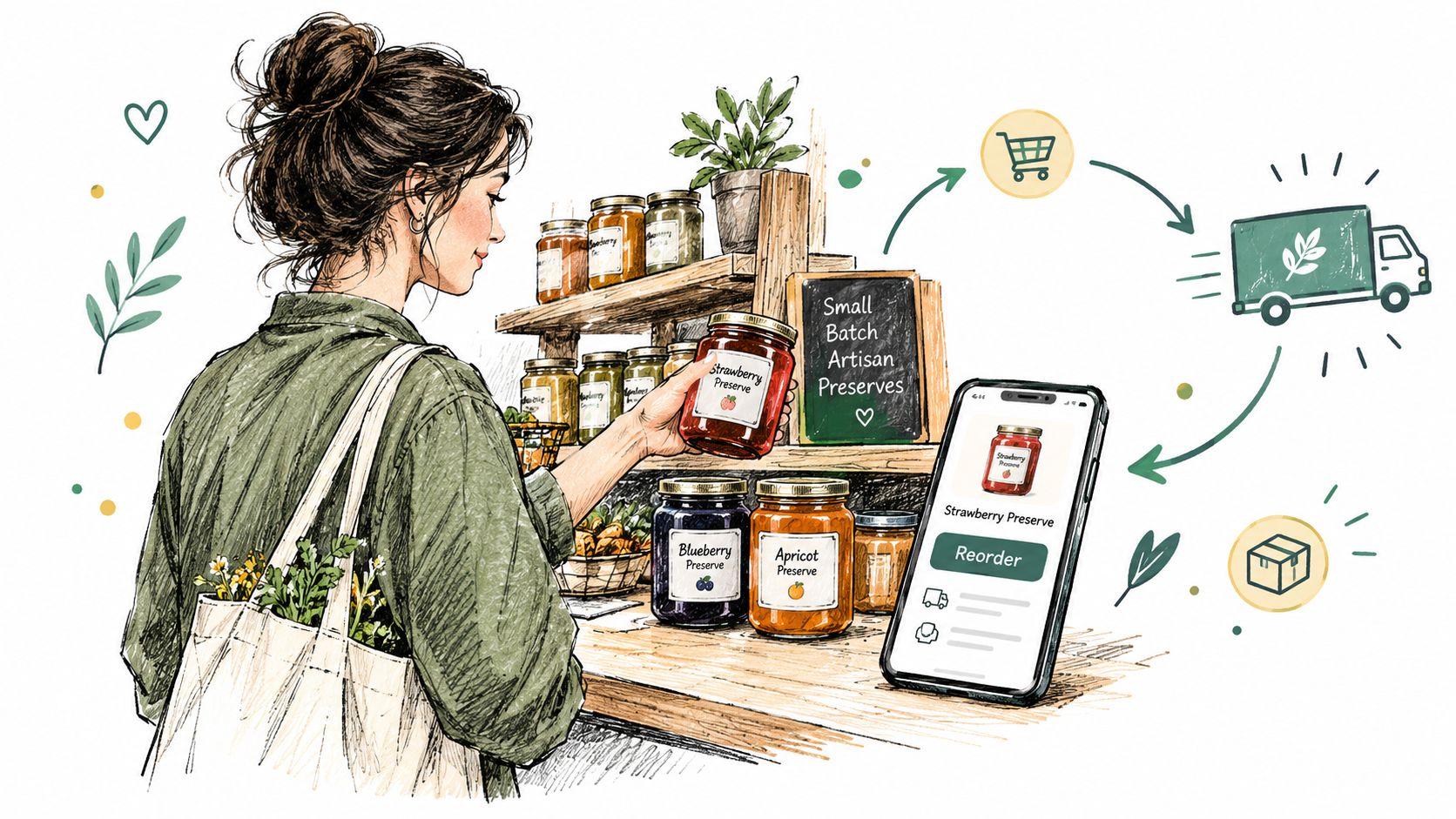
Buying directly from the maker can give you clearer product information and a more accountable relationship. It can also give a producer access to customer feedback without relying entirely on retail gatekeepers. But direct commerce doesn't automatically make food cheaper. Fulfillment, packaging, shipping, and compliance still cost money, and transparent pricing is more useful than pretending those costs don't exist.
Online sales also need a repeat-purchase design. A shopper might love a local roast, sauce, treat, or wellness product and still forget where they found it. Clear product pages, sensible storage guidance, reliable delivery, and an easy reorder path turn one good discovery into a practical routine.
For makers serving cafés, offices, or hospitality businesses, a focused coffee shop wholesale supply resource can help them assess wholesale options without abandoning direct customer relationships. For shoppers, a marketplace such as Loyaltie functions as a place to discover and buy directly from independent brands in the US, bringing product discovery and online purchasing into one path.
Upgrading Your Everyday Pantry
Don't replace your whole pantry in one dramatic sweep. Pick the products you use often, then upgrade them one at a time. Coffee, hot sauce, bread, dates, skincare, supplements, pet treats, and wellness staples all give you repeated chances to compare flavor, performance, ingredients, and the maker's transparency.
Use a simple buying routine:
- Start with the product you notice most. If supermarket coffee tastes flat, investigate independent roasters. If your everyday salsa relies on sweetness or filler, try a sauce that describes its peppers, acids, herbs, and heat clearly.
- Read before you romanticize. Check the ingredient list, maker identity, production location, storage guidance, and customer feedback. A real quality upgrade should be obvious in use, not only in the product photography.
- Buy directly when the information is better. Market stalls let you ask questions. Online storefronts let you compare details and reorder. Use both.
- Keep what earns its place. Taste and function decide whether a product becomes part of your routine. A local label doesn't get a permanent spot in your kitchen just because the story is appealing.
A product such as roasted tomatillo salsa verde makes the standard easy to apply. You can ask what gives it its flavor, how the ingredients are handled, and whether the description matches what arrives at your table. The same questions work for facial oil, a pet supplement, or a bag of coffee.
The larger natural and organic products category shows why this shift isn't confined to specialty food. The U.S. natural and organic products market reached $342 billion in 2025 and has grown by 545% since 2001, according to the cited industry reporting (coverage of the U.S. natural and organic products market). Independent brands can compete in that environment by making quality visible, not by copying the visual language of mass retail.
Your best default is simple: buy from the maker when the maker can prove the value. Look for honest ingredients, specific methods, sensible packaging, and a product you'll happily use again.
Loyaltie is a marketplace where you can discover and buy directly from independent brands and local makers across the US, including everyday food and other quality-focused products. Visit Loyaltie to find products with clearer maker stories, buy without unnecessary middleman layers, and build a better pantry around brands you can actually understand.