
You know the moment. You're standing in your kitchen on a Saturday, staring at the same grocery options you always buy, and wondering why breakfast, lunch, and even snack time can feel so flat. Then you walk into a market, smell fresh bread, see a cheesemaker slicing a wedge for a customer, and realize the difference isn't just taste. It's that the person who made the food can explain it, stand behind it, and often hand it to you the same day.
An artisan food marketplace brings that feeling online without turning it into a faceless checkout page. The best ones let you discover independent brands, buy directly from the maker, and keep the human part intact. That matters because the appeal isn't charity or a cute story, it's getting food that feels fresher, more distinctive, and easier to trust when you're choosing what to bring home again and again.
Table of Contents
- A Saturday Morning at the Maker Counter
- The structure matters
- The marketplace should help you judge authenticity
A Saturday Morning at the Maker Counter
The bread hits first. Warm crust, yeasty steam, and that slightly sweet smell that makes you slow down even if you were moving fast. A few steps later, you're talking with a cheesemaker who can tell you where the milk came from, how the batch was handled, and why one wheel tastes cleaner than another.
That is why farmers markets, food halls, and local pop-ups stick in memory. You do not just buy a thing, you meet the person behind it, and that changes how you judge the product. A loaf, a jar of granola, or a bag of coffee stops being a label and becomes a choice you can explain to yourself later.
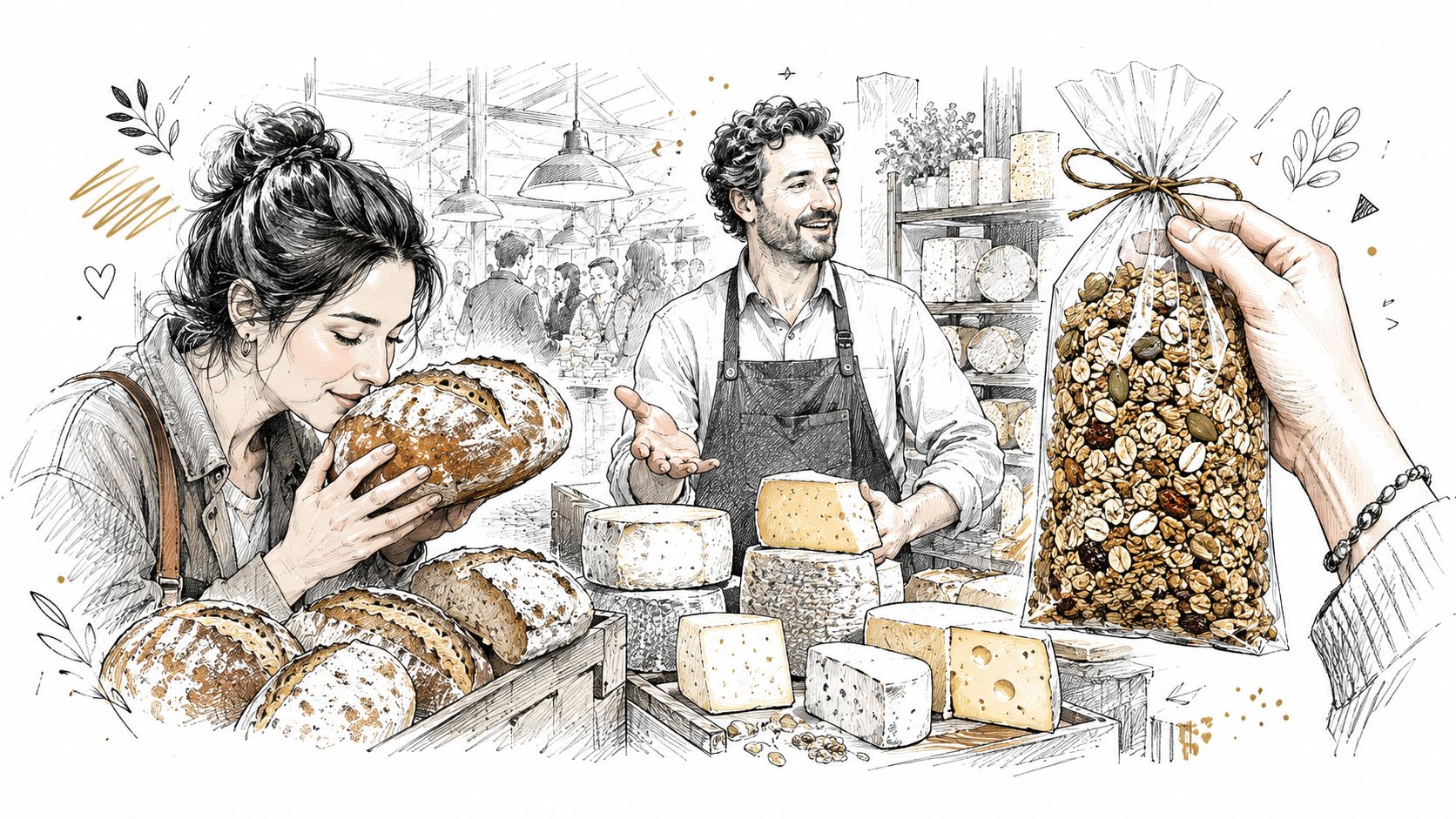
That feeling does not disappear online. It just needs a marketplace that keeps the maker visible instead of burying them behind generic product tiles. When a platform shows a producer profile, lists what the maker sells, and lets you reorder from the same source, the experience starts to work like the market counter, not a warehouse shelf.
Repeat buying is where that matters most. If you liked a honey on your first order, a clear marketplace page should let you return to the same producer, such as Arshoth Honey, check the same jar size, and place the same order again without hunting through unrelated listings. That kind of product page does more than describe the food, it gives you a practical way to buy it again when you want the same taste and the same maker, which is what turns a nice first purchase into something you can rely on.
A good example is Gluten-Free Banana Bread Mix, Vegan & Allergen-Friendly, Moist Homemade Taste, 1 Box | Really Great Food by Loyaltie, a pantry item described as a mix for moist, bakery-style banana bread without gluten, dairy, nuts, or soy. The listing makes the promise concrete because you can see what the maker is trying to deliver before you buy, and you can come back to the same product later instead of guessing which version you ordered the first time.
What an Artisan Food Marketplace Actually Is
A real artisan food marketplace is not just an online store with a rustic font. It's a place where multiple independent makers can be discovered in one searchable space, and where the buyer still feels close to the person producing the food. Think neighborhood food hall, not supermarket aisle.
The structure matters
A generic grocery app tries to move volume. A marketplace built around makers tries to connect you to origin, process, and repeatable buying from the same producer. That difference shows up in the product pages, because the good listings usually tell you who made the food, how it's produced, and why the batch may taste a little different from mass-made goods.
Practical rule: if you can't tell who made the product, the platform is acting more like a store than a marketplace.
That's also why the definition of artisan food matters. A peer-reviewed study describes artisanal foods as products made by hand or through traditional methods with specially selected ingredients, often with unique flavor and batch-to-batch variation that comes from those methods. You're not buying nostalgia. You're buying a product that can taste or feel different from a mass-produced version. Study on artisanal food production and batch variation
The marketplace should help you judge authenticity
Michigan State University Extension, citing the Hartman Group, says the screening questions are simple. Is a real person crafting the product? Is it made by hand in small batches or limited quantities with specialty ingredients? Does it reflect expertise, tradition, and process? And can you connect with the maker to verify those claims? Michigan State University Extension on real artisan food screening
That's the difference between a pretty listing and a trustworthy one. A strong marketplace makes those answers easy to find, because it knows shoppers are buying quality, not just browsing categories.
Why Independent Food Brands Are a Quality Upgrade
A good artisan food marketplace makes the buying decision feel closer to talking with the person who made the food. That matters because the value is not just in the story around the product, it is in how the product holds up when you bring it home, store it, and order it again.
What changes in the food itself
Freshness shows up fast. Coffee tastes cleaner when roasting and fulfillment stay close together, bread makes more sense when it is baked for a smaller audience and does not sit for days in transit, and cheese, granola, sauces, fermented foods, pet treats, and pantry staples all tend to benefit from tighter ingredient control and a narrower production window. You usually notice that in texture, smell, and the way the food holds up once it is on your counter.
Reliability matters just as much. If a maker can keep batches consistent enough that you know what to expect, direct buying starts to fit real routines instead of feeling like a one-off treat. That is the part many shoppers care about after the first purchase, because a product can be charming once and still fail if it is hard to get again. In that sense, quality is not only about flavor, it is about whether the brand can repeat the experience without drifting.
The broader market reflects that demand. Stratistics MRC estimates the global artisanal food market will reach $137.1 billion in 2026, rising to $233.8 billion by 2034 at a 6.9% CAGR. Future Data Stats projects $1.5 trillion in 2025 growing to $2.5 trillion by 2033 at 7.5% CAGR. The estimates differ a lot, which tells you category definitions vary, but both point in the same direction, there is durable demand for foods that feel more real and more specific than a generic store brand. Stratistics MRC artisanal food market outlook
How to spot the real thing
A strong maker page should give you enough detail to answer a few basic questions without guessing. Who made it, what is in it, and how was it produced? If the answers are fuzzy, you are probably looking at branding, not craftsmanship.
That same clarity helps with repeat ordering. If a maker explains ingredients, batch style, storage needs, and shipping timing in plain language, you can judge whether the product will fit your kitchen and your schedule. A jar of sauce is easier to trust when you know whether it was made in a small run or filled by a faceless co-packer, because those details often affect both freshness and consistency.
A maker who is proud of the process usually makes the process visible.
Buying directly from the maker also gives you clearer provenance, a better sense of freshness, and a path back to the person who made the food if you have a question. If the product is good, those details should support the experience before the first bite and after the second order.
The Different Marketplace Models Compared
Not every marketplace works the same way, and that's where a lot of confusion starts. Some platforms are broad and noisy, some are tightly curated, and some are run more like producer collectives. If you know the model, you can tell what the platform will be good at before you spend time or money on it.
Four common setups
A technically advanced multi-vendor marketplace needs more than a single-store checkout. It has to split orders by seller, calculate vendor payouts, manage disputes, and support location-based search with secure payments and commission processing. Sharetribe on local food marketplace infrastructure
| Model | Best for Shoppers Who Want | Strength | Common Limitation |
|---|---|---|---|
| Open national marketplace | Lots of variety in one place | Easy browsing across many makers | Lower personal connection |
| Curated regional platform | Fewer, more carefully chosen options | Stronger trust and clearer identity | Smaller selection |
| Producer-owned collective | A direct relationship with the source | Maker control and strong authenticity | Harder to scale discovery |
| Hybrid local-plus-online format | Both browsing and repeat ordering | Convenience with local familiarity | Fulfillment can be uneven |
That table is the short version. The longer version is simple, too. Open marketplaces can be great for discovery, but they can feel noisy. Curated platforms usually do a better job of helping you separate real makers from polished middlemen. Producer collectives can be authentic, but they sometimes lack the technology or logistics that make ordering easy.
What to ask when you see a listing
If the platform makes the maker easy to find, that's a good sign. If it hides fulfillment details, origin, or who ships the order, you should slow down. The model itself doesn't guarantee quality, but it tells you what kind of experience to expect.
How to Evaluate a Marketplace Before You Buy or Join
The fastest way to judge a marketplace is to read it like a skeptic who still wants to be pleasantly surprised. You're looking for proof that the platform respects both the product and the people behind it.
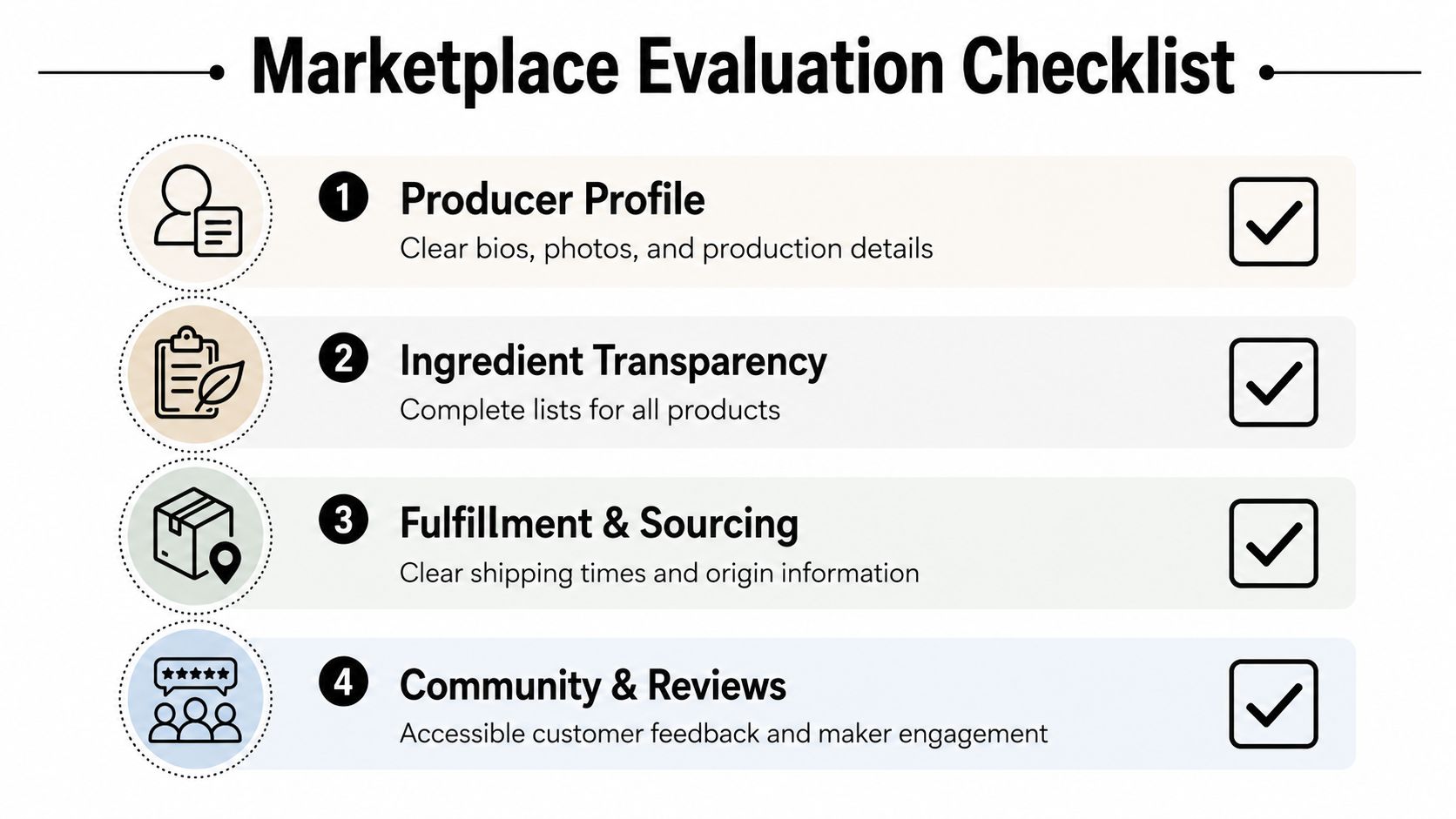
What shoppers should check
- Producer profile: Look for a real bio, clear photos, and production details that sound specific rather than generic.
- Ingredient transparency: Read the full list, especially if you care about allergens, additives, or simple formulations.
- Fulfillment and sourcing: Check shipping times, origin information, and whether the maker explains how products stay fresh.
- Community and reviews: See whether buyers can leave meaningful feedback and whether the maker responds like a real person.
A marketplace that does those things well is usually easier to trust because it's doing the work up front. That saves you from turning every purchase into a detective story. It also helps you figure out which makers deserve a second order.
What makers should check
If you're joining as a seller, use the same lens in reverse. Ask how commission works, how disputes get handled, whether onboarding feels guided or thrown together, and whether the platform reaches the kind of customers who buy again. A marketplace can have beautiful branding and still be a bad fit if it doesn't support repeat sales.
For sellers, Sell on Loyaltie is one example of a path built around getting products in front of local buyers through a marketplace format. The point is not just being listed. The point is being discoverable in a place where buyers already expect to compare makers and reorder from the ones they trust.
Logistics, Compliance, and the Repeat-Purchase Problem
The hard part isn't getting someone to buy once. The hard part is getting them to buy again when they're busy, hungry, and tempted to fall back on the familiar grocery default. That's where logistics matters more than pretty photos.
Repeat buying runs on reliability
Customers build habits when vendors show up at the same place and time every week, and repeat buyers care most about reliability, specific volumes, schedules, and prices. In other words, the product can be great, but if it doesn't arrive when expected, the relationship gets shaky fast. Ecosystems United on reliability and repeat buyers
That's especially true for food. If a maker runs out often, ships late, or leaves freshness unclear, shoppers stop planning around them. They may still love the taste, but they won't build the habit that keeps the business steady.
The basics behind the scenes
Food sellers also have to think about handling, labeling, licensing, and packaging long before a box leaves the kitchen. Fresh or fragile goods need packaging that protects quality without making the product feel over-processed. If a marketplace promises ease but ignores those details, the buyer feels it first.
A useful way to think about this is simple. Discovery gets someone to click, but reliability gets them to reorder. That's why a marketplace like Nourish Meal Delivery can matter in this space, because the buying decision depends as much on consistent fulfillment as it does on the first attractive product page.
Trust here is built by showing up the same way every time. A beautiful label helps, but dependable availability is what turns curiosity into routine.
Actionable Tips for Shoppers and Sellers
If you're shopping, start small and pay attention to how easy the maker is to find again. Save the brands that feel clear, fresh, and consistent, then reorder when you know they fit your routine. If you're buying pantry items, keep an eye on seasonal availability and don't assume every maker carries the same thing year-round.
- For shoppers: Try one curated discovery list, then narrow to the makers whose product pages answer your questions fast.
- For shoppers: Order a small first buy before you commit to regular delivery.
- For sellers: Write the producer story like a real person will read it, because they will.
- For sellers: Tighten inventory snapshots and shipping expectations so buyers don't have to guess.
If you're packaging food, a practical resource like the guide to food safe materials UK can help you think through materials with more care before you ship anything. And if you want a place where people discover and buy directly from the best independent brands in the US, Loyaltie fits that job without making the experience feel complicated.
Loyaltie is built for shoppers who want better everyday products from real makers, with the convenience of browsing and buying in one place. If you're ready to find independent food brands that feel worth reordering, visit Loyaltie and start with a few makers whose products you'd want in your kitchen next week.