
The most popular advice is to hunt for a Made in USA sticker and stop there. That advice fails the moment you flip the piece over and ask who actually melted the glass.
A sticker can sit on a tumbler pressed from a local batch, on a blank that was only engraved here, or on a design owned by an American brand and formed somewhere else. Price and star ratings won't sort those apart. You need a test for the claim before you compare anything else.
American-made glassware is worth that extra minute because the better everyday pieces come from independent makers who control the furnace, the form, and the finish. You're not doing anyone a favor by asking. You're buying a clearer glass and a sturdier rim, with a story you can check.
Table of Contents
What American Made Glassware Really Covers
A Made in USA sticker can describe very different amounts of U.S. work. A U.S. brand, a domestic designer, and a final polish are not the same as melting and forming glass here. The label alone may leave you unsure whether the piece began as an imported blank or was made at an American furnace.
Place the piece on this four-tier scale before weighing its claim.
| Tier | What happens in the US | What to ask the seller | Strength of claim |
|---|---|---|---|
| Melted and formed in the US | Sand to finished piece, all in American facilities | Where is the furnace and forming line? | Strongest |
| Formed in the US from imported glass | Shaping and annealing in the US, raw glass from abroad | Where does the raw glass come from? | Strong |
| Decorated or finished in the US | Engraving, painting, or cutting on imported blanks | Which step is done locally, and where are the blanks made? | Moderate |
| US-owned or US-designed but imported | American brand and design, glass made abroad | Is any part of the glass made in the US? | Weakest |
How the tiers show up on a shelf
Two tumblers can carry the same flag on their tags and still represent different tiers. A plant in western Pennsylvania that melts its own batch and presses tumblers on site fits the strongest tier. An Ohio studio that buys clear blanks from abroad and cuts or paints them locally fits the moderate tier. Both do work in the US, but only the first makes the glass there.
A brand name or U.S. warehouse does not establish where a piece was made. Ask for the studio or plant location, the step performed there, the country of the inputs, and whether production is by hand or on a line. Those answers let you compare like with like, rather than treating every American connection as the same claim.
American glass production once clustered in the Midwest and along the Ohio River, where fuel, river freight, and skilled crews came together. By 1880, about 57% of U.S. glasshouse output came from Midwestern states such as Ohio and from western Pennsylvania, according to Belt Magazine. By 1920, the broad region accounted for roughly 80% of U.S. glass manufacturing.
Practical rule: Place any target piece in one tier before you compare prices or reviews.
Domestic production still leaves energy source, furnace efficiency, shipping distance, and recycled content to check. Glass furnaces operate at temperatures above 1,500°C, making energy use part of the production picture, as described by Grand View Research. The firm reported that North America represented 26.6% of global glass-manufacturing revenue in 2025, while manufacturers invested in furnace modernization and recycled-glass use. Geography helps establish provenance, but it does not answer every question about how a piece was produced.
A listing that names its glass gives you a useful starting point. For example, this clear soda-lime glass latte cup and saucer identifies the material. Ask the seller which provenance tier applies to the cup itself.
Quality Questions That Expose Weak Glass
A rim with a clean bevel is an easy detail to check at a craft fair. It tells you little about stress hidden in the glass wall, which can lead to delayed cracking. Ask how the piece is made and checked, not just how it looks on the shelf.
Five questions, and the answer that counts
1. Do you anneal, and how? During annealing, glassware is reheated to approximately 590–650 °C, then cooled uniformly to reduce residual stress that can weaken the piece and cause delayed cracking, as described in the glass production overview on Wikipedia. A useful answer names the lehr and cooling path. “It's strong” or “it's tempered” does not explain the annealing step.
2. How do you inspect? Ask whether the maker checks for internal stress with polarized light or a similar test. Find out whether inspection includes the first piece from each mold, scheduled checks, and another check when the batch or heat settings change. Visual inspection alone leaves internal stress unaddressed.
3. What happens to rejects? Ask how rejected pieces are handled and whether they return to the furnace. A clear description gives you more to assess than “we never recycle rejects” or no answer at all. Avoid assuming every maker follows the same inspection or recycling process.
4. What are the dimensions? Request rim geometry, wall thickness, base stability, and capacity. Capacity in ounces cannot tell you whether the base sits flat or the rim is even. Those details help you judge how the piece will handle everyday use.
5. What is the recycled content? Factory scrap and post-consumer cullet are different claims. The U.S. EPA estimated a 31.3% recycling rate for glass containers and packaging in 2018, as reported in Fluke Process Instruments' notes on bottles and containers. Ask for the maker's percentage and whether it refers to post-consumer or pre-consumer material. “Recycled glass” without either detail is too vague to compare.
Treat slogans as incomplete answers. Ask a follow-up before buying, and compare how plainly makers explain their process. Clear answers to all five questions give you something more useful than an origin story.
Construction matters in other household purchases, too. These quality furnishing tips from Stahl Home Center also focus on looking beyond a hangtag. For glass used with hot water each morning, ask the same questions about a borosilicate pour-over starter bundle, rather than judging the set by appearance alone.
What Labels Mean
Picture a tumbler with a painted lip and a gold band. It looks finished. It may also put decoration on the surface your drink touches, and the same doubt applies to metallic rims, colored coatings, and vintage or imported pieces.
FDA guidance states that food-contact substances must not migrate at harmful levels, and FDA enforcement materials identify lead and cadmium as hazards relevant to foodware, with specific leaching guidelines for ceramic hollowware. Those documents focus substantially on ceramics. For glass, the open question is whether the glass itself is safe, and whether decorations, coatings, or printed surfaces stay put after repeated washing and acidic drinks.
Country of manufacture is not a food-contact compliance statement. A domestic piece can still need a test. An imported piece can arrive with a lab sheet.
| Label | What it tells you | What it leaves unproven |
|---|---|---|
| Lead-free | The glass or decoration contains no added lead | Migration of other metals or coatings |
| Food-safe | The maker believes the piece is suitable for food contact | The test method and the surfaces tested |
| Tested for migration | A lab checked how substances move into food or drink | Whether the test covered repeated washing and acidic use |
| Made in USA | Where the piece was produced or finished | Whether it is food-safe or lead-free |
| Dishwasher or microwave safe | The maker claims the piece tolerates those conditions | Whether decoration survives repeated cycles |
Questions for the person who decorated it
- Is the decoration on the food-contact surface? A band on the outside is a different risk from paint on the lip.
- Do the pigments contain regulated metals? "Lead-free" doesn't answer cadmium or other coatings.
- Which standard or lab method was used? A named method is the difference between a belief and a test.
- Were dishwasher or microwave claims validated? Heat, detergent, and acid are separate stresses.
If a maker can't name a test method, treat "food-safe" as a claim, not a fact.
Provenance and safety stay separate questions, so don't let a flag on the box stand in for either one. A vintage pressed piece used for something other than drinking, such as this Fostoria American sugar bowl poured as a soy candle, still deserves a plain reading of what touches the contents.
This short walk-through shows how decoration and heat meet the glass, which is the same place your questions should land.
Where to Buy and What to Expect to Pay
The words “American made” are a starting point, not a location. Buy from a maker's site or studio when you want a direct answer about where the glass was formed. Galleries, markets, independent marketplaces, and retailers offer other ways to shop, but each listing still needs to say what work happened in the United States.
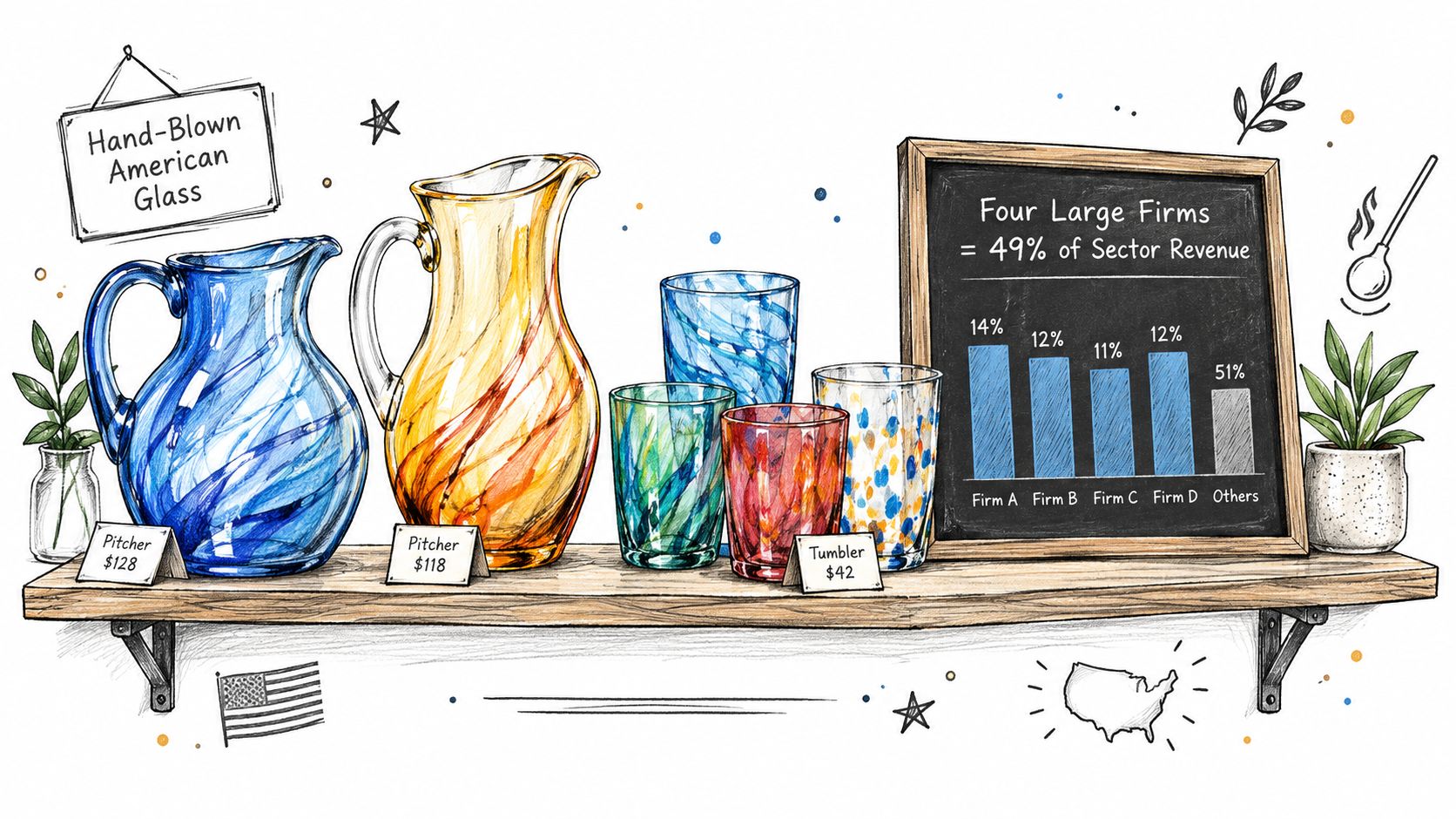
In 2022, U.S. pressed and blown glassware manufacturers recorded approximately $3.61 billion in domestic shipments, with 349 firms and 376 establishments, and the four largest firms represented about 48.6% of sector revenue, according to a Histometrics industry primer. The same primer reports that China supplied roughly 30% of U.S. glassware imports that year and that the United States accounted for about 6.6% of global glass-and-glassware exports. Those figures describe a broad market, not the origin of a particular glass. Check the production location on the listing.
| Channel | Best for | Trade-off |
|---|---|---|
| Local glass studios and galleries | Seeing pieces in person and asking questions face to face | Fewer pieces and limited hours |
| Craft fairs and makers' markets | Meeting makers and finding one-off designs | Stock changes weekly and returns can be hard |
| Maker websites | Full product details and direct answers from the maker | Shipping costs for fragile glass |
| Independent marketplaces such as Loyaltie | Browsing many independent brands in one place | Check each maker's provenance on the listing |
| Big retail with a made in USA tag | Convenience and easy returns | The tag may cover only a finishing step |
What the price is actually buying
Compare the price per glass as well as the set price. A set can cost less per piece, while hand-formed glass usually carries more labor in each item. Fragile shipping may add a carton charge, so include it when comparing listings.
Compare like with like. A hand-blown tumbler and a pressed glass may differ in forming method, finish, and price, so the price gap alone does not tell you whether one is marked up. Check whether a seconds listing describes the flaw and how it differs from first-quality glass. If that distinction is unclear, ask before ordering.
A direct purchase can make it easier to ask one specific question about the piece. Read the listing for shipping, breakage, and return terms before checkout. On Loyaltie, shoppers can browse independent makers and producers, but the maker's listing is still where to check the glass's origin and condition.
Check the Maker and Confirm Your Order
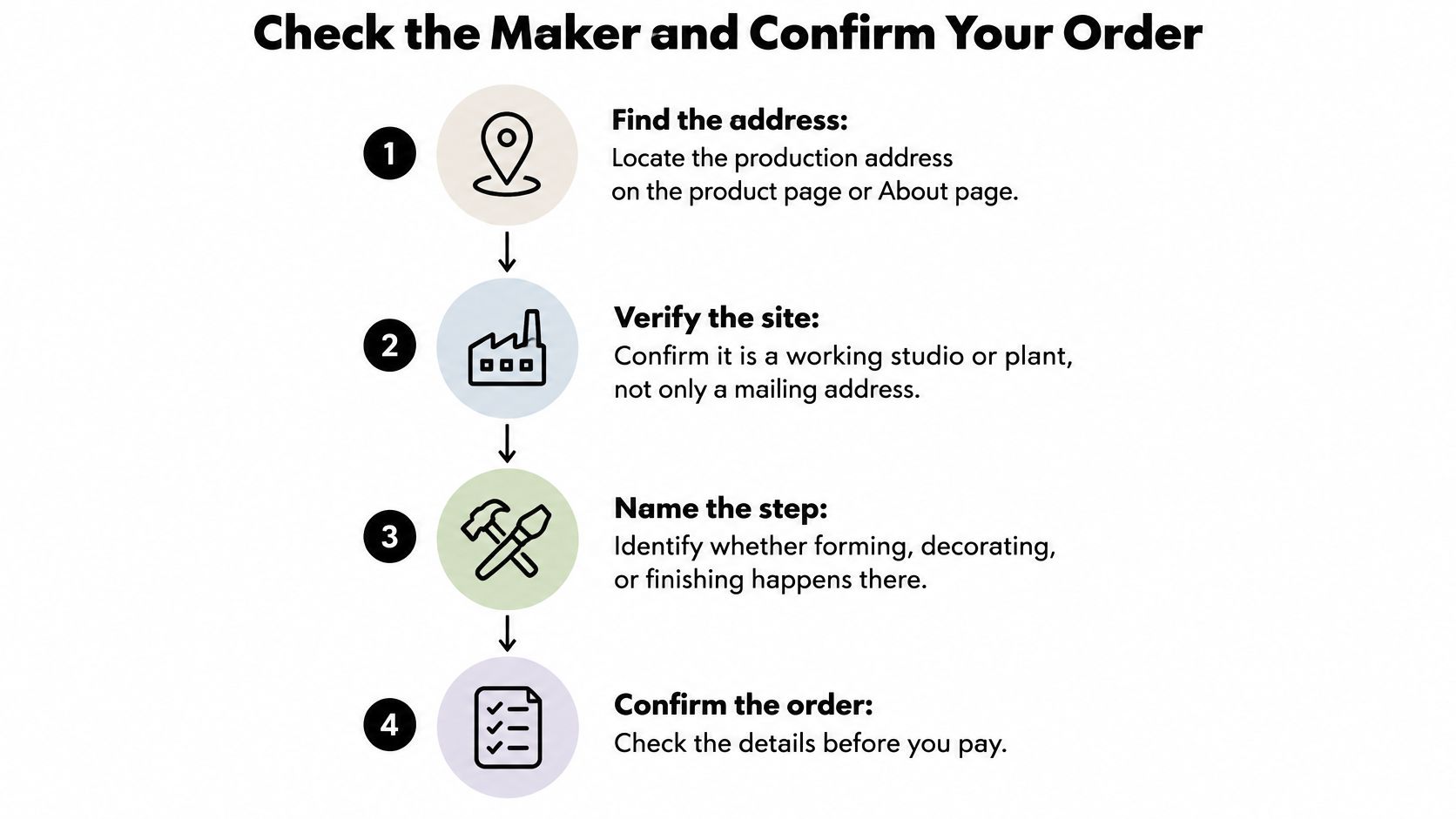
"American made" is a claim to test, not a feature to trust. Start with the address, then find out which step happens there. A workshop that decorates imported blanks and a plant that forms glass locally may both be American businesses, but they represent different levels of provenance.
- Find the production address on the product page or About page. Look for a street address tied to glassmaking, rather than only a mailing address. A post office box can be valid for mail, but it does not identify where a piece is made.
- Name the step done there: forming, decorating, or final assembly. Use that answer to place the piece on your four-tier provenance scale.
- Sort the item as pressed, blown, or fabricated. U.S. glass manufacturing includes flat glass, pressed or blown glassware, bottles and jars, and products made from purchased glass, such as lighting, mirrors, architectural glass, and electronic glassware. Dlubak Glass describes a broad field that serves automotive, lighting, plate, fiberglass, container, and specialty-glass industries, with five plants across Pennsylvania, Ohio, Kentucky, Texas, and Oklahoma. A real American glass plant may still make something other than your drinking glass.
- Ask where the raw glass comes from and whether the piece is formed by hand or on a production line. “Quality glass” names no source.
- Cross-check the business name against its address, workshop photos, and local-market appearances. If those details conflict, ask the maker to clarify before ordering.
What the listing should already say
Before checkout, look for the item category, forming method, production location, and raw-glass source in plain language. Recycled-content and food-safety statements should be specific enough to understand, not just slogans. Check that the return policy explains what happens if glass breaks in transit and whether seconds are sold. Then send one specific question. A clear answer helps establish whether the provenance details describe the piece you are buying.
The four checks below turn that review into an order decision, from the production address to checkout.
Loyaltie is a marketplace for discovering and buying directly from independent brands across the US. Compare listings by their stated provenance, then choose a tier and a maker before ordering a single piece. A small first order lets you judge the glass and the seller's description before committing to a full set.
Care Habits That Keep Glass Clear for Years
Thermal shock is how good glass fails at home. Move a cold tumbler into hot water, or set a hot base on a cold stone counter, and the piece can crack even when the maker annealed it properly.
- Hand wash decorated or painted pieces. Repeated dishwasher cycles wear paint and metal bands.
- Let the glass warm gradually before you pour anything hot.
- Use a soft brush or sponge. Abrasive pads haze the surface.
- Skip the microwave unless the maker states it's safe.
- Don't stack pieces tightly. Rims and bases chip where they touch.
- Store glasses upright, not rim-down, so the lip isn't carrying the weight.
Hard-water film lifts with a soak in diluted white vinegar. Scrubbing harder just marks the glass. The same gentle clean is what keeps a narrow neck clear, which is why keeping your whiskey decanter crystal clear is a useful read if you own one.
A maker who has tested a dishwasher cycle will say so. Follow that note. If they haven't said it, don't grant yourself the permission. Wash a new piece by hand after the first use, then check the rim and the base once a month for chips.
Loyaltie is where you can discover and buy directly from independent brands across the US, including makers who state how their glass is formed. Take the tier test and the label questions onto a real listing, then order one piece you'll use day to day. Visit Loyaltie and start with a single glass before you commit to a set.