
You know the moment. You've got coffee, skincare, pet food, maybe a replacement charger, sitting in an Amazon cart, and half the brands look familiar in the weakest possible way. It's convenient, sure, but convenience isn't the same thing as getting the right product for your kitchen, bathroom, pantry, or dog bowl.
More people are moving toward alternatives to Amazon shopping because they want better sourcing, clearer ingredients, and products that feel made by people who care about the category. The good news is you don't have to give up convenience to do that. You just have to stop treating one giant marketplace like it's the only place the internet exists.
| Platform Type | Best For | What You Give Up | What You Gain |
|---|---|---|---|
| Local marketplaces like Loyaltie | Everyday essentials, local brands, discovery | The biggest possible catalog | Direct access to independent brands, local connection, no middleman |
| Specialty marketplaces | Books, handmade goods, niche gifts | Broad general shopping | Better curation and stronger category fit |
| Big-box retail chains | Households basics, electronics, fast replenishment | Some of the unique finds | Familiar pricing logic and dependable logistics |
| Direct-to-consumer brand sites | Skincare, wellness, food, supplements | One-stop browsing | Better product stories, tighter quality control, and direct buying |
| Resale platforms | Used books, gear, furniture, and fashion | New-product consistency | Lower waste and more varied finds |
| Offline options | Groceries, home improvement, urgent needs | Digital convenience | Instant pickup and hands-on selection |
Table of Contents
Why People Are Looking Beyond Amazon Right Now
A lot of people start this shift the same way. They open a cart to reorder coffee, dish soap, and dog treats, then notice they're buying a random mix of marketplace brands, some familiar, some not, and almost none especially memorable. At that point, the question isn't whether Amazon works. It's whether it's still the best fit for what you buy every week.
Amazon's scale is still massive, but the market around it is bigger than the platform itself. In 2023, Amazon accounted for about 37.6% of U.S. e-commerce sales, while 62.4% happened elsewhere. It also represented about 10% of all U.S. retail sales and 4.4% of total consumer spending, which means most shopping dollars still flow through other channels such as Walmart, eBay, Target, and direct-to-consumer stores. That's not a fringe rebellion, that's a very normal shopping pattern, and it leaves plenty of room for specialized alternatives to win on trust, curation, and community connection. Trusted Buyer Report
What changed for regular shoppers
The old idea of Amazon as the default for everything has gotten weaker because shoppers are more category-specific now. You might still want Amazon for one-off emergency buys, but not for coffee, skincare, supplements, or food you reorder every month. Those are repeat purchases, and repeat purchases are where quality differences become obvious fast.
The big shift is that people don't just want “another place to buy stuff.” They want a better way to buy the stuff they already use. That means fresher coffee, cleaner ingredient lists, more transparent sourcing, and less guessing about who made the product and why.
Practical rule: If a product matters to your routine, don't let the default marketplace pick it for you.
That's why alternatives to Amazon shopping are no longer just about values in the abstract. They're about better results in your hands, on your shelves, and in your pantry. Coffee tastes fresher when it comes straight from a roaster. Skincare feels less throwaway when the maker explains the formula clearly. Pet food is easier to trust when the brand doesn't hide behind generic marketplace packaging.
If you've been meaning to switch, start with the categories where consistency matters most. Those are the purchases that deserve a better home.
The Main Categories of Amazon Alternatives Worth Knowing
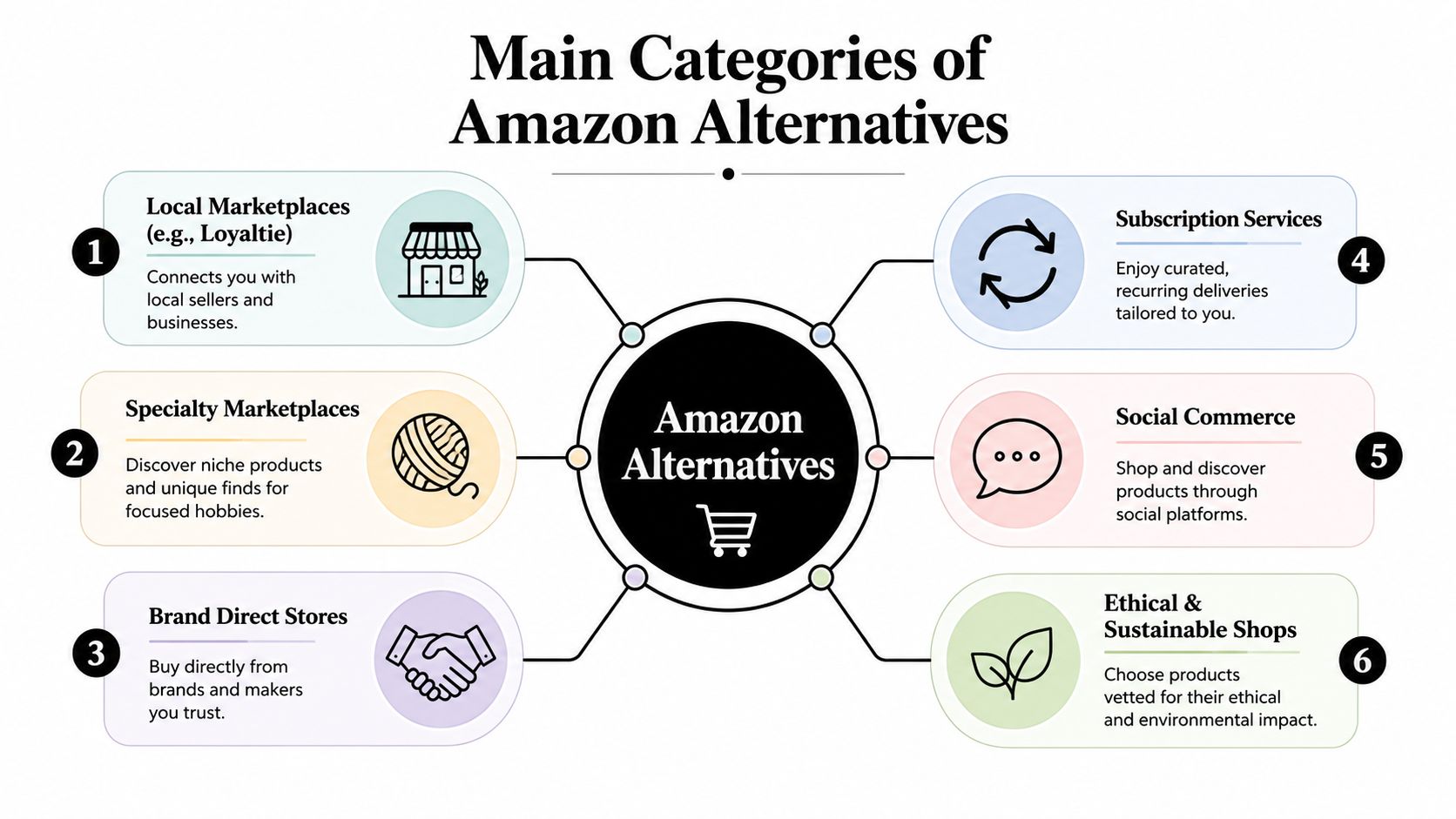
The easiest way to stop thinking in “Amazon or not Amazon” terms is to sort alternatives by shopping job. That's how you avoid wasting time on platforms that look nice but don't fit what you need.
Start with the lane, not the logo
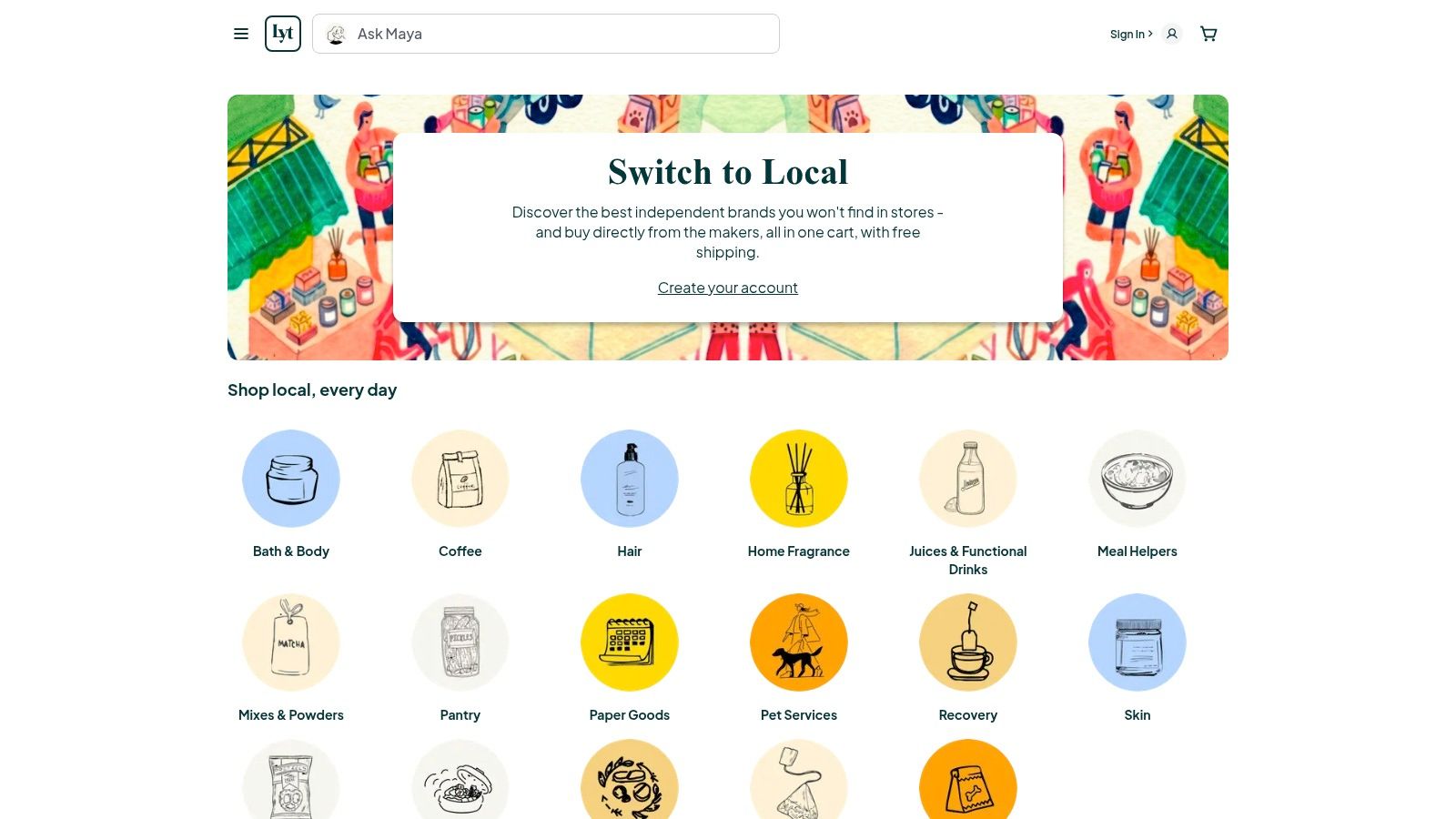
Local marketplaces, like Loyaltie, are for people who want to discover and buy directly from independent brands in the US without turning shopping into a scavenger hunt. That makes them strong for food, wellness, home goods, gifts, and repeat buys where provenance matters. The trade-off is that they're not trying to be the biggest catalog on earth, and that's the point. I'd use this lane when you want one basket across several makers and you care who you're buying from.
Specialty marketplaces are better when the product category itself matters more than the platform. Think books, handmade goods, niche gifts, or hobby items. These sites usually win on curation and character, but they can be uneven on speed or depth outside their core category.
Brand direct stores are what you use when you already know the maker you want. This is the cleanest path for skincare, supplements, coffee, and pet products when the brand's site is the source of truth. You lose the giant marketplace browse session, but you gain a clearer product story and fewer layers between you and the maker.
Big-box retail chains still matter, especially for household basics, electronics, and same-day practical errands. They aren't exciting, but they're dependable, and they often make sense when you care more about speed and return convenience than discovery. For many shoppers, this is the “keep life moving” option.
If you're replacing Amazon for the first time, don't try to replace everything with one site. Match the store to the category.
Second-hand and resale platforms make sense for books, gear, furniture, and anything you don't need brand new. You'll sacrifice consistency, but you'll often gain better value and less waste.
Offline options still win for groceries, urgent home needs, and anything you want to touch before buying. A local store or farmers market can beat a website when you need it now, not tomorrow.
For a real example of a local brand discovery path, take a look at Rose of Eden Home & Scents on Loyaltie. That's the kind of direct-from-maker browsing that gives you a clearer feel for what's being sold.
How the Top Alternatives Compare
If you are deciding where to shop next, start with what you buy most often. Amazon still makes sense for broad selection and a checkout flow people already know. The moment you care more about product quality, curation, or local impact, the comparison shifts and the better option becomes category-specific.
| Platform Type | Price | Quality & Curation | Sustainability & Local Impact | Shipping & Returns |
|---|---|---|---|---|
| Amazon | Often competitive on quick comparisons, especially for commodity items | Huge selection, but uneven quality and lots of clutter | Weak on local connection, because the experience is built around scale | Fast and familiar, with a strong returns culture |
| Walmart Marketplace | Often stronger on household basics and cost structure for sellers | More practical than curated | Limited local discovery, but useful for everyday essentials | Strong logistics, especially for common goods |
| Specialty marketplaces | Can be fair for the right category | High curation in books, handmade goods, or niche items | Better alignment with makers and category communities | Varies by seller and category |
| Direct-to-consumer brand sites | Often good when you buy straight from the source | Usually stronger product story and clearer standards | Better for direct maker relationships | Depends on the brand, but policies are usually clearer |
| Local marketplaces like Loyaltie | Often attractive when direct buying cuts out the middle layer | Strong for finding independent brands you wouldn't see elsewhere | Best fit for local commerce and community connection | Built for a simpler one-basket experience across makers |
Where each one wins
For price, Walmart Marketplace and category-specific retailers usually make the most sense if your main goal is not overpaying for household staples. That does not mean Amazon always loses on sticker price, it means price alone is not enough to justify using Amazon for everything.
For quality and curation, direct brand sites and specialty marketplaces are the smarter default. You get fewer random listings and more context about what you are buying. That matters when a product touches your skin, your pantry, or your morning routine.
For sustainability and local impact, local marketplaces and direct-to-maker shopping are the cleanest fit. You are not buying through a giant middle layer that hides where the product came from. You are buying closer to the source, and that usually gives independent sellers more room to stand out. A marketplace like Loyaltie fits that pattern well when you want to discover local brands without giving up a browsable storefront.
For shipping and returns, big-box retail still has the edge when you need speed and predictable logistics. Amazon is strong here too, but so are some national chains, and that is why they still deserve a place in your shopping mix.
My take: Do not ask which alternative is “better” in the abstract. Ask which one is better for coffee, skincare, books, or electronics. That is the question that gets you a useful answer.
For sellers, the economics can matter just as much as the shopper experience. Independent industry reporting places Walmart seller fees at 6% to 20% with no subscription fee, versus Amazon's roughly 15% all-in cost in the same comparison. AmzPrep That does not decide everything, but it does change the math for lower-ticket goods where fees can eat into margin quickly.
Replacing Amazon by Category Without Losing Convenience
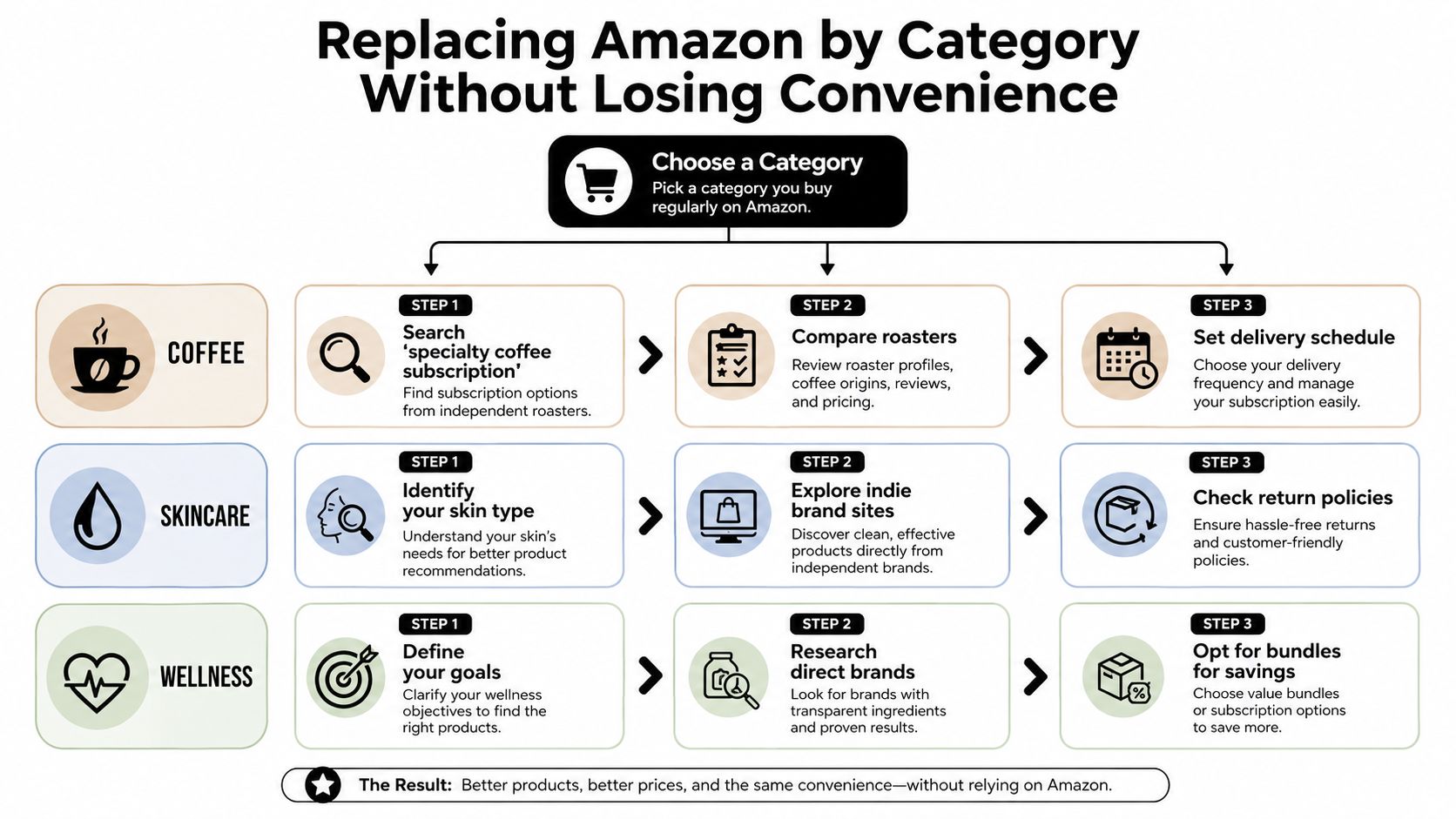
The cleanest way to move off Amazon is to stop treating every purchase like it belongs in one giant cart. Break your buying habits into categories, then replace each category with the place that fits it.
Build your replacement list from the last order
Start with the last few things you bought, then sort them by type, not by habit. Coffee usually belongs with a roaster or direct maker. Skincare and wellness products usually belong on a brand site or a curated marketplace. Books fit better through a bookstore-focused channel. Electronics often still make sense at a big-box retailer or specialty seller. Household basics can go either way, depending on whether price or sourcing matters more.
That category-by-category reset is what keeps the switch practical. You are not rebuilding your whole shopping life. You are just replacing the items where Amazon is the lazy choice, not the smart one.
Use the same routine every time you reorder. Check what you bought, group it, replace the category, and save the new site for next time. That habit cuts down on the “I'll just use Amazon for this one thing” drift that turns into default shopping all over again.
If you want a purchase flow that starts with comparison instead of a giant marketplace scroll, Google Shopping can help. WordStream says the average Google Shopping conversion window is almost a full week shorter than Amazon's conversion window, which points to faster purchase decisions once someone already knows what they want. WordStream That works especially well for items where you care about price, shipping, and product page quality more than endless browsing.
Make the switch feel routine
Coffee is the easiest place to start. Go straight to a roaster or specialty coffee shop site, then set up regular delivery if you buy the same bag every week. For skincare, buy directly from the maker when ingredient lists and return policies matter. For wellness products, check the brand's own site before you settle for a random marketplace listing. For pet food, stick with brands that explain sourcing and packaging clearly.
A good example is the Keto Porridges Variety Bundle | Nourish Meal Delivery by Loyaltie, a warm breakfast option built around keto porridge instead of oats, with collagen peptides and farm-sourced ingredients. It shows the kind of buy that makes more sense when you want a specific routine item, not a generic marketplace substitute.
A marketplace like Loyaltie fits this approach because it gives you a way to discover and buy directly from independent brands in the US without falling back on a giant catalog full of lookalike listings. That is the point. Keep the convenience, drop the clutter.
And yes, if you like seeing the buying path in motion, the embedded walkthrough below shows how this category-based switch works in practice.
The easiest part is that you do not need a perfect replacement for everything. You only need a few better defaults.
Why Buying Direct From Independent Brands Is a Quality Upgrade
Buying directly from independent brands usually improves the product before it improves the story around the product. You get closer to the maker, closer to the ingredients, and closer to the people who can answer a real question without sending you through layers of customer support.
What changes when you buy closer to the source
Coffee is the easiest example. You are more likely to get a fresher roast and a clearer sense of origin. Skincare is another one, where shorter ingredient lists and better product explanations are easier to find. Supplements are usually clearer too, because direct brands can explain sourcing and formulation in plain language instead of hiding behind marketplace fluff. Pet food follows the same pattern, since you are usually one click closer to understanding what is in the bowl.
That is why I do not treat direct buying as a moral gesture. It is a quality upgrade. The product tends to be better because the maker has more control over how it is presented, packed, and explained.
A marketplace like the Loyaltie seller page fits that model because it is built as a place where people discover and buy directly from independent brands in the US. For shoppers, that means a simpler way to browse without defaulting to a giant catalog that buries the maker behind generic listings. For sellers, it means an easier path to show up where their customers are already looking.
How to vet a brand fast
- Read the product page first: If the description is vague, the brand probably is not ready for your money.
- Check the ingredient or materials list: Real makers usually tell you what is inside without making you work for it.
- Look for direct contact options: A clean support email or clear return policy beats a faceless listing.
- Compare the product story with the packaging: If the brand cannot explain its own goods, skip it.
If the product page feels evasive, trust that feeling. Better brands are usually easier to understand, not harder.
Shopping this way also helps when you want one basket across multiple makers instead of a dozen separate tabs. Local marketplaces and direct-brand discovery beat the old marketplace habit because they cut noise. When you are buying things you use every day, less noise is a serious advantage.
Matching the Right Alternative to What You Care About
If price is the main thing on your mind, start with Walmart Marketplace and category-specific retailers. They are the least painful way to move away from Amazon without paying extra just for a different checkout page.
If quality matters most, go straight to direct-to-consumer brand sites and specialty marketplaces. That is where you usually get the clearest product story and the least clutter.
If sustainability or local impact matters, use local marketplaces and ethical shops, because they put you closer to the maker and farther from anonymous supply chains. If shipping and returns are essential, keep some big-box and DTC options in the mix so you do not trade away the convenience you rely on.
For readers who want a cleaner way to find deals while switching, AIR.POG's deal finder app list is a useful side resource to compare offer tools without getting buried in ad noise. That kind of comparison helps when you are deciding whether to buy direct, wait for a sale, or reorder on a plan.
My shortcut is simple. Price goes to big-box and category retailers. Quality goes to direct brands. Local impact goes to community marketplaces. Keep those three rules in mind, and you will stop shopping by habit and start shopping by purpose.
Money-Saving Tips and Your Next Steps
Stop treating every Amazon replacement the same. If you buy the same basics over and over, order them directly from one maker or from a shop that bundles related items, because that usually makes shipping easier to justify and keeps your cart cleaner. Use email or text discounts only when they fit what you were already planning to buy. If a discount changes the item, the size, or the timing, you are not saving money.
Before you check out, compare unit prices on direct sites and look at what happens on the next reorder, not just the first one. That matters more than a one-time coupon. Keep regular delivery for the items you already know you will buy again, and skip subscriptions for anything you are still testing.
A pantry example helps here. The Keto Porridges Variety Bundle from Nourish Meal Delivery fits the kind of buy-on-a-plan thinking that makes switching easier, because it is already framed as a recurring breakfast item instead of a one-off novelty.
- If you're price-first: replace your most repeatable Amazon order with one direct or local source, then compare the next reorder before you buy.
- If you're quality-first: move skincare, coffee, and supplements off Amazon first. Those are the categories where better sourcing shows up fastest.
- If you're local-first: start at Loyaltie, where you can discover and buy directly from independent brands in the US without making local shopping complicated.
If you want a cleaner way to compare offers while you switch, AIR.POG's deal finder app list is useful for sorting out whether to buy direct, wait for a sale, or set up a reorder plan.
Start with one category this week. Once that feels normal, the rest gets easier.