

Almond butter runs about 6 calories per gram, according to the USDA FoodData Central based estimate for almond butter. That rate looks harmless until you weigh what your spoon holds, because grams are easy to overshoot and every one carries the same price.
That's where the label's tidy serving math falls apart at breakfast. A level tablespoon, a rounded one, and the generous scoop you take when you're hungry can look nearly identical in the jar and land very differently on your toast.
The jar didn't change. Your spoon did.
Weighing closes that gap faster than any amount of eyeballing. Put the jar on a kitchen scale, scoop, and read the negative number; repeat for a week or two and you learn what your usual portion really weighs instead of guessing. I trust the scale over my eyes for exactly this reason.
Once you know your portion in grams, the label figures start working properly. You can compare a small jar from a local maker against a national store brand on equal footing, spot where added sugar or oil changes what a serving delivers, and judge whether the calories earn their keep in protein and fiber. You don't need to weigh forever. You just need to weigh long enough to learn what your spoon holds.
Table of Contents
Almond Butter Calories by Serving Size
Say you spread almond butter on toast without measuring, then check the label afterward. The jar tells you calories per serving, but it can't tell you whether your knife carried 16 g or 25 g. That gap between the printed serving and your real spoon is what decides whether the number on the label means anything at all.
The USDA Agricultural Research Service comparison of almond butter measured a 2-tablespoon (32 g) portion at approximately 196 kcal, 17.8 g total fat, 6.7 g protein, 6.0 g carbohydrate, 3.3 g dietary fiber, and 1.4 g total sugars. That analysis used analytical sampling rather than copying a manufacturer label, so it's a solid reference point for plain almond butter. It works out to roughly 6.1 kcal per gram, or about 613 kcal per 100 g, and that per-gram rate is what makes every other serving size easy to price.
The Spoonfuls You Really Use
A teaspoon stirred into oatmeal, a tablespoon on toast, a second helping straight from the jar: real servings rarely match the printed 32 g. The table below applies the same 6.1 calories per gram rate, so you can match the row to what you really served.
| Serving | Grams | Calories |
|---|---|---|
| 1 teaspoon | 5 g | about 31 |
| 1 tablespoon | 16 g | about 98 |
| 2 tablespoons (standard serving) | 32 g | about 196 |
| 3 tablespoons | 48 g | about 294 |
| 4 tablespoons | 64 g | about 392 |
Read it row by row and the pattern is obvious. 1 teaspoon at 5 g is about 31 calories, a small addition that still counts if you're adding it several times a day. 1 tablespoon at 16 g is about 98 calories, which is a realistic thin spread on one slice of toast. The standard serving doubles that, and by the time you're at 3 or 4 tablespoons you've added close to 300 or 400 calories before anything else on the plate gets counted.
The Math That Travels With Any Jar
You don't need to memorize the table. If you weigh your portion, just multiply the grams by 6.1 for a plain jar. A 20 g serving is about 122 calories, and a 25 g serving is about 153 calories, using that same working rate. If you only have spoons, use the closest table row and be honest about whether your spoon was level.
Practical rule: If you know the grams, multiply by 6.1. If you only have spoons, use the table row closest to what you spread.
Plenty of store jars print around 200 calories per 2 tablespoons, and that's not a red flag or a sign that one label is lying. Almond variety, roast level, grinding method, moisture, and small amounts of added oil or salt all shift the final number a little. Plain, unsweetened almond butter gives you the most consistent basis for comparison, while sweetened or flavored versions can carry extra calories from sugar and other ingredients. Grams are also the equalizer for jars with no tidy label at all. Weigh your portion of a local maker's blend and you can compare it directly against any national brand, calorie for calorie, as long as you check the gram weight behind each jar's headline number first.
How Almond Butter Stacks Up Against Other Nut Butters
Nut butters land in a similar calorie range. At the same 2-tablespoon serving, almond, peanut, cashew, and sunflower seed butters sit within a small spread of each other, so the choice comes down to flavor, fiber, protein, fat type, and allergies.
Differences show up outside the calorie column.
This comparison keeps the serving consistent so you can see where those differences sit.
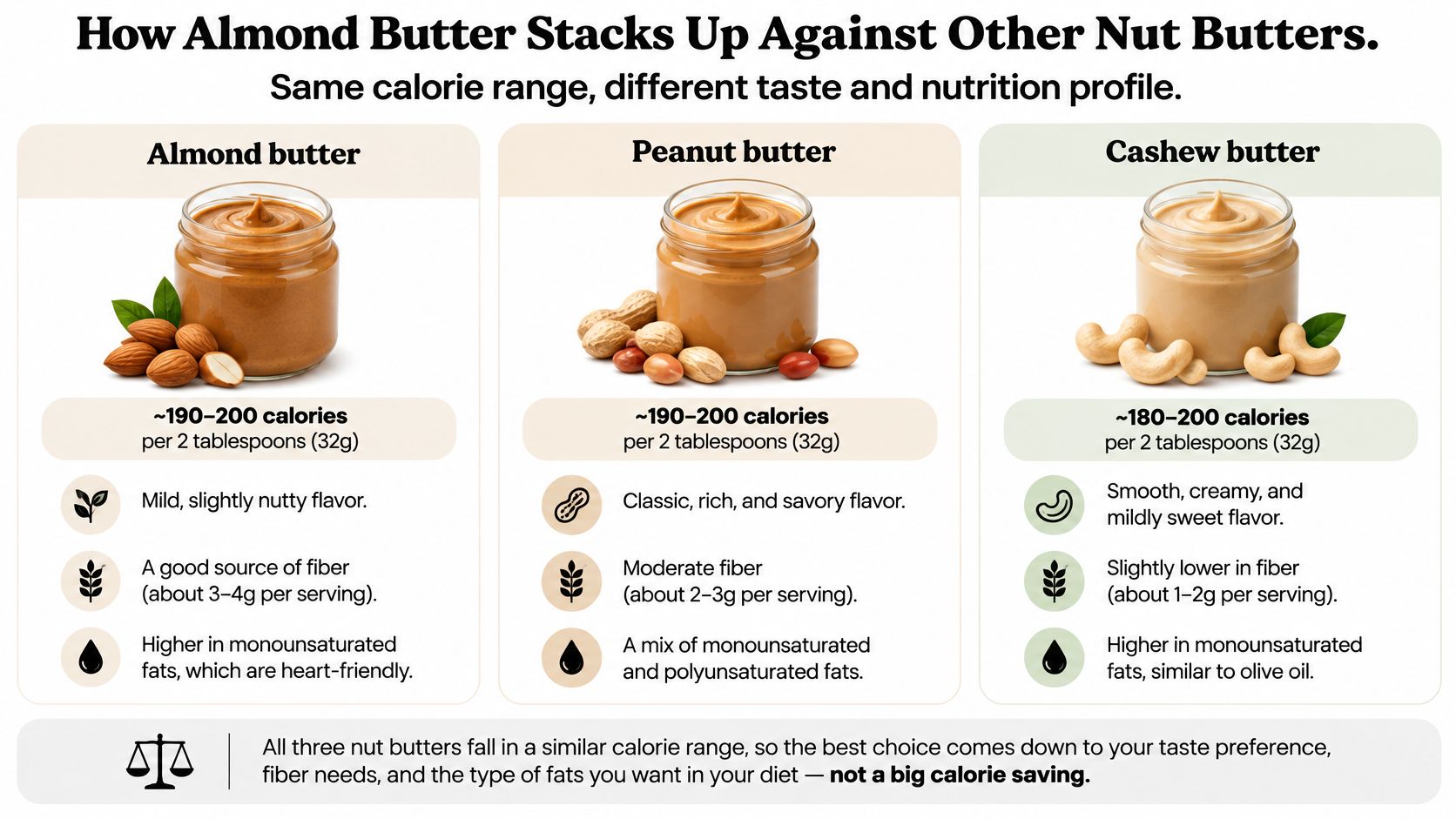
The values below are typical reference values for plain versions at about 32 g, drawn from USDA FoodData Central. Sweetened, salted, or oil-added jars shift a little, so treat this as a shopping guide and check it against the label in your hand.
| Nut butter (2 tbsp) | Calories | Fat (g) | Protein (g) | Standout point |
|---|---|---|---|---|
| Almond butter | about 196 | 17.8 | 6.7 | Most fiber per serving (about 3.3 g) |
| Peanut butter | about 190 | about 16 | about 7.7 | Most protein per serving |
| Cashew butter | about 190 | about 16 | about 5 | Mildest flavor, least fiber |
| Sunflower seed butter | about 200 | about 18 | about 5 | Nut-free option with similar calories |
Picking for Your Goal
If you want more fiber from your spread, almond butter has the edge in this group, and that can help a small portion feel more satisfying. Its mild, slightly sweet flavor also pairs well with fruit, oats, and baked goods without taking over the dish.
If protein is your priority, peanut butter gives you a little more per serving for similar calories, with a stronger taste and an allergy question as the trade-offs. Cashew butter is the one I'd reach for when you want something especially mild and creamy for sauces or desserts, accepting less fiber for roughly the same calories. Sunflower seed butter earns its spot as the nut-free option, which matters for school lunches and shared kitchens.
Skip the calorie hair-splitting between jars. A gap of 6 or 10 calories disappears the moment your spoon comes out heaped instead of level, which is exactly why the number on any jar is only as reliable as the spoon behind it. Weigh the portion and the comparison gets honest: a gram on the scale means the same thing in a local jar as in a store jar. Pick the taste and nutrient profile you'll enjoy in a measured portion, then let portion size do the calorie work.
Why Almond Butter Is So Calorie Dense
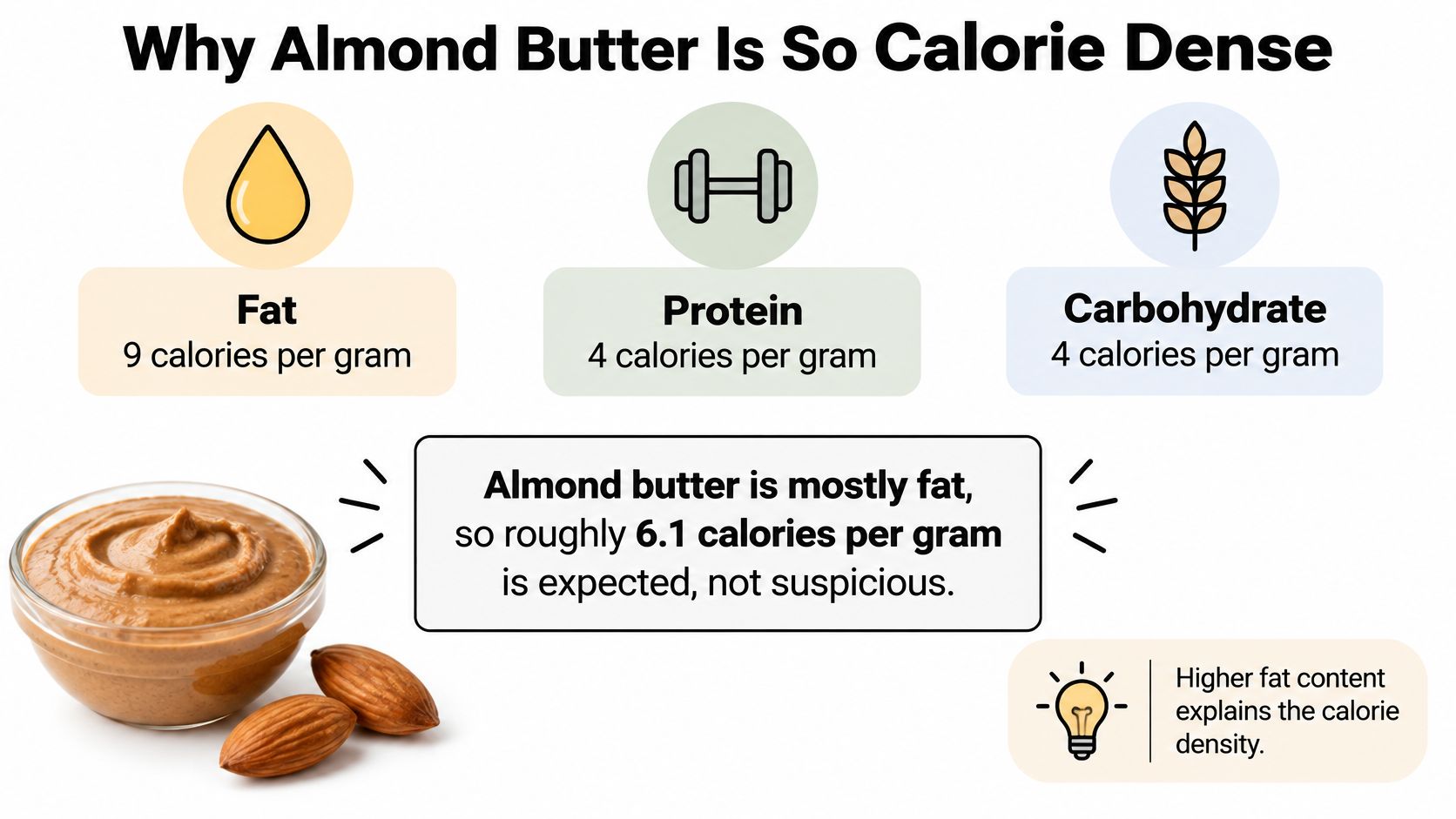
Almond butter is calorie dense for a straightforward reason. Most of its weight is fat, and fat carries more than twice the calories per gram that protein or carbohydrate does. When a food is built mostly on fat, roughly 6.1 calories per gram is expected rather than suspicious.
Whole almonds tell the same story before they're ever ground. Harvard's Nutrition Source page on almonds reports that 1 ounce of almonds provides about 165 calories, 6 grams of protein, 14 grams of fat, 6 grams of carbohydrate, and 3 grams of fiber, with the fat broken into approximately 80% monounsaturated, 15% polyunsaturated, and 5% saturated fat. Grinding those almonds concentrates that energy into a spoonable form.
What the Calories Bring With Them
A high calorie count on a plain jar mostly reflects what almonds are. The more useful question is what comes with those calories: protein and fiber, or mostly added sugar and extra oil.
On that front, plain almond butter earns its place. USDA-linked data summarized for almond butter indicate about 614 calories, 55.5 g fat, 21 g protein, 18.8 g carbohydrate, and 10.3 g fiber per 100 g, which works out to roughly 3 g protein and 2 g fiber in a 16 g tablespoon of about 100 calories. That's why I compare spreads by protein and fiber per calorie, not calories alone. If you're building meals around foods that pull their weight, this guide to whole-food nutrition for busy lifestyles is a helpful way to think about that bigger pattern.
The payoff has a limit, and the limit is the spoon. Doubling your serving doubles the protein and fiber along with the calories, so almond butter isn't automatically a weight-loss food because it's made from nuts. It also means the label number is only as honest as your measure. A heaped tablespoon can run well past 16 g, so a scale beats a scoop if you want the numbers to mean anything. For a snack that keeps the almond flavor in a different form, you could look at carob covered mixed nuts as a chocolate alternative snack and apply the same gram-based check.
Calorie density is a fact about the food. How much you eat decides whether it fits your day.
Why Local Jars Vary From Store Brands
Two plain-looking jars can give you different calories for the same spoonful, and that variation is normal once you see how many small decisions go into each batch. The range is wider than most shoppers expect. USDA-linked records for almond butter varieties report roughly 603 to 645 calories per 100 g across creamy, plain, salted, and lower-sodium versions, with a 16 g tablespoon at approximately 98 to 103 calories in several records while a branded 32 g serving can be 180 calories. Those records reflect different products, made differently, then rounded for a label.
A label number only helps if your spoon matches the serving behind it.
Where the Differences Come From
Several factors stack up before the jar reaches your counter.
- Nut variety and roast level: Different almonds and a darker or lighter roast change moisture and flavor, which can nudge calories per gram.
- Grind and density: A finely ground, runny butter packs into a spoon differently than a thick, coarse one, so your tablespoon may not weigh the same across jars.
- Oil separation: The top of an unstirred jar can be oilier than the bottom, so stir thoroughly before you measure or your first servings won't match your last.
- Added ingredients: Salt doesn't add calories, but sugar and added oil change both the calorie count and what those calories are made of.
- Label rounding: Packaged-food labels round calories to standard increments, so two jars a few calories apart can read the same on paper, or a small real difference can look bigger than it is.
Local makers can show more batch-to-batch variation because they work in smaller runs and may adjust roast or grind as their almond supply changes. That variability comes with an upside worth using: independent brands tend to spell out their ingredient list in more detail, and a real person can tell you what changed between batches if you ask. A thick, oilier jar and a thin one can share the same calories per gram but very different calories per heaped spoon, which is exactly why the scale matters more than the label when you compare them.
A new jar deserves a fresh weigh-in, even if it's the same flavor you bought last month.
Check the gram weight per serving each time you switch jars. Ask the maker whether the recipe or roast changed if the texture seems noticeably thicker, thinner, or oilier than the last batch. Then weigh your first few servings from that new jar to recalibrate your eye. After three or four measured portions, you'll know what a true tablespoon from that specific jar looks like, and a local jar and a store jar finally sit on the same footing: grams in, calories out.
How to Measure Almond Butter Accurately
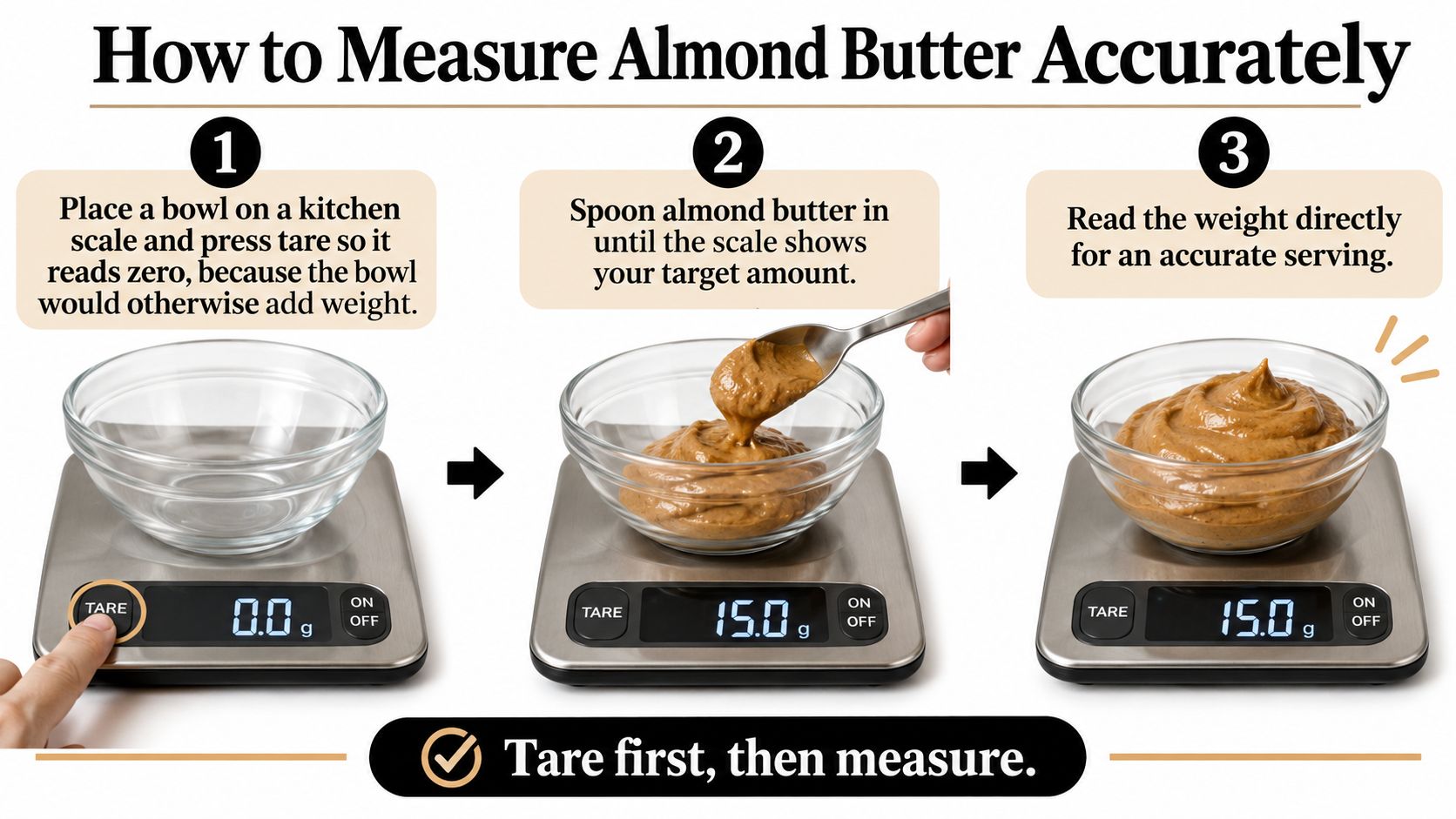
Spoons lie in a friendly way. They don't mean to, but a heaped tablespoon can hold far more than a level one, and spreading almond butter thin across toast doesn't change how much you used. A cheap kitchen scale fixes this in about ten seconds.
Calories scale almost directly with grams, which is why the scale matters so much here. A food-composition reference for almond butter reports approximately 614 calories per 100 grams and about 98 calories per tablespoon, with a tablespoon defined as roughly 16 grams. If your spoon holds 24 g, you didn't eat a tablespoon serving. You ate one and a half.
A Routine You Only Need to Learn Once
- Tare the bowl first: Place your bowl, plate, or toast on the scale and press tare so it reads zero. The common slip is forgetting the container weight and adding its grams to your portion math.
- Spoon to your target weight: Add almond butter until you hit 16 g for a tablespoon or 32 g for the standard serving. Go slowly near the end, because one extra swipe can add several grams.
- Level the spoon when you use one: If you're measuring with a spoon for a recipe, level it with a knife rather than mounding it. A heaped tablespoon can add a third or more to the calories without looking dramatically different.
- Write your jar's rate on the lid: Read the label calories, divide by the label's gram weight, and write the calories per gram on a small note on the lid. You do the division once, then every future weigh-in is a quick multiplication.
- Log grams for one week: Record the actual grams for a week, not the servings you intended to eat. You'll quickly see your real habit on toast, in oatmeal, and straight from the jar.
- Re-check with every new brand: Weigh again when you switch jars, because a new maker may grind to a different density. Stir oil back in evenly first, since an oily top scoop and a dry bottom scoop won't match.
You don't have to do this forever to get the benefit. A week of weighing teaches your eye what 16 g and 32 g look like in your bowl and on your bread. After that, spot-check when you open a new jar or notice your portions creeping up, and you'll stay close without turning breakfast into a lab exercise.
Label Lines That Reveal Added Sugar and Oil
The calorie line gets all the attention, but it doesn't tell you whether those calories come from almonds alone or from almonds plus sugar and extra oil. Read the label top to bottom, in the order it's printed, and the jar gets much easier to judge.
Calories also need context from the rest of the panel. The FDA guidance on Daily Value on Nutrition Facts labels lists a 2,000-calorie daily diet as the general reference and identifies current Daily Values of 78 grams for total fat and 50 grams for added sugars. That framework helps you see whether a serving is contributing protein and fiber along with its fat, or mainly adding sugar you'd rather spend elsewhere.
| Label line | What it tells you | What to look for |
|---|---|---|
| Serving size | The grams behind the calorie count | Stated in grams, not only spoons |
| Calories | Energy in one stated serving | Divide by grams to compare jars fairly |
| Total and saturated fat | Mostly almond fat, with some saturated fat | Close to 17.8 g per 2 tbsp in plain jars |
| Protein and dietary fiber | Nutrients that make calories more filling | More protein and fiber per calorie |
| Total sugars and added sugars | Sugar from almonds versus sugar added | Little or no added sugar in plain jars |
| Ingredient list | Everything added beyond almonds | Almonds alone, or with salt and a little oil |
Reading the Lines in the Aisle
Start with serving size in grams, because every other number depends on it. Then divide calories by those grams so you can compare a local jar with a 30 g serving to a store jar with a 32 g serving without guessing. Check total fat against the plain benchmark, and look at saturated fat to see whether added oils may be changing the fat profile.
Protein and fiber are your value check. More of each per calorie generally makes a spread more filling, while a jar that trades almonds for sugar gives you sweetness without the same payoff. Total sugars include the small amount naturally in almonds, but added sugars are the line that shows what the maker put in. If you want more help separating those figures on packaged foods in general, this guide to reading sugar figures on protein labels walks through the same habit in another aisle.
Finish with the ingredient list, because it explains the numbers above it. Almonds alone, or almonds with salt and a little oil, is the cleanest read for an everyday jar. Whipped, honey, and chocolate almond spreads often add sugar and oil, so their calories can sit above plain jars even when the serving looks identical, and the ingredient list tells you why. A sweetened jar can carry similar calories to a plain one while delivering a very different profile, which is why I'd trust the ingredient list over the calorie number alone when you're choosing between two jars for daily use.
Portion Plans for Toast, Smoothies and Baking
Portions get easier when you attach them to foods you already make. Instead of thinking in abstract servings, think in toast, smoothies, and recipes, then count the almond butter before the rest of the meal hides it.
This visual maps common uses to the amounts most of us serve.

On toast, a thin, even layer is usually about 1 tablespoon, roughly 98 calories, while a generous layer that reaches every corner is closer to 2 tablespoons, roughly 196 calories. Neither is wrong, but they're not interchangeable if you're tracking your day. If you want a concrete breakfast to copy, try almond butter toast with fresh strawberries and weigh the spread the first time you make it so you know which end of that range your knife lands on. Fruit on top helps the portion feel bigger without another spoonful.
Smoothies and Baking Math
In a smoothie, 1 tablespoon adds about 98 calories before fruit, milk, yogurt, or protein powder enter the blender. That's easy to forget because it disappears into the drink, so measure it at the counter rather than scooping straight over the blender jar. If the smoothie is a snack, one tablespoon may be plenty. If it's breakfast, the standard serving may fit your plan just fine.
Baking spreads the calories across the whole batch, which makes the per-piece number friendlier than the recipe total suggests. A quarter cup is about 4 tablespoons, roughly 392 calories in total, so if that batch makes 12 muffins, each muffin carries about 33 calories from the almond butter alone. That same divide-by-the-batch habit works when you're using a prepared option like a chocolate hazelnut baking mix made with almond flour, since the serving count on the package does the first step for you.
If you want to see portioning in motion before you try it, watch this short demonstration and notice how small a level tablespoon looks next to a heaped one.
A few habits keep these portions steady without much effort.
- Pre-portion for the week: Spoon one-tablespoon amounts into small containers for snacks and lunchboxes.
- Use a marked teaspoon for small adds: Three level teaspoons give you a quick tablespoon measure for oatmeal.
- Spread thin and even: Cover the whole slice lightly rather than piling almond butter in the middle.
- Pair it with produce: Apple slices, celery, or berries make a measured portion feel like a bigger snack.
Picture a simple day that starts with one standard serving on toast at breakfast. You've accounted for about 196 calories from the spread, you got protein and fiber with it, and you still have comfortable room for the rest of your meals. Adjust up or down from that known starting point, and the jar stops being a guessing game.
Pick a Jar You Can Measure and Trust
A jar earns your trust when the label gives you a gram weight, the ingredient list stays short, and your scale confirms what the spoon holds. Three checks cover all of that.
First, choose plain almond butter for your everyday jar, or one with only salt and a little oil added. That keeps the calories tied to almonds rather than sweeteners, and the label becomes much easier to interpret. Flavored jars can still have a place as an occasional treat, but I'd keep them separate from the jar you reach for every morning.
Second, confirm the serving is listed in grams. The FDA page on serving size on the Nutrition Facts label explains that nut and seed butters use a reference serving of 2 tablespoons with the metric gram weight shown alongside it, and that a serving describes the amount customarily consumed, not a recommended quantity. That gram figure is what lets you compare jars fairly and do your own math at home.
Third, weigh your first portion and set your personal benchmark. Put your toast or bowl on the scale, add 32 g, and read the calories off that jar's label. You now have a number built from your food and your spoon, and that beats any generic chart. Independent makers often make these checks easier with short ingredient lists and gram weights on the label, and Loyaltie is a marketplace where shoppers discover and buy directly from nearby businesses, independent makers, and local producers, so comparing plain jars in one place takes minutes rather than a shelf-by-shelf search.
Buy directly from the maker when you find a jar you love, weigh it a few times, and then relax. Once you've done that, you know exactly what's in your spoon.
Visit Loyaltie to discover plain almond butters and other everyday foods from independent makers and local producers, with clear labels you can compare before you buy. Choose a jar with the gram weight and ingredients you want, buy directly from the maker, and weigh your first 32 g serving so your next breakfast starts with a number you trust.