
You're standing in the dairy aisle with your usual milk in one hand and an A2 carton in the other. You'd like your morning coffee or bowl of cereal to sit comfortably, but you don't want to pay for a health promise that means less than it sounds.
The useful question isn't whether A1 milk or A2 milk wins a healthier-milk contest. It's what bothers you about milk, what the carton changes, and whether the producer can explain what you're buying.
Table of Contents
- Is A2 milk lactose-free?
- Is it safe for a milk-protein allergy?
- How can you check an A2 claim?
- Is switching worth trying for digestive comfort?
What A1 and A2 Milk Actually Are
A1 and A2 are naturally occurring versions of beta-casein, a protein in cow's milk. They're not different animal milks, and A2 isn't a treatment added after milking. Think of them as closely related versions of the same ingredient.
Beta-casein accounts for approximately 30% of cow's milk protein. The difference involves a single genetic change that swaps proline for histidine at position 67 of the protein chain; researchers consider A2 the older variant and trace A1's emergence to some European cattle herds roughly 5,000–10,000 years ago, as described in this review of beta-casein variants and their origins.
What you're comparing on the shelf
| Carton description | What it tells you | What it doesn't establish |
|---|---|---|
| Conventional milk | May contain both A1 and A2 beta-casein | Whether you'll experience discomfort |
| A2-only milk | The beta-casein claim concerns the A2 variant | That the product will suit everyone |
| Lactose-free milk | The product addresses lactose | That its beta-casein is A2-only |
The distinction is easier to understand when you separate the protein's identity from the rest of the carton.
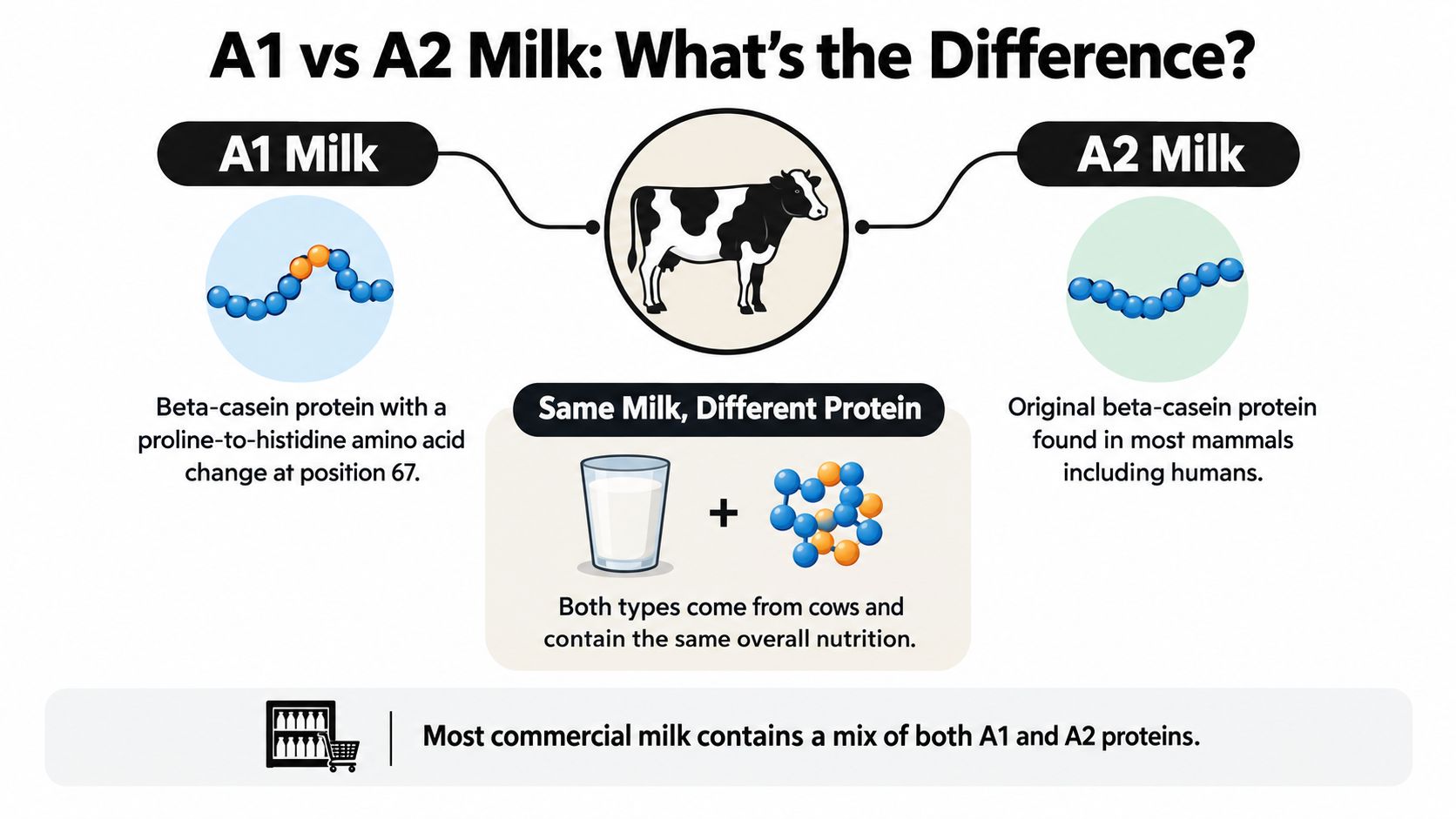
Conventional milk in the clinical comparisons discussed below contains both variants, while A2-only milk contains only A2 beta-casein. Historical differences among cattle populations help explain why herds can differ, but a farm's location alone isn't enough to establish what's in its bottle.
A2 describes protein composition, not a complete nutritional ranking. Don't use that label to infer everything else you care about, such as sourcing, handling, or how the milk will work in your kitchen.
- Separate related products. If you encounter digestive wellness whey from Supplemynts, from Supplemynts Inc., evaluate it as a separate product, not as evidence about A2 milk.
- Ask a precise question. Instead of asking whether a dairy sells “better milk,” ask whether its milk is A2-only and what supports that description.
That small change in wording makes it easier to get a useful answer rather than a broad wellness pitch.
How A2 Milk Became a Category in the US
The protein variation is old. The consumer category is much newer.
Farmers began learning about A2 milk in the 1990s, and the New Zealand-founded A2 Milk Company entered the US market in 2015, according to the AURI assessment of the A2 dairy market. That assessment reports US A2 dairy sales growth of 43% in 2023 and 36% in 2024, with fluid milk accounting for 63% of the A2 milk-products market in 2024.
From herd distinction to shopping choice
The commercial shift matters because shoppers don't usually buy milk by asking about cattle genetics. They buy a carton for breakfast, baking, or coffee, often choosing by habit until something prompts them to reconsider.
A2 gave that genetics distinction a consumer-facing name. Instead of needing to understand a herd's history, you could look for a short label on a familiar product.
A more visible category gives you another choice. It doesn't, by itself, give you a medical reason to switch.
Those sales figures also put the category in perspective. This isn't only a discussion about formula or specialty processed products. Ordinary drinking milk is central to the A2 shopping decision.
What popularity can't answer
A growing category can make a product easier to recognize, but sales figures can't tell you why your stomach hurts. They don't distinguish lactose-related symptoms from reactions involving protein, and they don't predict your personal response.
For an independent dairy, the useful opportunity isn't to repeat the largest claims on the shelf. It's to explain the product more clearly: what the herd produces, what has been checked, and what the dairy does and doesn't promise.
As a shopper, you can apply the same standard to a national carton and a local bottle. Treat category growth as commercial history, not proof of broad health superiority. Your reason for choosing A2 should come from the product's verified characteristics and your needs, not its popularity.
What the Research Actually Says About A1 and A2 Milk
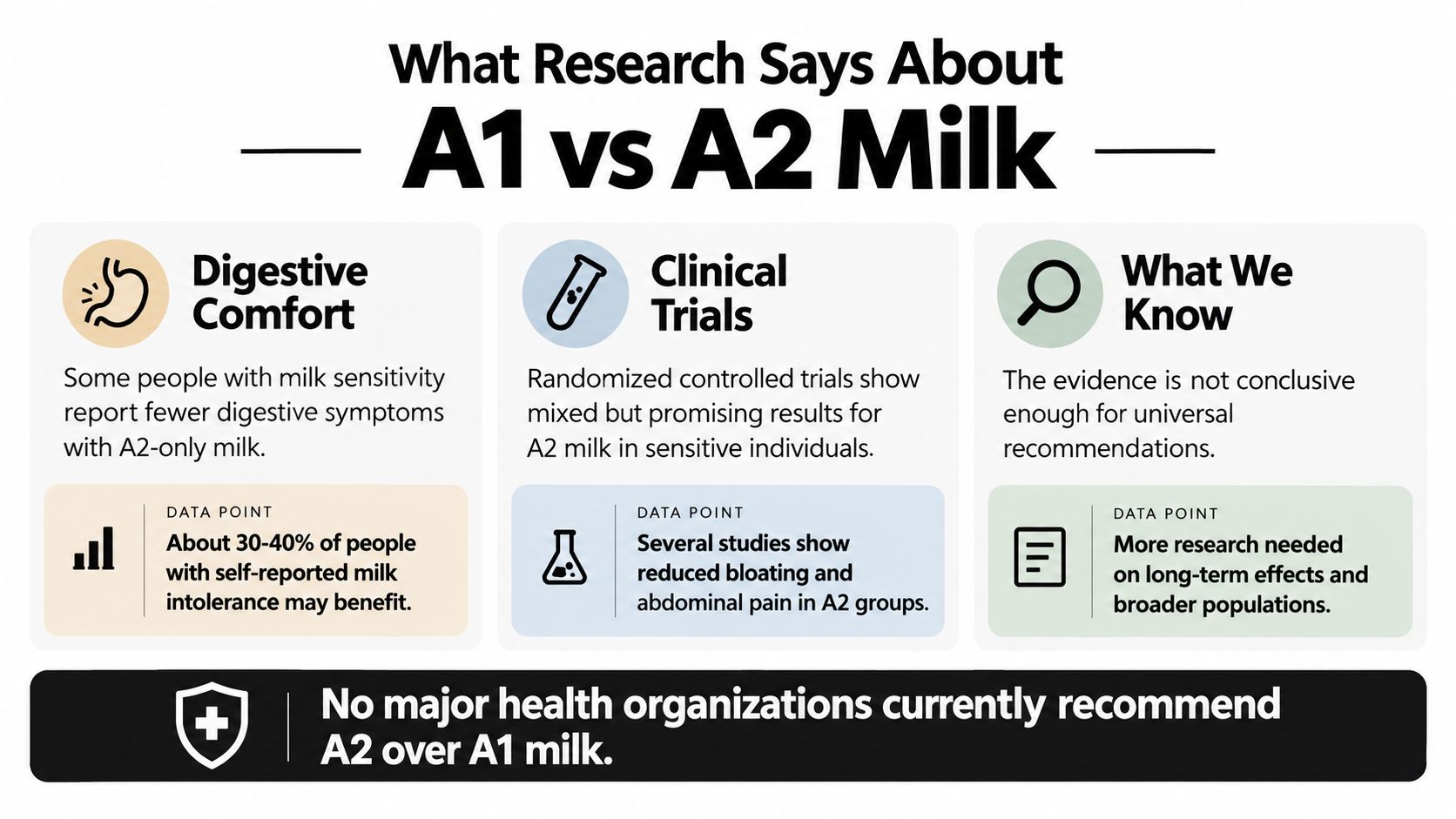
The most defensible finding is fairly narrow: some people experience fewer digestive symptoms with A2-only milk. That's meaningful if milk regularly leaves you uncomfortable, but it's different from proving that everyone should avoid A1.
This visual summarizes the topic, but don't treat its suggested percentage of people who might benefit as an established personal forecast. The evidence discussed below doesn't justify a reliable universal responder rate.
What the human trials found
In a randomized, double-blind crossover trial involving 25 lactose-intolerant or lactose-malabsorbing participants, A2-only milk produced lower abdominal-pain scores than conventional milk (p = 0.004); among lactose maldigesters, breath-hydrogen production and overall gastrointestinal symptom scores were also lower (each p = 0.04), as reported in this clinical evidence review. The same review covers an 80-child randomized crossover trial reporting less abdominal pain, lower stool frequency, and fewer gastrointestinal symptoms with A2-only milk.
In a crossover design, participants receive the different milk options at different times. That helps researchers compare responses within the same people rather than relying only on differences between separate groups.
The p-values aren't percentages of improvement. They describe statistical evidence, not how much better your own stomach might feel.
Where the evidence stops
A 2019 systematic review assessed 15 randomized controlled trials, two case-control studies, and eight ecological studies. Using GRADE, its authors rated evidence for digestive effects as moderate certainty, while evidence for other outcomes was low or very low certainty, according to the systematic review of A1 beta-casein and human health.
That distinction matters. A digestive finding doesn't justify promises about preventing diabetes, improving cardiovascular health, or treating inflammation.
Evidence check: “May improve digestive tolerance for some people” is a reasonable conclusion. “Healthier for everyone” isn't.
For a video companion to the topic, you can watch below. Evaluate any health claims against the limits of the human evidence rather than the confidence of the presentation.
The practical takeaway is encouraging but modest. A2 is a plausible option for a particular digestive problem, not a general-purpose health upgrade.
Matching Your Symptoms to the Right Milk
Symptoms are a starting point for choosing what to investigate, not a diagnosis. Bloating after milk doesn't identify the cause by itself, and neither does feeling better after changing cartons.
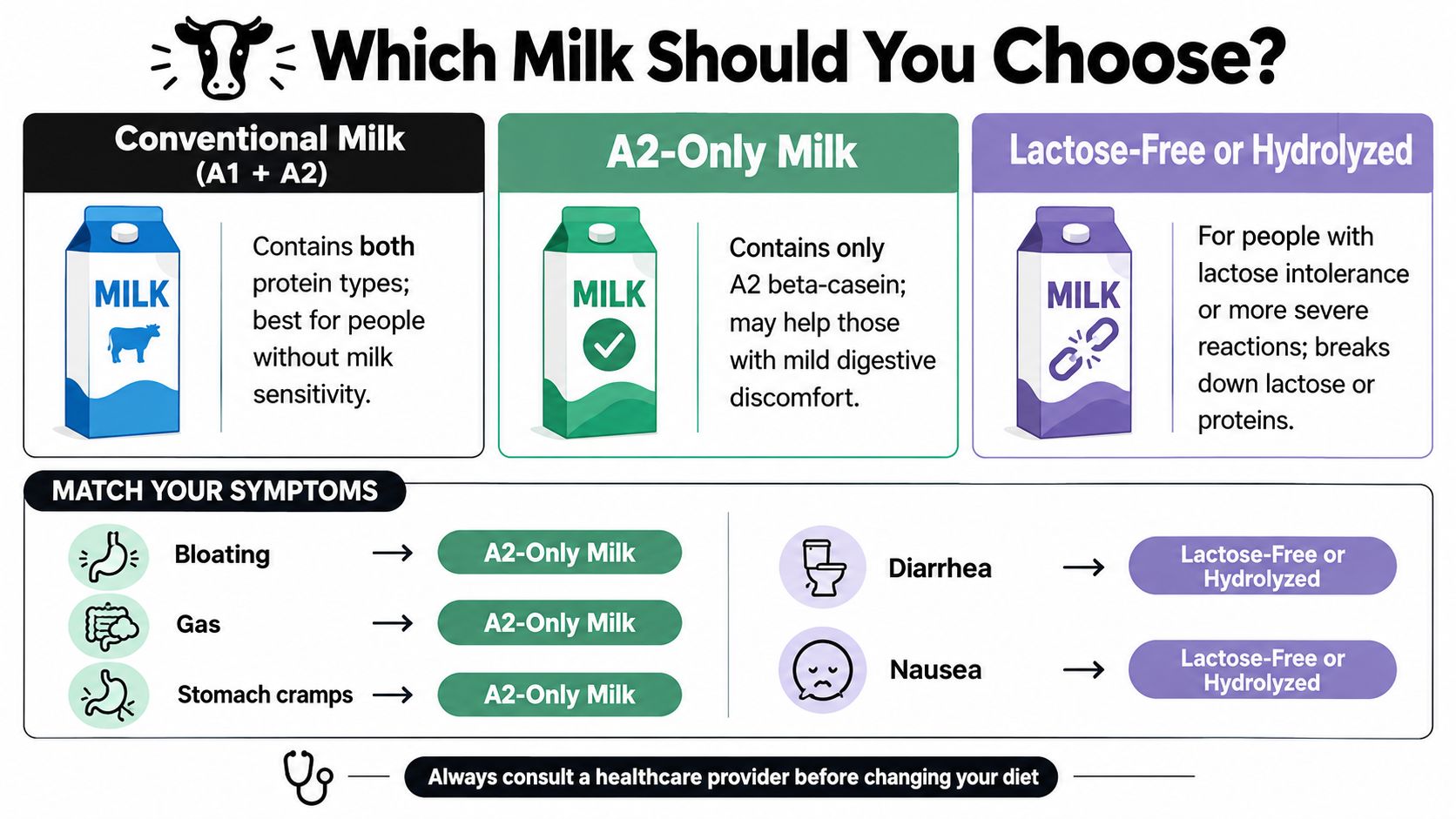
In a 2025 randomized crossover trial, lactose-tolerant, milk-sensitive volunteers experienced similar gastrointestinal symptoms with A2 milk and protein-hydrolyzed lactose-free A1/A2 milk. Among lactose-intolerant participants, symptoms increased with lactose content, and the hydrolyzed lactose-free option was better tolerated, according to the trial comparing these milk formulations.
Choosing Milk by What Actually Bothers You
| Symptom Pattern | Conventional A1/A2 Milk | A2-Only Milk | Lactose-Free or Hydrolyzed Milk |
|---|---|---|---|
| Milk causes no noticeable discomfort | No symptom-based reason to change | An optional preference | May not address a problem you have |
| Gas, bloating, or cramps with suspected lactose intolerance | Doesn't specifically address lactose | Not a dependable lactose solution | A lactose-free option addresses that question more directly |
| Discomfort continues with lactose-free dairy | Repeating the same choice may not clarify the cause | A possible discussion point with your clinician | Check what was changed; lactose removal and protein hydrolysis aren't interchangeable |
| Diagnosed milk-protein allergy or severe reactions | Don't use for a home comparison | Don't treat as an allergy workaround | Don't assume these products are safe without clinical guidance |
The visual below offers a simplified comparison. Its symptom arrows aren't diagnostic, and lactose-free and protein-hydrolyzed products shouldn't be treated as the same thing.
Make the comparison useful
If lactose is the suspected issue, investigate that directly rather than assuming A2 will solve it. If lactose-free dairy still causes trouble, that's a reason to consider other explanations with a clinician, not proof that A1 protein is responsible.
- Record the context. Note the product, serving amount, accompanying food, symptoms, and timing.
- Avoid changing everything together. Switching milk, breakfast, and supplements at once makes your experience harder to interpret.
- Keep outside advice in perspective. Yuve's guide to improve dairy tolerance naturally can provide reading material, but it shouldn't replace evaluation of persistent symptoms.
The best comparison is the one that answers a specific question. “Does reducing lactose help?” is more useful than “Which carton looks healthiest?”
Why A2 Labels Are Harder to Verify Than You Think
A confident label can make a complicated claim feel settled. But “A2” should prompt questions about what was verified, not an automatic assumption about health benefits.
A scientific review of A2 milk and health claims describes limited evidence for broad advantages, with favorable findings from animal and laboratory work not consistently confirmed in human trials. That makes it important to separate a claim about protein composition from a claim about what drinking the product will do for you.
Composition isn't a health guarantee
Regulatory treatment hasn't been uniform internationally. India's food regulator issued a directive prohibiting A1/A2 labeling and later withdrew it following industry opposition, while stating that existing evidence didn't justify mandatory differentiation.
That history shouldn't be read as a statement about the rules for a particular US carton. It illustrates why you shouldn't assume that every market uses the same labeling standard.
Use this image as a reminder to examine the claim, not just the front-panel wording.
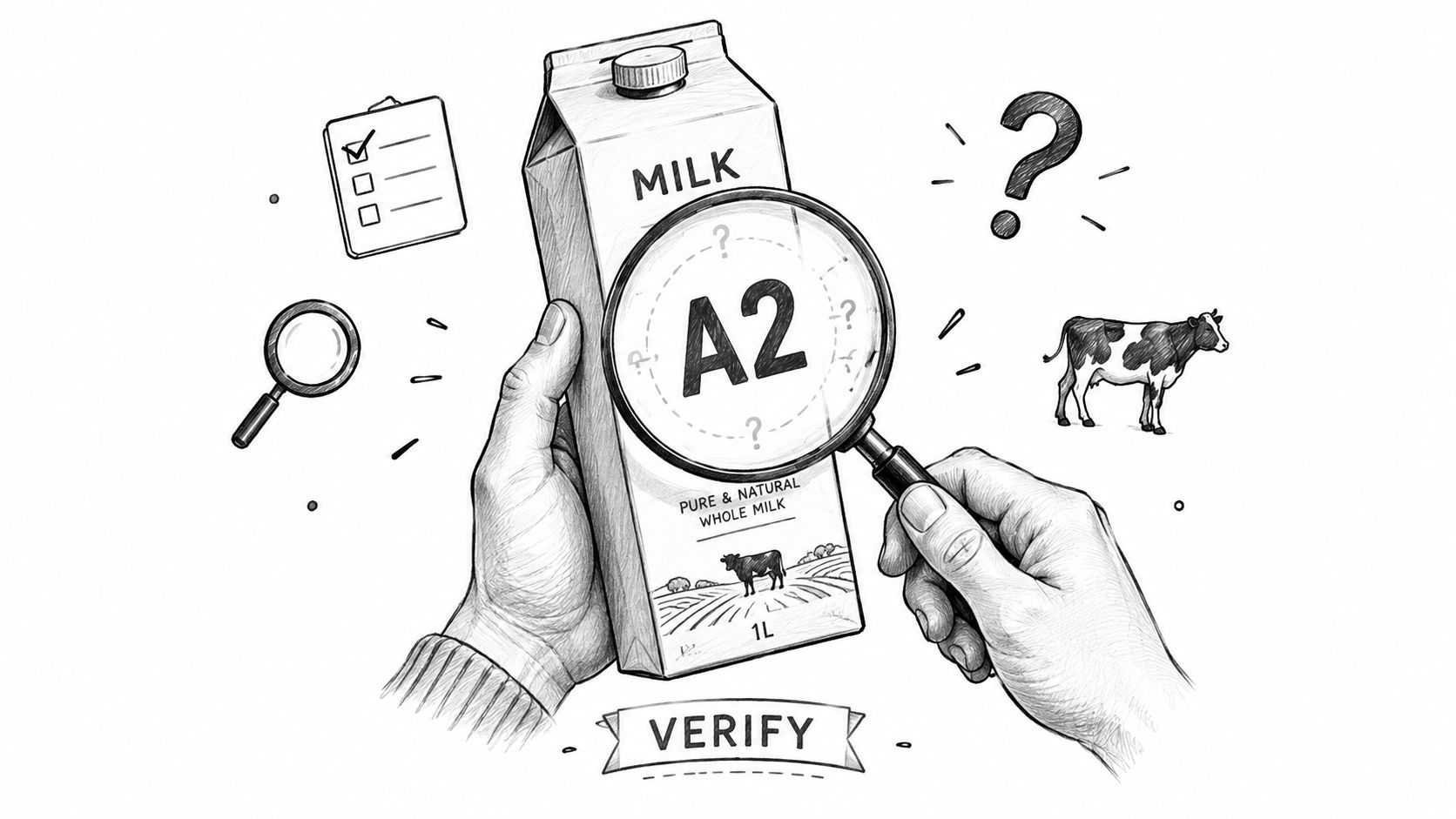
Ask what stands behind the words
- Define the claim. Does the producer explicitly say A2-only, or use vaguer language about selected cows?
- Identify the verification. Ask who performed testing and whether the documentation concerns animals, milk, or a certification program.
- Separate promises. Evidence about beta-casein composition doesn't establish a claim about immunity or disease prevention.
- Read for your actual risk. If allergies are relevant, Guiding Growth's guide to read food labels for allergies is a separate resource for approaching the label carefully.
A producer who can explain a narrow claim clearly is more useful than one who makes a sweeping claim confidently.
You don't need to become a laboratory specialist. You need an understandable answer, documentation that matches the product, and a producer willing to acknowledge the limits.
If a seller responds to a testing question with nothing but a story about tradition or healthy cows, keep asking. A good story can explain a farm's values; it can't substitute for verification.
Who Tends to Feel Better on A2 Milk
The person most reasonably considering A2 isn't someone searching for protection against every chronic disease. It's someone who likes dairy, experiences non-severe digestive discomfort with conventional milk, and wants to investigate a more targeted option.
A 2017 systematic review found limited human evidence associating A1 consumption with delayed intestinal transit in one clinical study and looser stool consistency in two studies. It also reported correlations between discomfort and inflammatory markers after A1 consumption, but those findings don't establish disease causation, as explained in the review of gastrointestinal effects of A1 and A2 beta-casein.
A reasonable candidate, not a guaranteed responder
You may recognize yourself in the studied population if ordinary milk repeatedly causes discomfort and you haven't found a satisfactory explanation. But the evidence doesn't provide a symptom checklist that reliably predicts who will benefit.
- Mild, recurring digestive complaints. A carefully considered comparison may be useful when there is no known allergy and no concerning reaction history.
- An unresolved response to lactose-free milk. That makes the question broader, but it does not establish protein sensitivity.
- No difficulty with your usual milk. There is not a digestive problem you need to solve because another label exists.
Who shouldn't self-test
Anyone with a diagnosed milk-protein allergy shouldn't use an A2 carton as a workaround. Likewise, someone with diagnosed lactose intolerance should keep the lactose question central rather than assuming a change in protein answers it.
Persistent, worsening, or severe symptoms deserve clinical attention before another shopping experiment. The point is to make eating more comfortable, not to keep testing products indefinitely while an underlying problem goes unexplored.
For an appropriate candidate, a modest personal comparison can help inform a buying decision. Treat feeling better as useful personal information, not proof of a diagnosis or proof that conventional milk is harmful.
Buying A2 Milk from Independent US Dairies
The quality upgrade in buying directly from an independent dairy is the opportunity to choose a better-documented product from people who can answer for it. Independence alone doesn't establish A2 status, but access to the producer can help you investigate it.
Start with dairies serving your area, whether you encounter them through a farm store, a local food retailer, or a direct-order website. Look for clear product descriptions before committing to a trip or placing an order.
Questions worth asking before you buy
- Is the milk A2-only? Ask whether all milk entering that product comes from the herd covered by the claim, or whether other milk is blended in.
- What verifies it? Request the name of the laboratory or certification program and an explanation of what it tests.
- What does “certified” mean here? Ask who issued the certification and what its scope covers.
- How is it handled? Ask about processing, bottling, refrigeration, and collection or delivery arrangements.
- What benefits do you claim? Look for measured language about possible digestive tolerance, not promises to prevent disease.
A useful answer might explain the documentation in plain language and tell you where to inspect it. An unhelpful answer might insist that you don't need to ask because the cows are a particular breed or the farm is local.
Judge the whole buying experience
A direct relationship is valuable when it produces concrete information. Notice whether the dairy answers your question, explains unfamiliar terms, and makes the actual product details easy to find.
You can also ask how reordering works. Before you buy on a plan or arrange regular delivery, decide whether you like the milk, whether it suits your household, and whether the producer's handling information meets your expectations.
Buying rule: Choose the producer whose evidence and product fit your needs, not the one with the most ambitious health language.
That's a quality-first approach to local shopping. You're not choosing an independent brand as a favor. You're choosing clearer sourcing, accountable people, and a product you can evaluate beyond the front label.
Quick Answers Before You Buy
Is A2 milk lactose-free?
Not automatically. A2 identifies the beta-casein variant, not the absence of milk sugar; the review of A2 milk's potential gastrointestinal benefits also found insufficient evidence for broad public-health recommendations.
Is it safe for a milk-protein allergy?
Don't treat it as a fix. Follow your allergy clinician's guidance rather than experimenting with another cow's-milk carton.
How can you check an A2 claim?
Ask for the testing or certification documentation and what it covers. The useful question is whether the evidence applies to the milk you're buying, not merely to part of a herd or a general farming philosophy.
Is switching worth trying for digestive comfort?
Possibly, if your symptoms are non-severe, you don't have a milk-protein allergy, and you've considered whether lactose is the more relevant issue. Start with a small purchase from a producer you trust rather than committing to repeated orders.
A2 is a real product distinction with possible digestive benefits for some people. You don't need to declare one milk good and another bad to make a sensible choice for your own kitchen.
Visit Loyaltie, a marketplace where you can discover and buy directly from independent brands across the US. As you explore food makers and everyday alternatives, use the same standard you'd bring to an A2 dairy: clear ingredients, understandable sourcing, and people who can answer your questions before you reorder.