
Everyone keeps saying fast hair color is the smart choice. I don't buy that, not unless you already know exactly what your hair can handle, what kind of gray you're covering, and how much maintenance you're willing to live with. 10 minute hair dye can be a great tool, but it's not magic, and the wrong shortcut leaves you with see-through roots, uneven depth, and a color job that looks rushed because it was rushed.
The bigger truth is that hair dye has always been a convenience game as much as a beauty one. The modern category grew from early synthetic dye chemistry, then became mainstream through at-home use and faster formats, and now the market is large enough that speed-focused products compete in a huge, mature space rather than a gimmick aisle. That matters because a quick formula has to earn its place on your head, not just on the box.
Table of Contents
Why Faster Hair Dye Is Not Always Better
Speed sounds like an upgrade until you ask the useful question, what problem is the fast formula solving. For busy people, the appeal is obvious. You want a root touch-up that fits between meetings, errands, or school pickup, and you don't want to sit with dye dripping into your ears for half an hour.
That's the value of 10 minute hair dye, it trims the wait. But it also trims the margin for error. If your gray is resistant, your strands are porous, or your goal is deeper tone saturation instead of just surface coverage, 10 minutes can be too little time to get a clean result. The phrase on the box doesn't change the chemistry of your hair.
Faster is a tool, not a universal upgrade
A fast formula usually exists for one of three reasons. First, it's built for root touch-ups, where you're working only on regrowth and not trying to transform the whole head. Second, it's designed for people who want convenience and predictable upkeep. Third, it's meant to reduce time in the chair without forcing you into a full salon appointment.
Practical rule: if you need gray blending at the part line and hairline, fast color can make sense. If you want major coverage change, richer depth on stubborn grays, or a full refresh on previously colored hair, don't gamble on the shortest processing time.
That's why I like to separate “fast” from “better.” Sometimes fast is exactly right. Other times it's just the path to patchy roots and a second round of coloring sooner than you wanted. When I test hair color, I care less about the label and more about whether the formula can do the actual job on your hair type, not the average hair in the ad.
The other thing people forget is that hair dye has a long commercial history built on convenience. The category became mainstream because consumers wanted at-home use, less salon dependence, and easier application. So yes, speed has a place here. It just isn't a free pass.
How 10 Minute Hair Dye Works
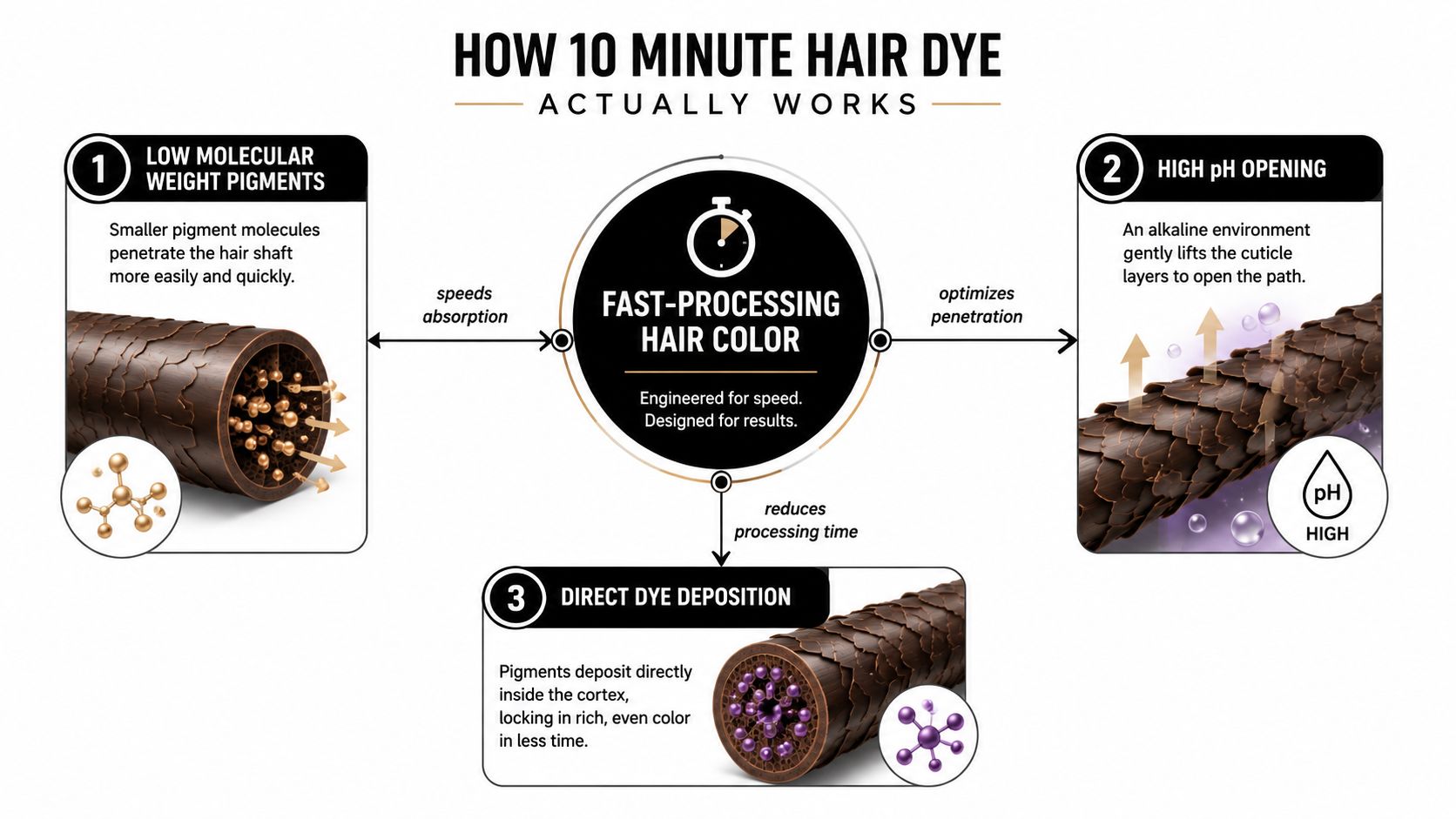
Fast color is engineered for speed, and that speed comes from the formula, the developer, and the timing working together. A professional 10-minute system can mix at 1:1 and use a 20-volume, 6% developer with a 10-minute room-temperature processing window. That setup is deliberate, because the product is built to move fast once the ingredients meet.
Once you mix the components, the reaction starts. A professional Redken launch says the formula should be applied promptly after mixing because it reacts right away, then processes for 10 minutes. Give it too much delay, and you weaken the result before it even reaches the hair.
The chemistry behind the shortcut
A Chemical & Engineering News review explains that one 10-minute system was developed over nearly 10 years and uses a new reaction pathway involving ammonium carbonate, hydrogen peroxide, and sodium glycinate to create reactive species that speed up coloring. It also identifies the product as Nice ’n Easy Perfect 10. That is real chemistry, but it belongs to a specific system, not a shortcut every box on the shelf can copy.
The market pressure behind these formulas is obvious. Hair color is a huge global business, with a widely cited estimate putting the worldwide market at about $28 billion by 2025, up from roughly $17.8 billion in 2019. In the United States, at-home hair coloring reached $4.8 billion in sales in 2024 and is projected to rise to $8.2 billion by 2033. Those numbers explain why brands keep chasing convenience, because home color already sells in serious volume.
Convenience has been the selling point for decades. Clairol's single-step hair dye in 1956 made ease of use part of the pitch, and modern 10-minute systems follow that same logic. They work when the chemistry, developer, and application window match the hair in front of you. When they don't, speed just gives you fast disappointment.
Realistic Expectations for Gray Coverage and Color Depth
Gray coverage is where people get disappointed fastest. If your hair is fine, fresh, and easy to take color, a 10-minute formula may look impressive. If your grays are coarse, resistant, or clustered at the temples and part, you can't expect the same result just because the timer hit ten.
The practical question isn't whether 10 minutes is “enough” in the abstract. It's whether it's enough for your gray pattern, your hair condition, and your shade goal. Some professional systems are built for natural levels 3–7 with 40% to 60% gray, and they can reach up to 100% coverage in the targeted range. Other guidance still recommends 30 to 45 minutes for standard permanent color and 45 minutes for maximum gray coverage. Those differences matter because the result you want might need a longer dwell time than the headline suggests.
Match the formula to the hair condition
Here's the blunt version. 10-minute hair dye is best when you're staying close to your current tone, touching up roots, or dealing with manageable gray. It's less reliable when you want richer depth on resistant gray or you're working over hair that has already been colored and stressed.
| Hair Condition | 10-Minute Result | Recommended Processing Time |
|---|---|---|
| Resistant gray | May need extra depth or a second pass | Often longer than 10 minutes |
| Fine hair | Usually takes color more easily | 10 minutes can be enough |
| Porous hair | Can grab color quickly, sometimes too quickly | 10 minutes or less, with close checking |
| Previously colored hair | Results vary, especially at the roots | Often longer, depending on the brand guidance |
A smart read of the chart is simple. The more resistant the gray, the less I trust a blanket 10-minute promise. The more porous the hair, the more you need to watch for oversaturation or darker-than-intended results.
Best move: treat 10 minutes as the starting point for a fast formula, not a law. If the brand's guidance allows a longer window, use it when your hair actually needs it.
There's also a fading reality people gloss over. A professional FAQ notes that some fast root color fades gently over about three weeks, which is useful if you want a maintenance-friendly fix, but it's not the same as a long-wear permanent refresh. If you want durability and depth, be honest about that before you choose the shortest process time.
Step-by-Step Application Tips for Best Results
The biggest mistake people make with fast color is moving too casually. 10 minute hair dye punishes sloppy timing. You want dry hair, clean sectioning, and a timer you trust, not the stopwatch in your head while you hunt for foil clips and answer texts.
Use the formula the way it was built
Professional 10-minute systems don't like improvisation. One launch from Redken specifies a 1:1 mix and says the formula should be applied promptly because it starts reacting once mixed. Schwarzkopf Professional's Color10 instructions also show that some “10-minute” products are meant for standard color services, while white coverage may require mixing fashion tones with a natural shade in equal parts and can need heat for resistant hair types. That's your cue to read the label like you mean it.
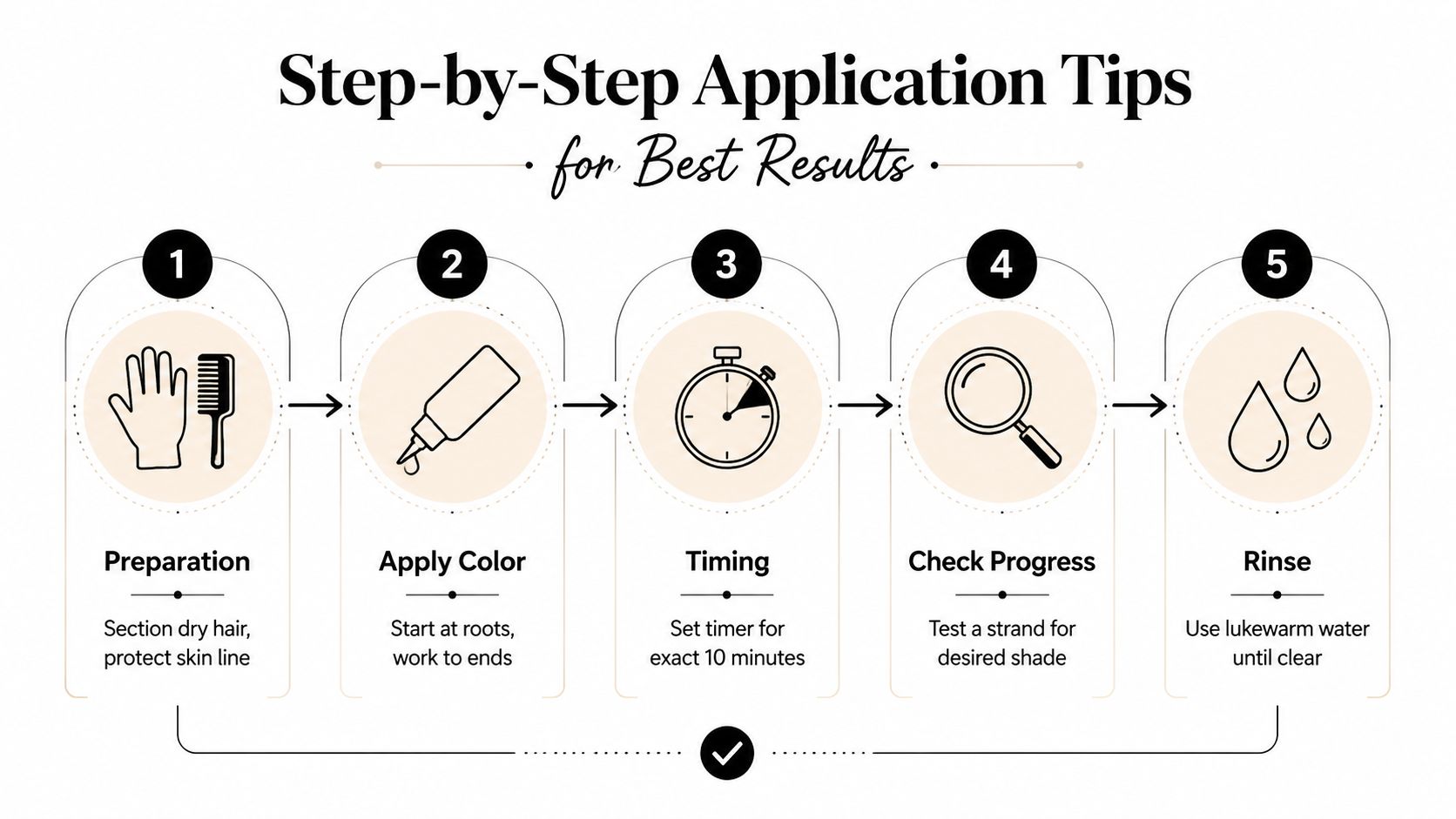
- Prepare first. Section dry hair, keep gloves on, and protect your skin line so you're not wiping color off your forehead later.
- Apply at the roots. Start where gray is most visible, then work outward. That keeps the strongest color where it matters most.
- Set an exact timer. Don't “roughly” do ten minutes. The whole point is precision.
- Check progress. If the formula and your hair condition allow it, glance at a strand before you rush the rinse.
- Rinse fully. Use lukewarm water until it runs clear, then move into aftercare immediately.
Use this logic for root touch-ups, not full-head experiments. Fast color shines when you're refreshing regrowth, not when you're trying to repaint every inch of hair like a weekend project.
If you like scalp care tools, a simple rinse routine pairs well with a gentle cleansing brush like this scalp massager shampoo brush, but don't confuse scalp stimulation with color processing. They're different jobs.
If you want a low-fuss styling product after coloring, Tallow Hair Pomade | Simply Natty by Loyaltie is described as formulated to provide hydration, softness, and support healthy hair. That kind of product belongs after the color job, not during it.
Ingredient Safety and What to Look For
Fast color should not mean blind trust. The ingredients matter, especially if you color at home and you're trying to protect your scalp, your hairline, and the rest of your routine. I care less about buzzwords and more about whether the formula is transparent enough that you can make a clean decision.
The useful filter is simple. Look at whether the product spells out its dye system, developer strength, and any known irritants. Some professional and consumer products lean on ammonia-free or PPD-free positioning, while others use oxidative chemistry that's more standard but not necessarily gentle for every user. If you've had reactions before, don't assume “fast” means “mild.”
Read the label before you buy
A smart label scan should tell you three things. First, what kind of color system it uses. Second, whether it includes ingredients you've reacted to before. Third, whether the product is meant for scalp hair only or has exclusions, since some fast formulas are specialized and don't belong on facial hair or especially sensitive areas.
The other thing I'd watch is conditioning support. If a formula claims to be quick but offers no care angle at all, I expect more dryness after repeated use. That's where independent brands can stand out, because they often lean harder into ingredient transparency and clearer usage guidance. If you want a deeper conversation about clean formulas, the piece why choose organic hair dye is a useful comparison point for thinking about gentler options.
My take: faster color is only worth it if the brand is honest about what's inside and what the product can't do. Hype without ingredient clarity is just expensive guesswork.
I'd also keep one practical option in mind for non-dye care. Veil Hair Care's soapnut shampoo is positioned around a scalp-soothing cleanse, which matters because your post-color routine should be calmer, not harsher. Good hair color is only half the story, good aftercare keeps you from starting over too soon.
Aftercare and Maintenance for Longer-Lasting Color
Color doesn't end at the rinse. If you want your 10 minute hair dye to look good for more than a few washes, you need to stop treating post-color care like an afterthought. The fastest way to shorten color life is to wash too aggressively, style with too much heat, and keep using products that strip tone out of the hair.
Keep the routine boring on purpose
Start with gentler washing. A color-refresh routine usually works better when you don't shampoo constantly, and when you do wash, use a formula that doesn't blast the cuticle open. Heat protection matters too, because repeated heat makes color look tired faster and can flatten the finish you just paid for.
A purple conditioner can be useful if your color job leans blonde or lightened and you're fighting brassiness. If that's your lane, the ArtNaturals purple conditioner review is worth reading before you buy anything similar. Use toning care only where it fits your shade, because the wrong maintenance product can muddy the finish instead of preserving it.
Your hair will also tell you when it wants a touch-up. Watch for the part line, the hairline, or visible fading at the temples. Those are the moments when maintenance, not reinvention, is the answer.
If you like lightweight finish products between washes, this botanical hair oil serum is a cleaner way to add shine without piling on heavy residue. Keep it on the lengths, not the roots, so you don't interfere with the next color application.
Finding Healthier Hair Care Options from Independent Brands
If you're shopping for color, don't stop at the speed claim. Independent brands often win on the stuff that matters to your hair, with clearer ingredient lists, more thoughtful formulas, and less empty hype. That's especially true when you buy directly from the maker, because you get the product closer to the people who formulated it, not a watered-down shelf pitch.
I'd use three filters. Does the brand explain ingredients plainly. Does it tell you what hair type or gray pattern the formula is meant for. Does it make you choose between convenience and hair health, or does it try to improve both. If the answers feel vague, keep moving.
For shoppers who want a place to compare options without getting trapped in mass-market sameness, Loyaltie is a marketplace where people discover and buy directly from the best independent brands in the US. That matters here because healthier hair care usually starts with better products, not louder advertising.
I'd rather see you pick a formula that respects your scalp, your shade goals, and your maintenance tolerance than chase the fastest box on the shelf. If you want better hair days with fewer regrets, start buying from makers who tell you what their product can do.
If you're ready to skip the generic aisle and look for hair care that's built with more thought, visit Loyaltie and browse independent brands that make it easier to buy directly from the maker. You'll find products that fit real routines, not just marketing promises.